| ABOUT US | ARCHIVES | LINKS | RSS FEED | MONDAYS | |

3quarksdaily

An Eclectic Digest of Science, Art and Literature

« Marbles | Main | 3 Quarks Daily News and a Request: Please Read This! »

August 13, 2012

The Revenge of the East?

by Namit Arora

A review of Pankaj Mishra’s "From the Ruins of Empire: The Intellectuals Who Remade Asia".

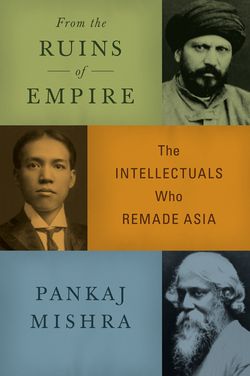
RuinsempireA few hundred years ago, a powerful cultural force arose in Western Europe that would later spread out and overwhelm much of the world. Fueled by a new spirit of individualism, inquiry, and innovation, it furthered personal ambition, a materialistic outlook, and competitive self-interest. This cultural force produced—and was in turn amplified by—scientific progress, the nation-state, advances in military and maritime technology, an escalating hunger for profit and raw materials, and secular institutions in education, governance, and finance, such as the joint-stock corporation.

In the ensuing centuries, European adventurers would subject many older, tradition-bound, and self-absorbed civilizations in Asia to the ravages of this aggressive and disruptive cultural force—and incidentally, to its refinements. Indeed by 1900, a minority of white Europeans had colonized much of Asia, controlling not just its political and economic life but also its cultural life in shaping the natives’ idea of themselves. The road to this widely resented domination—which the colonizers justified at home with theories of racial and cultural hierarchies, the white man’s burden, and plain old lies—was paved with countless imperial intrigues, extortionate treaties and taxation, skirmishes, plundering, drug dealing, massacres, and crushed mutinies. As Joseph Conrad wrote in 1902, ‘The conquest of the earth, which mostly means the taking it away from those who have a different complexion or slightly flatter noses than ourselves, is not a pretty thing when you look into it too much.’

In his engaging new work, From the Ruins of Empire: The Intellectuals Who Remade Asia, Pankaj Mishra chronicles ‘how some of the most intelligent and sensitive people in the East responded to the encroachments of the West (both physical and intellectual) on their societies.’ What did they see as the threats and the temptations of the West? What modes of resistance and internal reforms did they propose to meet this challenge? Mishra’s remarkable story, mostly untold in Western historiography, opens up important new vistas on the colonial West and the trajectories of Asians, whether in imperial Japan, nationalist and communist China, India, or Muslim countries from Turkey to Pakistan.

§
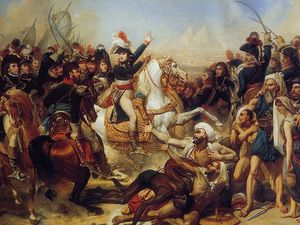
NapoleonEgyptMishra’s narrative opens with Napoleon's invasion of Egypt in 1798, described by Al-Jabarti, a cleric and scholar, as ‘the beginning of a series of great misfortunes.’ Al-Jabarti was nevertheless awed by the discipline and efficiency of the French and their innovations in democratic governance, raising a conscript army, and training it in modern weapons. A whole generation of Asian thinkers, writes Mishra, would soon realize that

... the remarkable strength of small European nation-states [with] organized human energy and action, coupled with technology, amount to a power that could radically manipulate social and political environments. Resentfully dismissive at first of Europe, these men would eventually chafe at their own slothful and uncreative dynastic rulers and weak governments; and they would arrive at a similar conviction: that their societies needed to attain sufficient strength to meet the challenge of the West.

But how was this to be achieved? Three sets of responses soon appeared all across Asia. The first was reactionary and emphasized renewed fidelity to one’s own superior traditions, whether of Islam, Confucianism, or Hinduism. The moderate response preferred reform and cultural synthesis and accepted that some Western ideas were necessary to supplement what were otherwise adequate traditions. Finally, the radical secularist response from folks like Mao and Atatürk advocated a revolutionary break from their traditional past ‘in order to compete in the jungle-like conditions of the modern world.’ All of these responses were tacit acknowledgement that the venerable civilizations of Asia were ‘poorly fitted for a new modern world the West was making and which they had to join or perish.’ Mishra adds:

This is why the European subordination of Asia was not merely economic and political and military. It was also intellectual and moral and spiritual: a completely different kind of conquest than had been witnessed before which left its victims resentful but also envious of their conquerors and, ultimately, eager to be initiated into the mysteries of their seemingly near-magical power.

A key intellectual in Mishra’s narrative is Jamal al-Din al-Afghani (1838-97), a polyglot, cosmopolitan Persian who lived in Iran, India, Egypt, Afghanistan, Turkey, England, and France. He often told fellow Muslims ‘that the power of the westerners and their domination over you came through their learning and education, and your decline in those domains.’ He advocated secular education and science, railed against the ‘evils of fanaticism and political tyranny’ in Muslim lands, and praised republican and constitutional rule. He stressed a modern reading of the Qur’an and ‘rejected the Shia-Sunni schism in Islam, blaming it on selfish rulers who used wars to keep their populations ignorant.’
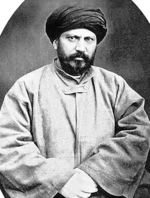

Al-AfghaniIn parallel, al-Afghani attacked European propaganda on their ‘progressive’ mission in Asia, dismissing history books written by the English, which were ‘marked by the hands of English self-love, with the pens of conceit and the pencils of deception, and inescapably they do not relate the truth and do not report reality.’ Mishra notes that al-Afghani was among the first to point out ‘that the British improved transport and communication in order to drain India’s wealth to England and facilitate trade for British merchants. Western-style schools, he argued, were meant merely to turn Indians into English-speaking cogs of the British administration.’ A tireless activist and journalist with a multinational readership, he also allied with reformist statesmen. In later life, he came to believe that ‘attacking religion risked undermining the moral basis of society ... and weakened the bonds that held communities together’. Embittered by the duplicity and cynical exploitation by Europeans, he would instead turn to the rhetoric of nationalism and pan-Islamism to unite people against the colonizers. Mishra argues that al-Afghani’s rallying of Islam as a basis for anti-Western solidarity would, decades after his death, inspire a wide range of left and right wing politics in other contexts, culminating in his unlikely elevation as the founder of modern political Islam and the intellectual godfather of the Iranian revolution—as well as in a major terrorist attack on the very capital of Western modernity.

LiangAnother charismatic moderate in Mishra’s narrative is Liang Qichao (1873-1929), ‘China's first, iconic modern intellectual. His lucid and prolific writings, touching on all major concerns in his own time and anticipating many in the future, inspired several generations of thinkers including the much younger Mao Zedong.’ Well before Lenin, Liang explained how ‘by tying imperialism to individual economic interests, Western countries had given it a popular base among their own populations.’ He saw that the inertial Qing dynasty was unable to defend against the West’s many humiliations of China, exemplified by the Opium Wars, extortionate trade treaties, the quelling of the Boxer Rising, the brutal plunder of Beijing, and the burning of the summer palace. The old dynasty had to go. China had to learn to expand politically and economically, or perish. But the Confucian old guard wasn’t going to simply roll over. How was China to modernize and overhaul its state apparatus while preserving its cultural values? How was it to acquire a sense of nationhood and civic solidarity? Traveling in America, Liang was disenchanted with American democracy. Mishra presents a riveting account of his intellectual journey and of many others in light of China’s tumultuous encounter with the West.

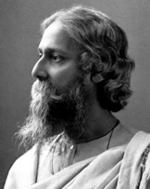
TagoreMany Indians also appear in Mishra’s historical essay, including Gandhi, Tagore, Nehru, Vivekananda, Aurobindo Ghose, and Bankim Chatterjee. In their various ways they vigorously critiqued both the West and their own societies. Supremacist Western takes on native customs and the wholesale reinterpretation of ‘Hinduism’ by orientalist scholars incited defensive religious chauvinism and neo-Hindu movements. Tagore took the high road and even criticized the Japanese when—after defeating the Russians at the Battle of Tsushima in 1905 and filling hearts with pride across all of Asia—Japan began competing in the same imperial game, ending in the blight of WWII. Though a secular rationalist remarkably open to other cultures, he saw no reason that ‘building up of a nation on the European pattern is the only type of civilization and the only goal of man’. According to Mishra, he told an American audience that the nation-state ‘is a machinery of commerce and politics turn[ing] out neatly compressed bales of humanity’. Curiously, while his concerns about the values and trajectory of the Western model found receptive audiences in America, he got ‘fierce opposition’ from intellectuals in 1920s China, who craved the Industrial gravy train of the West. They saw Tagore as a dreamy romantic harping on about the spiritual wisdom of the East. A newly minted Chinese communist poet summed it up: ‘Thank you, Mr. Tagore, but we have already had too many Confuciuses and Menciuses in China.’

Gandhi, too, ‘keenly registered the moral and psychological effects of this worldwide destruction of old ways and lives’, en route a world in which economic prosperity was sadly the primary goal of politics, even as he saw ‘the many benefits of Western modernity, such as civil liberties, the liberation of women and the rule of law.’ Meanwhile, many Hindu nationalists ‘saw salvation in the wholesale imitation of Western-style state and society’. Ashis Nandy, in his penetrating study of the psychology of colonialism on both sides, The Intimate Enemy (1983), reports that Vivekananda even went as far as saying that ‘the salvation of the Hindus lay in three Bs: Beef, biceps, and Bhagavad Gita.’ Similar to China, India too would soon ignore the cautionary words of both Tagore and Gandhi in chasing the secrets of Western power. And so while these two intellectuals gave voice to many significant viewpoints, it’s not clear that they ‘remade’ their part of Asia to any great extent. After all, their social, political, and economic visions were almost entirely ignored by later generations.

The mental colonization of the newly educated Indians—aka ‘Macaulay's children’—would be easier and deeper than elsewhere in Asia, since nearly all Indians, out of touch with their philosophical and literary heritage in Sanskrit, came to it via English translations and Western scholarship. They internalized the concepts, categories, and judgments of the colonizers, and—in what is a basic idea in the psychology of colonialism—aspired to be like their masters. This colonized elite later slipped into British shoes with a similar superior attitude towards the unwashed Indian masses. Such post-colonial elites, Fanon wrote, ‘simultaneously resisted the insidious agenda of colonialism and paved the way for the emergence of the current struggles.’ Disappointingly, Mishra says nothing about BR Ambedkar, a towering intellectual who, unlike Gandhi, was drawn to both Western modernity and Buddhism, and who has more substantially ‘remade’ modern India. Nevertheless, Mishra’s canvas is wide and his material well researched. The cosmopolitan individuals he has chosen were, like himself, shaped by and questioned Western modernity. They were also in frequent dialog with other Asians. Mishra sensitively recounts their conflicts and struggles in order to illustrate new contours of the Asian experience in colonial times.

§
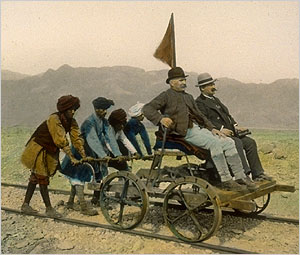
Train-1895Lest one is lulled by the selective memory of the West, Mishra, in words that barely contain his quiet outrage, revisits a host of calamities of Western imperialism as experienced by Asians. Anti-imperial Europeans have certainly documented them but from their own perspectives; many cultural memories and psychological states are not readily accessible to them. Apologists for imperialism still abound, many in the closet and even on the left. Some, like the rebarbative Niall Ferguson, clamor for its return. They will counter that Mishra isn’t telling us the whole truth, that Western imperialism was also good, that it was in fact more good than bad. Clearly the two sides don’t even mean the same thing by ‘good’ and ‘bad’. Every empire, wrote Edward Said, tells itself that ‘its mission is not to plunder and control but to educate and liberate.’ The apologists tend to overlook the strong pull that self-respect and dignity have on people, who willingly even die fighting for it. Colonialism, for all the benefits it brought to the natives despite itself, was above all a gross violator of self-respect and human dignity. This is why the colonizers, so unloved, were so unceremoniously booted out of Asia soon after the natives understood and embraced the secrets of Western power. In some parts of Asia, memories of humiliation would even lead to an instinctive cheer for the collapsing twin towers in 2001.

Many early Asian intellectuals, writes Mishra, ‘judged Western-style politics and economics to be inherently violent and destructive forces. They knew that borrowing technical knowledge through a modern system of education from Europe wasn’t enough; these borrowings brought with them a whole new way of life’ which threatened ‘the old moral order’ and not much to replace it with. The notion that culture X, with a very different history than culture Y, can be forced top-down to produce the best outcomes of culture Y is neither smart, nor in accord with historical change or human nature. ‘Out of the crooked timber of humanity’, wrote Kant, ‘no straight thing was ever made.’ Advocates of top-down change frequently discount this serious problem, that such change is often assimilated with great difficulty, or not at all, or creates new malignant forms.

Echoing a long-held view, Mishra writes that by aggressively exporting ‘its ideas to the remotest corners of the world, the West also destroyed native self-confidence, causing a political, economic, and social desolation that can perhaps never be relieved by modernity alone.’ Recurrent across his non-fiction is the image of masses of young men uprooted by top-down modernization, men who aspire more than their fathers but with fewer skills and traditional support structures of religion and community, morally adrift in societies with rising disparity, shrinking resources, and populist politics, a world changing too fast with collapsing safety nets, ‘exposing their raw nerves to extremist politics’ and demagogues. Globalization does not lead to integration or openness but ‘reinforces tribalist affiliations, sharpens old antipathies, and incites new ones while unleashing a cacophony of competing claims’. While pundits glibly expound on the rise of Asia—and ‘no alternative intellectual universalism has successfully challenged the prestige and authority of Western modernity’—billions more are now yoked to a wholly unsustainable model of economic growth and consumption, raising the stakes for all humanity. In his melancholic epilogue, an even darker gloom and Romantic disenchantment with modernity descends on Mishra. He ends the book with these ominous words:

[The hope] that billions of consumers in India and China will one day enjoy the lifestyles of Europeans and Americans — is as absurd and dangerous a fantasy as anything dreamt up by al-Qaeda. It condemns the global environment to early destruction, and looks set to create reservoirs of nihilistic rage and disappointment among hundreds of millions of have-nots — the bitter outcome of the universal triumph of Western modernity, which turns the revenge of the East into something darkly ambiguous, and all its victories truly Pyrrhic.

§
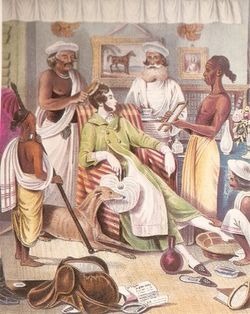
Bri_india02Perhaps the world would have been a better place without the West’s colonial misadventures. Perhaps then the Asians would have approached Western modernity on their own terms—and more gracefully assimilated it. Perhaps. But then there is Thucydides, the great historian of the Peloponnesian War, who began to see that some large events could not have gone any other way, in light of the human material and the often blind and contending cultural instincts of people. If Western colonialism was one such event, what then about Western modernity itself, as the motive force behind that event? Would the world have been better off without Western modernity too—and by extension, all that which created it: individualism, competitive self-interest, science?

Mishra’s intellectual affinities suggest that he would answer ‘yes’, seeing modernity as a package that is not amenable to selective borrowing, and whose toxicity cannot be contained once it inflates the ego and unleashes its energies in the minds of men. There is much food for thought (and room for debate) in this view. However, it is anybody’s guess what an alternative history might have been. Could it not have been much worse? Responses here will have to stay in the realm of polemics. VS Naipaul, another contemporary observer of Asian societies (who often criticized the Arab-Islamic imperialism of over a millennium ago but missed nearly every opportunity to criticize Western imperialism), might counter that modernity is akin to the gift of fire. Along with the power to ‘burn us down’, it has also given to humans a certain kind of awakened spirit and enlarged consciousness, which is what we then use to lament it. We may feel nostalgic for a fondly imagined pre-modern era but we don’t have the option of going back now—only the burden of knowing the dangers of this gift and taming it to serve us better. At times Mishra seems overly sentimental about pre-colonial Asia and its ‘traditionally self-sufficient peasants’ but few will consider his prognosis implausible. He could also have defined ‘Western modernity’ more clearly since not everyone imagines the same set of ideas when that term is critiqued, and Mishra does critique it in a variety of contexts, from secular rationality to any system of industrialization to liberal democracy.

With uncommon empathy, Mishra has excavated a range of ideas, existential debates, and spiritual struggles set in motion by Asia’s rude collision with the West, leading to outcomes no one could have predicted but which, after his account, seem more comprehensible. Above all, Mishra sheds new light on an important part of our collective journey, the inner and outer turmoil we inhabited, the price we paid, and what we did to each other along the way. We might yet learn from it and redeem ourselves in some measure.
___________________________

More writing by Namit Arora?
___________________________

Posted by Namit Arora at 12:40 AM | Permalink

Comments

1. Thanks for the review Namit. I was planning to purchase the book, but after reading your review I think will wait for it to reach my local library.

2. "[The hope] that billions of consumers in India and China will one day enjoy the lifestyles of Europeans and Americans — is as absurd and dangerous a fantasy as anything dreamt up by al-Qaeda."

What can Mishra possibly mean by the above statement? Why does he call billions of individuals "consumers"? Is that all they represent? Why does economic freedom evoke contempt in Mishra?

I have no idea if Western standards of living can be reached by the whole world, but I think it is possible. Why is it "absurd"? And whats with the odd comparison to Al Qaeda? What makes economic freedom and prosperity "dangerous"?

Does Mishra even try and justify these astonishing statements? Or are they merely intended as a pose, and therefore not to be taken seriously?

I guess I will have to wait until the book reaches my local library.

Posted by: Sundar | Aug 13, 2012 11:11:04 AM

Mishra's biggest problem is his awful lack of historical perspective. Perhaps a sign of how the Western imperialists have taken over our minds? He seems to have no consciousness of our history prior to Western colonization except in the form preferred by some modern Western fashions (where the world is divided into pastoral idyll (pre-colonization) and evil modernity, and everyone except White people is painted as helpless victims of superior Western thinking...with the additional caveat that in the 19th century "superior Western thinking" was regarded as a good thing and now its fashionable to regard it as a bad thing..the valence has changed, the notion of vast superiority and qualitative difference has not).

Jamaluddin Afghani's pan-islamic dream (for example) is an uncomfortable fit with the notion of pastoral resistance to modern evils. A much simpler version of events would present his views (and those of many others) as an attempt to figure out why the West was now so much superior in firepower and organization SO THAT WE COULD DO THE CONQUERING ONCE AGAIN (a perfectly reasonable and human thought, but not what Mishra has in mind). That last bit escapes Mishra since he seems to have missed Arab history (and Persian history, and Chinese history, and Roman history, etc etc) in his vast reading...

Posted by: omar | Aug 13, 2012 12:14:19 PM

I agree with Omar that Mishra lacks historical perspective (and seems uninterested in acquiring it).

I have found "After Tamerlane" by John Darwin to be a very intriguing analysis of the history of empires. Quoting from Maya Jasanoff's review: "Darwin has provided an ambitious, monumental and convincing reminder that empires are the rule, not the exception, in world history. What their passage has meant - and will continue to mean - for the people who live within them remains for others to explore. But of their persistence, their variety and their global power, this book leaves no doubt."

http://www.guardian.co.uk/books/2007/may/12/featuresreviews.guardianreview7

Posted by: Sundar | Aug 13, 2012 12:30:14 PM

While I haven't read the book I am struck by how it's being marketed outside of the U.S. The subtitle, in Canada & the U.K., is "The Revolt Against the West and the Remaking of Asia". Do American readers find intellectuals less intimidating than revolutionaries?

Random House: http://preview.tinyurl.com/cx7ymn8
Penguin: http://preview.tinyurl.com/d59uf6r

Posted by: Rick Miller | Aug 13, 2012 1:41:45 PM

Good review, Namit. Like Sundar, I too may borrow the book but will not buy it and like Sundar, I don't see why prosperity per se is harmful either to one's body or one's soul.

Having read quite a bit by Bankimchandra, Tagore, Amartya Sen and some others, I don't think Mishra will shed much new light on what I have come to believe about colonialism.

There is no doubt about the toxic legacy of colonialism, in every way that is mentioned here. Japan is a very good example of how modernity and prosperity can be achieved by embracing scientific (western) ideas wihout paying the high price of sacrificing or eroding tradition. Japan of course, was never colonized by the west but itself exercised similar imperial hubris over other Asian countries like Korea and Taiwan.

That said, I am not willing to accept that everything may have been salubrious for the vast majority of "natives" in Asia before the dreaded Europeans came. The fact that it wasn't so is probably attested by the fact that a huge geographic area teeming with people like the Indian subcontinent could be ruled for two hundred years by a handful of "goras" by hook, crook or devotion to materialism. It was mostly by crook, I admit but why or how?

Posted by: Ruchira | Aug 13, 2012 4:34:33 PM

And Rick, I wouldn't read too much in the "revolt" vs "intellectual" switcheroo in the blurb. The US publisher may not have as delicate a finger on the public pulse as it thinks. From what I observe in the tone and content of the general discourse during this election year, Americans may be more suspicious of intellectuals than they are of revolts.

Posted by: Ruchira | Aug 13, 2012 10:53:28 PM

LOL, how ABCDs are commenting on the review. Why bother borrowing it from the library? Go buy "3 cups of tea" whatever the name of that book is? Take a trip to the nearest SBUX read and discuss it with someone sitting on the next table-;)

Posted by: Diego Del Gastor | Aug 14, 2012 1:16:14 AM

I ordered TWO copies of the book (one as a gift).

To Sundar: you ask what Mishra meant by the allusion to al Qaeda. Many Indians somehow think they will be able to live like Americans (the house, the car, the TV, etc.) and at the same time continue to have Indian cultural values (arranged marriage, aunties, etc.) No, India will lose its culture, just as the West lost its culture when industrialization and consumerism spread. The women will refuse arrange marriages, divorce will skyrocket, the extended family will disappear, to be replaced with drugs, sex, TV.

Watch "The Wire". It's a TV series about the widespread problems of drugs, corruption, incompetence, and indifference in American cities. That's what you're going to get, along with your shiny flat screen TV, your Porsche, and your Gucci handbags.

Posted by: Andreas Ramos | Aug 14, 2012 10:58:06 AM

The soul is now western while the body remains defiantly eastern. Is that the revenge or is it the samosas?

Posted by: Raza | Aug 14, 2012 12:16:39 PM

I don't have the energy to repeat what I have said a few times before in similar contexts about the so called clash of western materialism and eastern spirituality / family values etc. ad nauseum. It really distresses me that someone or the other is bound to pipe up with warnings about the dire consequences of material success in the east. Do these people know what the Indians want or think? What if they wish to go down the path of divorce, drugs and disrupted family life for the sake of owning a Porsche and a flat screen TV? Can't they make up their own minds? Are they little children to be lectured at by the likes of Mishra and Andreas Ramos? And whom are they kidding anyway? Wasn't there greed and corruption in the east before European colonial rule showed them the lure of materialism? Come on!

Colonialism can be of the mind too - like the kind that would keep alive the drama of "poverty with purity" alive in the east (or in Africa) just so that some people can get on their favorite hobby horse of "the materialistic west vs the spiritual east" debate. Just read the post above on Kapuściński’s ‘empathy’. And I say this as someone who really admires Kapuscinski's writings for the most part.

Posted by: Ruchira | Aug 14, 2012 4:32:56 PM

Ruchira, one might take all this more seriously if Pankaj Bhayyia's own carbon footprint was a bit smaller and he was happily enjoying the benefits of a large patriarchal joint family, cultivating their little mint garden in uttar pradesh and contemplating the rise and fall of empires with the same detachment those yogis supposedly exhibited in front of Alexander.

Modernization may be as bad as he says, but the peasants, they are voting with their feet as they rush to buy washing machines and motorbikes. If its a disease, its a HUMAN disease, not just a Western disease.

This is polemical and Razib Khan can be a tough read for people fully socialized into modern liberal fashions, but its worth a read: http://blogs.discovermagazine.com/gnxp/2011/12/the-poverty-of-multiculturalist-discourse/
comments section clarifies some of the arguments. And yes, I made comment number 30.

Posted by: omar | Aug 14, 2012 6:24:27 PM

Excellent review Namit. I liked the way you deconstructed Mishra's work for the prospective reader -- and then used it to reconstruct the larger theme of the inexorable 'miscegenation' of civilizations that have taken place throughout human history either via conquest or coercion, or both.

I also liked your choice of profiles that you picked: al-Afghani and Tagore. And the passages you quote from the book, for example: "According to Mishra, he [Tagore] told an American audience that the nation-state ‘is a machinery of commerce and politics turn[ing] out neatly compressed bales of humanity’. There is some truth to it, but the way it was said tickled me, too. :)

As you point, Mishra seems to have an unconscious self-serving bias -- an unavoidable condition for any author -- in terms of how he has treated the topic.

My own view, probably a conceited one at that, is any civilization which harnesses the "gift of fire" would have worked to subjugate the other. I wonder if Palestinian were European Jews, and the Jewish were Palestinian Arabs, whether things would have been any different. In a similar vein, if the Industrial revolution, secularization and capitalism had taken root in Asia, the same history would have written itself in reverse. Europeans would have been the "subjects" of an Indo-Sino-Nippon-Arab axis. (a mirror image of British, French, Portuguese and Dutch colonists.)

Finally, I am not sure if Pankaj Mishra cites any of these three books in his work, if not he is remiss as a scholar and historian.
- Guns, Germs and Steel by Jared Diamond
- Can Asians Think by Kishore Mahubani
- And why Britain got there (industrial revolution), among the West, first?*
*These two reviews (of books) take on this topic:
http://online.wsj.com/article/SB10001424052748703940904575396112998790810.html
http://www.economist.com/node/13688053

Posted by: Moin Rahman | Aug 14, 2012 8:28:01 PM

I haven't read this book and probably won't. But from what I have seen in Mishra's other writings, I am guessing that he has put the 99% of Asia's problems on colonialism. The deep material and emotional misery brought upon by colonialism is uncontested. See the last two pictures above to understand the contempt with which the imperialists treated the natives. It is stomach turning in light of our current sensibilities. But the exact same pictures could be substituted with Indian rajahs and nawabs without distorting India's history one bit. With caste, religion, bonded labor, regional barriers, a rigid patriarchal system, and huge economic divides pervading the social fabric, human rights and dignity were not exactly flourishing in Asia for the common man. Everyone knew his / her place. The occupiers rose to the top of the totem pole and for the first time, Asian aristocrats too experienced indignities.

I have no problem in pointing out the harsh and inhumane conditions that existed under colonialism. Loss of dignity and self confidence may have been the worst outcome of all - not materialism or scientific knowledge.

The difference between Mishra and the critics of colonialism such as Bankimchandra, Tagore, Gandhi, Ishwarchandra Vidyasagar, al-Afghani, Ambedkar etc. is that the latter saw plenty wrong within their own house too and their outrage was directed not only against the interlopers. That is why they would be remembered as reformers and not mere critics.

Posted by: Ruchira | Aug 14, 2012 11:31:18 PM

Thanks for the review. Very interesting, and the comments about Mishra as well.

I would add one little comment to Rushira,

The reason India was "relatively" easily colonized by the British (and other Europeans) was because they had already been colonized by the Turks and Persians. It's much easier to knock off and take control of a predatory empire ruling over culturally distinct vassal peoples, as Cortez demonstrated in Mexico with the Aztecs. It's not only imperialism when Europeans do it!

Posted by: Hektor bim | Aug 15, 2012 11:18:06 AM

Namit, this was a fabulous book review. I really appreciated getting the book deconstructed! In fact, when I finished I thought, “oh good, I don’t have to buy that one now” :) Your review was too good!!!! And, what I really loved was the end, where you discuss the impossibility of imagining a different history. I love to read anti-histories, like what if the An Lushan Rebellion had never occurred etc. In this case, one can imagine other histories without India or China have been colonized. And, as Ruchira suggested it isn’t as if those would have had been rosy or un-traumatic histories. However, I think that Mishra’s insistence about this emotional side of colonial history is really something that needs saying and re-saying. As you know, I have many friends who are “China experts” and academics and in the case of China, you do see the "experts” being dismissive of what China calls its “100 years of humiliation.” In one sense, I understnad that they feel that current leadership in the CCP uses this colonial humiliaton for political or ideological reasons, and yet, what they call a humiliation is maybe something that is present and something real for many, many Chinese people. I mean, reading the history from that time it is infuriating. Each country was different and had a different experience, of course, but I think that Mishra and my beloved Amitav Ghosh are really important voices.

Ruchira, I think you are right and not right about Japan. Japan was never colonized but it did suffer defeat and then American overrule for a long time. It was definitely different than having being colonized (or victimized), however their dramatic rise was part of this nexus (massive American investments and technology transfers)... I really do agree with you, the japanese and Koreans have retained a high level of cultural cohesion despite becoming highly developed and so why couldn’t Indians too, right? The earth cannot sustain those numbers though so hoping they would try and develop more like Japanese and Europeans with stricter manufacturing laws and less like Americans who remain the #1 polluters of the world’s developed countries.

Posted by: peony | Aug 15, 2012 3:35:22 PM

Thank you, all. Many interesting comments, some not entirely fair I think. So I'll just add a few remarks to try and better situate Mishra's current project as I see it.

In this book, Mishra approaches Western colonialism from a pan-Asian perspective, drawing out common responses, cross-country conversations, and elevating little known protagonists. This material is the best reason to read the book. More Asians need to tell their own stories and not just rely on outsiders to tell it for them. Histories tend to be written by the winners and are inevitably biased to be self-serving. New scholarly accounts with other biases, and which contest dominant accounts, can play a useful role. This much I hope is not controversial to most of us on 3QD.

Nor should we conclude that since Mishra focuses on Western colonialism, he is oblivious to past colonialisms, including within Asia (though he may well regard Western colonialism worse than others, not the least because it came with the curse of Western modernity?). One could say that Mishra's focus on Western imperialism is selective and politically driven, but this too is not bad in itself. Unlike Ottoman or Persian imperialists of the past, many dominant ideologies of our day — such as neo-con hawkishness, or free market fundamentalism — are peddled by former Western imperialists and allies that are still powerful, and it is in their interest to whitewash their histories to justify present-day behavior. So auditing their recent past in the context of present claims is a tad more useful than auditing Persian imperialism of the medieval age. Mishra's focus is driven more by our current geopolitical debates, than 'disinterested' research meant for academic journals. One could even see this book as a longish response to the likes of Nalayak Ferguson who has called for "creative destruction" in Iran (and NF has lots of neocon acolytes and institutional prestige).

I think it is unfair to say that Mishra is not critical of India. On countless Indian blogs, the nationalistic crowd despises him for not buying into the India shining BS, for highlighting Indian brutalities in Kashmir and sundry abuses of power within India, for showing the motherland in a "bad light", etc. That said, one can still disagree with Mishra on many things, including his take on modernity, or how much blame the West deserves for passing it on to the Asians in the course of exploiting them. One might even say that this bias diminishes his historical analysis, that he can be stubbornly pessimistic, that he tends to romanticize the past. I aired some reservations in the review, but like Peony, I still see his voice as useful and relevant. To invoke a cliché, there is more than just bathwater in this work—for reasons I summarized in the review's final paragraph.

Posted by: Namit | Aug 16, 2012 12:04:04 AM

Namit, you may have done Pankaj Mishra a disservice by writing an excellent and thorough review:-) Like Peony, I too felt, "oh good, I don’t have to buy that one now."

Posted by: Ruchira | Aug 16, 2012 4:37:13 PM

Hi,
Punch into google search CNN IBN SHAM AWARD FOR GREATEST INDIAN- VADAKAYIL.
Be shocked!!
Do NOT read the invaders version of our Indian history— rather read what your ancestors told or wrote.
All patriots should read this post.
Angrez ka aulads must lay off.
Capt ajit vadakayil
..

Posted by: ajit vadakayil | Aug 19, 2012 12:24:42 PM

A really simple (not necessarily simplistic) way of visualizing the impact of colonialism anywhere is by imagining a society's development or progression in stasis for centuries. This arrested development kept many societies across the global south to not autonomously figure out their own renaissance and escape from feudalism. Indians have retained many feudal qualities because our renaissance under whatever iteration (mughals, rajputs, bengali zamindars) simply didn't happen. This implies little of course, as far as apportioning blame to feudal rulers go, because the same was true for Europe forever until the 15-16th century. They got there early through dumb luck and so would we. Only we were merely headed in a different direction with our social renaissance which surely would have happened sooner or later. Instead we got a botched partition, turmoil in south asia, and a bureaucratic democracy. This is entirely British imperialism's fault, with some collusion from mediocre Indian minds who engineered our freedom.

Also remember, no reparations till date and no Nuremberg for the British brigand! Churchill said about reparations - "over my dead body!" This prepsterously racist, ignorant tool is routinely celebrated as the greatest Briton ever in every other poll.

Ruchira, it's silly to blame "India" for not having its house in order - what house? It used to be a ragtag bunch of feudal territories when the British came along. The king of Manipur here, a Chalukya there, an Aurangzeb everywhere. There was no union to speak of. I do feel "India" was headed in a cooler direction than unifying territories under a martial nation state though, which is Europe's gift to the world along with industrial capitalism, science (!), rationality (!!) and penny farthings.

Posted by: bobo | Aug 20, 2012 9:10:14 PM

Bobo, now YOU for example have some interesting things to say about colonialism and why it was bad. But if you read Pankaj, you will find that he is the farthest thing from this kind of argument (or any other interesting argument). What he presents is so sophomoric and cliched it makes one despair of the (liberal) human race. If he were making your kind of argument (or Ashish Nandy's arguments or any of a dozen other interesting arguments) it would be a book worth engaging with. But I have finally started his book and boy was I right. Its worse than I thought it would be. Admittedly I am only a third of the way thru right now, but I am live-blogging it at http://www.brownpundits.com/2012/09/24/pankaj-mishras-tendentious-little-book/
Please add your comments.

Posted by: omar | Sep 24, 2012 7:48:46 PM

and my rolling review continues at http://www.brownpundits.com/2012/09/25/pankaj-mishras-sophomoric-book-continued/

Posted by: omar | Sep 25, 2012 12:19:12 PM

Nice reviews, Omar. Far more astute comments over there; Kabir notwithstanding - just kidding, you Meera bhajan singing you!

Posted by: Sam | Sep 26, 2012 12:50:12 AM

@ Sam,

lol.... do we have problems with Meera Bhajans now? Is that too kind of wishy-washy "bhakti" for you and not "Hindu" enough?

Poor me.... can't win anywhere... the Pakistanis freak out that the mention of the word "bhajan" and the Hindu Nationalists go "oh Meera bai...." I feel like the dhobi ka kutta... na ghar ka na ghat ka.....

Posted by: Kabir | Sep 26, 2012 3:00:15 AM

@Omar, Excellent rolling review. A quibble:

You misuse the word batshit. It means crazy. So you can't say "they know batshit about the Chinese guy" when you men "they don't know shit about the Chinese guy".

BTW, excellent observation. I felt the same way. He (along with all other Indians) skip any mention of Tagore's ugly obsession with the Soviet Union.He knew about Stalin's brutal dictatorship, but still gushed about the Soviet Union.

Posted by: Sundar | Sep 26, 2012 8:57:37 AM

Sundar, thanks. I should indeed have used shit instead of batshit.
Btw, this "rolling review" was mostly dictated on "dragon naturally speaking" (I still have to make some corrections and add in proper names, but it works surprisingly well). That sort of lets me go on and on. As Pascal (and others) pointed out long ago, one needs a lot of time to be successfully brief. Maybe this weekend I will make something more focused out of it.

Posted by: omar | Sep 26, 2012 11:05:16 AM

Folks might find this conversation between Ian Buruma and Mishra interesting. In it Buruma asks Mishra some awkward questions. Not as awkward as Omar might prefer but still :).

http://www.youtube.com/watch?v=tGhtd_S5aUM

Posted by: Namit | Sep 28, 2012 3:57:42 AM

@Namit, Very Interesting Discussion.

I enjoyed Buruma's incisive questions. Some good moments:

Buruma asking Mishra why he assumes we need a universalist ideology... "Hasn't universalism done enough damage already?"

Posted by: Sundar | Sep 28, 2012 8:05:57 AM

@Namit, Thanks for posting this. I thought Mishra did quite well in responding to the "awkward" questions. I would love to see him debate Omar!

@Sundar: Hasn't different religions, economic and political systems done enough harm already?

Posted by: Raza Husain | Sep 28, 2012 9:33:30 AM

Buruma really nailed Mishra. By pointing out that racism, etc. were by no means a western invention.

Mishra's complaint seems to be that the Europeans were just bloody good at playing the game...

Posted by: Sundar | Sep 28, 2012 1:19:59 PM

Part three of my non-review is up.. a serious effort will inshallah follow: http://www.brownpundits.com/2012/09/30/pankaj-mishra-and-countless-fans/

Posted by: omar | Sep 30, 2012 6:58:17 PM

Omar, I enjoyed reading your three-part rolling review. Many sound insights and valid critiques. Hope you will develop it into what you call a "proper review" and put it up here on 3QD.

That said, in this latest part, you might want to reconsider what you say is the "weakest part of the book", namely, the idea that the three intellectuals that anchor it remade Asia ("How exactly can the last 100 years of Indian history be described as the fruit of Tagore’s intellectual labors?"). But where does Mishra make this argument? He has even said that Tagore was almost entirely ignored in the Indian nation-state (except in a small literary/cultural space), though he sees that as a mistake worth remedying. Clearly, you are responding only to the U.S. edition's subtitle. The British/Asian edition has another subtitle: "The revolt against the West and remaking of Asia", which has a whole different meaning. Publishers often change covers so we can call it a bad choice (are Americans more drawn to history marketed around individual figures?). Notably, Mishra's approach inside the book is that studying individual lives is a valid way of exploring some of the intellectual currents in history, which often lead to or inform new ones. In the prologue, he voices his "conviction that the lines of history converge in individual lives, even though the latter have their own shape and momentum." And in each region, he discusses several individuals, not just the main three.

I'm curious: was there *anything* you liked in this book?

Posted by: Namit | Oct 1, 2012 2:55:09 AM

We must be thankful that Tagore's social and political vision was mostly ignored. To those unfamiliar with Tagore's political thought, please read his "Letters from Russia". In it, Tagore calmly justifies Soviet Russia's mass murder and violence. (I am not exaggerating).

Even Tagore's fawning biographers could not ignore his worship of Stalin (and Mussolini... ).

Some choice bits:

http://indianskeptic.tumblr.com/tagged/tagore

Posted by: Sundar | Oct 1, 2012 11:57:06 AM

Namit, have to look at the book tonight to see if PM made that claim directly (except on the cover)...I did stick to saying "as claimed on the book cover and by his reviewers.
The book has bits and pieces of interesting information scattered through it, but its ruined by PM's tendentious viewpoint (or rather, viewpoints...he has a way of saying ALL the fashionable things even if they contradict each other..HE doesnt mind, but I am surprised even his reviewers dont seem to mind..one brought that up somewhere but I cannot recall who that was...it was one of the British reviews).
In summary, the book has nuggets of information in it. but I am just so irritated by the whole project that I cannot even say I liked that.
This is going to get me blackballed at the 3QD club, but I think Niall Ferguson is ten times more valuable as a writer than PM. HE has a viewpoint that I dont like either, but the information to propaganda ratio is better than 1. With PM, its well below 1. Even Ferguson's worst books (like that "6 killer apps" thing he did recently) have a lot of information in them. And the politics is pretty explicit and one can imagine (rightly or wrongly....I am sure some people would argue that the unconscious contamination from Ferguson's books is lethal..I could then be exhibit A in that case...I can see a case being possible) that one can filter out the politics and still have learned something new. With PM, my claim is that you would be much better off just reading Wikipedia.

Posted by: omar | Oct 1, 2012 2:15:01 PM

Sundar, A History 101 question for you. Who were Stalin's and Pol Pot's allies? Look up Wiki if you don't know.

Posted by: Raza Husain | Oct 1, 2012 3:29:49 PM

Raza, I am going to be the kid who jumps up with the answer even though the teacher specifically asked Sundar:
Answer: The Chinese communists.

Do I get an A?

Posted by: omar | Oct 1, 2012 3:52:16 PM

Omar, Fyi, Wikipedia has 500 million unique visitors per month, ranking sixth largest site by traffic. It has 4 million articles compared to Britannica's 120 thousand. There are more than 70,000 contributors working on 20m articles in more than 200 languages. Accuracy test put both Wikipedia and Britannica at about the same level. Wikipedia sources are transparent and the articles are better cross referenced. Britannica went out of print. The elitists are uncomfortable with Wikipedia because knowledge was exclusively their domain.

Posted by: Raza Husain | Oct 1, 2012 11:17:11 PM

Raza, huh?
I love wikipedia. Where did that response come from?
You had asked who were Stalin and Pol-Pot's allies. You recommended looking up wiki if I didnt know, but since at least one ally was well known to me already, I jumped up with the answer. I am sure there were others, but my answer should still count. Or atleast, I think so.
Was it a trick question of some sort?

Posted by: omar | Oct 2, 2012 2:36:21 PM

Omar: "With PM, my claim is that you would be much better off just reading Wikipedia."

Sorry if I misunderstood but that's what led me on.

Cheers!

Posted by: Raza Husain | Oct 2, 2012 7:04:52 PM

Post a comment


Subscribe to this blog's feed  

PayAnywhere with iphone credit card swiper

Android Tablet

Bluetooth Headset

2013 New Style Dresses

Compare Car Rental Prices

DHgate.com Wholesale

3QD on Facebook

3QD on Kindle

3QD by Daily Email

Receive all blogposts at the same time every day.

Enter your Email:


Preview 3QD Email

3QD on Twitter

Miscellany

Lijit Search

AddThis Social Bookmark Button

Add to Google

Recent Comments

musafir on Loneliness, isolation and desperate yearning

carlos on The Gut-Wrenching Science Behind the World’s Hottest Peppers

Dredd on A young Houston couple is planning to give away $4 billion—but only to projects that prove they are worth it. Can they redefine the world of philanthropy?

Dredd on Why Rational People Buy Into Conspiracy Theories

JonJ on Daniel Dennett's seven tools for thinking

JonJ on Race Is Not Biology

omar on Race Is Not Biology

omar on Race Is Not Biology

Dredd on Race Is Not Biology

Dredd on Race Is Not Biology

allsmiles on A Mother, a Son and a Wife

sverson on Race Is Not Biology

carlos on Daniel Dennett's seven tools for thinking

araldo on Race Is Not Biology

jo smith on Daniel Dennett's seven tools for thinking

Louise Gordon on Why race as a biological construct matters

Louise Gordon on Race Is Not Biology

Dave on Race Is Not Biology

Bill on Daniel Dennett's seven tools for thinking

Boursin on Why Rational People Buy Into Conspiracy Theories

Usha Alexander on Race Is Not Biology

Abbas Raza on Daniel Dennett's seven tools for thinking

X on Race Is Not Biology

Usha Alexander on Race Is Not Biology

jo smith on Mohsin Hamid: 'Islam is not a monolith'

Acclaim For 3QD


"I couldn't tear myself away from 3 Quarks Daily, to the point of neglecting my work. Congratulations on this superb site."—Steven Pinker, Johnstone Professor of Psychology, Harvard University.

"I have placed 3 Quarks Daily at the head of my list of web bookmarks."—Richard Dawkins, Charles Simonyi Professor of the Public Understanding of Science at Oxford University.

"Just wanted you to know I’m one of many who reads and enjoys 3 Quarks....almost daily."—David Byrne, musician, former lead-singer of the Talking Heads, artist, intellectual.

Read more here.

The 3QD Prizes

Subscribe to this blog's feed