
| ABOUT US | ARCHIVES | LINKS | RSS FEED | MONDAYS | |

3quarksdaily

An Eclectic Digest of Science, Art and Literature

« Beyond Recognition and Misrecognition: the Shooting at Oak Creek Gurdwara | Main | How the Islamic World Gave Us Coffee and Democracy »

August 06, 2012

Remembering Kashmir

by Majid Maqbool

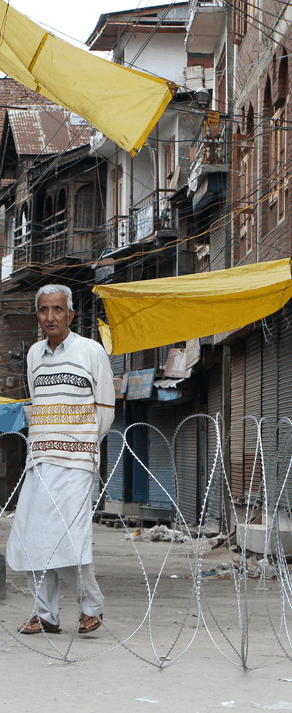
ScreenHunter_09 Aug. 06 12.29On days when I’m alone at home some vivid images and memories of my childhood rush back. They arrange themselves in disturbing ways, unsettling previous memories. Sometimes these memories write themselves in solitude. Sometimes they are forgotten, only to return later from the oblivion: in the middle of some conversation, for example, while travelling, or at night, in the dreams. Sometimes it’s too painful to write down compelling memories. Sometimes remembering them is the only way of making peace with them. And all these memories are unforgettable, lingering in some corner of mind, waiting to be summoned.  

I write because I remember. Because what I remember makes me who I am.

I remember, for example, those military crackdowns that loomed large over my childhood like black clouds: people ordered out of their homes early in the morning by the Indian troops, and assembled in open fields and playgrounds. And then that fearful wait for the next order of the troops. The troops lining up people, one frightened person after another, in front of that dreaded army gypsy. And whenever a masked mukbir (informer) seated inside the guarded army vehicle made a particularly shrill signal or a coded gesture, the person paraded in front of him was immediately frisked away by the troops. Often, he never returned home.

In my school days I remember the Indian army convoys driving past our school bus made us to wait till all the army trucks drove ahead, first, always. Often that meant waiting for hours, and getting late for school. To pass those uneasy hours, I remember counting the army trucks that made up that long and uninterrupted line of that dreaded army convoy. I remember the games we would play in the school bus: How many military trucks went past us today? 50? 100? 150, 200….? We would often challenge each other with the count. I remember the small bets we had kept for successfully predicting the number of army trucks that drove past our school bus. Quite often, I lost count of them…

I remember the first time I was slapped by a CRPF trooper. I was a 9th standard student then. That afternoon I was walking back to home after school.  The front yard of a big CRPF camp, occupying a cluster of housing quarters, could be seen from the bridge I stepped on. While walking on a bridge, I made funny faces, childishly mocking at one of the CRPF trooper I could see washing an army vehicle inside the camp. Given my size and age, I had hoped he would not mind it. But he came out, gun slung across his shoulder, and then he stopped me near the front gate of the camp. Then he slapped me with his left hand– a hard, tight slap. Abuses followed. As his heavy hand came down on my cheeks, I felt as if time had stopped. Shooooo…Deafening silence. I lost my balance.  But I quickly gathered myself, stood straight, my hand still on my reddened face. Then I did something that angered him more: I looked him in the eye; I kept looking him in the eye. After being slapped, I didn’t want to look down. That filled him with more anger. Then he just pushed me away…

I remember seeing a father and his little son getting thrashed by the Indian troops one day in the summer uprising of 2008 in which over 50 unarmed people were killed by the government forces in Kashmir. Reason: they had dared to step out of their home on a curfewed day during a week-long curfew imposed by the government. I remember how this frail father unsuccessfully tried to receive blows meant for his son. I remember their pleas of innocence that fell on deaf ears. I remember both of them trying to protect each other from the raining batons of troops– but all in vain. I remember the unmentionable abuses – some things about mother and sister – hurled at them by that group of troops who had trounced on them. I remember the frightened child trying not to weep in front of his humiliated father.  I remember the wounded father and son not looking at each other when they were finally let off. After the beating, they held each other, arms over each others’ shoulders. Then they limped away, in silence.

In the summer uprising of 2010 I remember a middle aged man, wearing a white khan dress, shouting out to people from a load carrier in which a little boy injured in anti-government clashes had to be carried to the hospital. “Yena yae mashravev…hae, yena yea mushravev, (Don’t forget this… Don’t you forget this...),” he repeatedly shouted, waving his arms from the vehicle, pointing at the injured boy as the vehicle rushed to the hospital. The injured boy, in bloodied clothes, lay unconscious in his lap.  Even when no one was on the road, the man kept hysterically shouting, asking people to always remember the oppression unleashed by the troops.

I remember a few years back visiting a small mud walled house with a thatched roof in a remote, hilly village in Baramulla district of north Kashmir. I had come to meet an 80-year-old man. He has lost all his three sons in the past two decades of conflict. I remember him welcoming me with tears moistening his sunken eyes. Then he spread out walnuts, apples, and pears from his hulm made by holding two ends of his pheran( the winter cloak). No one had come to his house to listen to his story, he lamented, leave alone helping him in all these years.

His youngest son was killed by army; another son by militants on suspicion of working with the army. And his eldest son had crossed the border when he was a teenager. He never came back. Instead, few envelopes arrived from across the border. They contained letters and pictures of his wife and children he had raised across the border. The letters stopped coming after 2005. The old man lives with only one wish – to travel to the other side of the border, and see his only son, one last time. I just want to hug him tight and kiss his kids before I die, he said as his eyes brimmed with tears. He was not issued the passport. As I stepped out of his home, he kept kissing the last photographs and letters he had received from his only son alive.

I remember the strong and politically mature voice of the young mother of 13-year-old Wamiq Farooq. A bright kid, a meritorious student, Wamiq was one of the 118 people killed in the summer of 2010 by the government forces. Yehaz lekhzeav, (Please write this down), his proud mother told me in an emphatic voice: “Kudaie gaese bozun, yaeth gase bayea wathun..,( May God bring another revolution here…)

I write because I remember it all. I write because it’s too painful to keep all these stories unexpressed. And yet it’s painful, and sometimes impossible, to express the full import of our stories as we have lived them. But these stories cannot be unexpressed for long. The stories unwritten, the tales untold, also matter. Writing then becomes an act to share the grief of the grief stricken. Knowing that that many of our stories remain untold, forgetting them will mean disrespecting the pain inherent in these stories.

I write because there’re stories distorted to spread lies about the reality we live in everyday. And I am also part of the stories I write about.  I write with a hope that one day our stories will no longer remain unresolved in the crushing indignity of military occupation. That these stories will someday find a future home, where they will rest with honour in the dignity of freedom.

Writing also becomes an act to make sense of these unresolved and painful memories. The state would rather want me to forget the memories they don’t want me to remember. But we must write to remind them, to remember and re-remember, again and again. To not lapse into the graveyard silence of forgetfulness – that also is the idea of our resistance.

I write to contribute my share, however little, in our struggle against forgetfulness. My remembrance then is also my resistance. And my memories are my biggest weapons against the powers that always look for ways and means to suppress them. The occupier often forgets that the memories of the occupied can’t be snatched, imprisoned, or killed. They’re beyond the forces of occupation. They belong to us, the people.

Majid Maqbool is a writer and journalist based in Kashmir. Besides several Kashmir-based newspapers and magazines, his writings have also been published in several Indian publications like Open Magazine, Hard News magazine, Tehelka, Media Voice, Kindle magazine and Governance Now magazine, and also in Pakistan based publications like Dawn, and Newsline magazine. His writing has also been previously published in Aljazeera English, Dispatches International, and Ceasefire magazine. He also maintains a blog that features some of his writing: maqboolvoice.blogspot.com.

Posted by S. Abbas Raza at 12:05 AM | Permalink

Comments

This is an ode to the persistence of memory. Bravo!

Posted by: rmk28 | Aug 6, 2012 8:59:58 AM

Bravo

Posted by: Junaid Rather | Aug 6, 2012 9:39:34 AM

I write because I remember too, too much actually. Bravo Majid bhai.

Posted by: Muhammad Faysal | Aug 6, 2012 10:13:59 AM

Good job, Majid.

Posted by: Diego Del Gastor | Aug 7, 2012 12:52:45 AM

Excellent article.It is a trail of blood and tears all over Kashmir.

Posted by: Parviz . Sani | Aug 8, 2012 12:08:31 AM

And you why the likes of can't remember or right because the sorts of us were threatened to our lives if we didn't have left, and I was just two years old, hidden by my parents so that the so called jehadis wouldn't slaughter or take me away.... yes indeed it's been a trail of blood and tears but people who live there had it coming to them... 140000 kashmiri panditon ki badhua toh kisi ko lagni hi thi...

Posted by: Ieshan | Aug 8, 2012 3:45:14 AM

And you why the likes of us can't remember or write because the sorts of us were threatened to our lives if we didn't have left, and I was just two years old, hidden by my parents so that the so called jehadis wouldn't slaughter or take me away.... yes indeed it's been a trail of blood and tears but people who live there had it coming to them... 140000 kashmiri panditon ki badhua toh kisi ko lagni hi thi...

Posted by: Ieshan | Aug 8, 2012 3:47:12 AM

kashmiris whether Muslims or Hindus have suffered, which is really a nightmare for both of us. I dont knw the exact history behind their(hindus) leaving the state but what i as a common man has seen since my childhood days was really was really painfull. To the innocent & to those ppl who were peace loving humans/kashmiris rather than specifically being Hindus or Muslims they dont still knw what were the real causes which prompted the hindus to left their homes. There had been more tragedies suffered by kashmiri muslims as well.
if yew really being kashmiri hindus arent still happy with the blood lost by ur muslim kashmiri brothers yew have a right to ask ua Bagvaan jee for more bloodshed. And if u think its nough now then raise your voice in our support for our peace and for our rights.
DON'T LET UA FELLOW KASHMIRIS SUFFER AS YOU HAVE SUFFERED.

Posted by: IMRAN ISHAQ | Aug 9, 2012 6:46:15 AM

All armies are like that.They are trained to kill and humiliate the enemy.Its their mindset, and they are paid to behave like that,even if they have to deal with their own people.Never ever, in the known history of mankind,a people could have been suppressed into submission.
Their will should be respected if an issue has to be resolved.
Kashmir belongs to the people of Kashmir.This has to be understood by both, India and Pakistan.If they want to find out a solution to this problem, they will have to give the people of Kashmir the right of self determination and respect that right in all its manifestations.

Posted by: Ali Ahmed Khan | Aug 9, 2012 6:50:37 AM

Kashmir belong to people of Kashmir and Kashmiris are Indians.

When you can get to elect your own representatives to take care of your issues. When you are allowed to have your own constitution, your own flag and are even allowed to have your own Grand Mufti in a secular country!, then what else is your grouse.

Yes, Army action has been brutal, there is no denying to that and custody killings needs to be investigated and culprits brought to justice. But Army will leave when the insurgency subsides.

Yes, there is corruption in the administration but it will improve over time with public participation, just like any other country.

If your demand if implementation of Sharia, then its a different matter!

Posted by: Anirudh | Aug 10, 2012 3:27:34 AM

Anirudh,

You say with such certainty "Kashmiris are Indians". Are you Kashmiri? Who gives you the right to determine people's nationality for them?

Many (not all) Kashmiris do not feel Indian nor do they want to be Indian. They have the national right of self-determination just as Indians did when they wanted freedom from the British. For many Kashmiris, rule from Delhi is just as bad as rule from London.

Posted by: Kabir | Aug 10, 2012 9:09:01 AM


This is not to belittle the loss of lives. Armies are no angels, especially when you put them in counter-insurgency mode. But the pangs of self-detreminism have NO moral meaning when (1) those demanding "freedom" went about killing and scaring hindus/sikhs and muslims ("Indian sympthesisers") with impunity. Don't you know how many thousands of NC/Congress/Communist party supporters (mostly muslims) have been shot dead?(2) Masjids sounded of claims of Kashmir for muslims and "nizame-mustafa" in 1989. (3)"leaders" based in Srinagar and few big cities claim that they have the right over original kingdom of Kashmir, over others. One even tried to claim Baltistan.

You have the democratic right to elect your own government and all the fundamental rights from the constitution. But you have no right to "claim" freedom after killing/scarring off everyone who might not agree. What about Jammu/Ladakh/Northern Districts? Muslim majority does not mean rule by Islamists.

Posted by: Nero | Mar 19, 2013 6:32:56 PM

Post a comment


Subscribe to this blog's feed  

PayAnywhere with iphone credit card swiper

Android Tablet

Bluetooth Headset

2013 New Style Dresses

Compare Car Rental Prices

DHgate.com Wholesale

3QD on Facebook

3QD on Kindle

3QD by Daily Email

Receive all blogposts at the same time every day.

Enter your Email:


Preview 3QD Email

3QD on Twitter

Miscellany

Lijit Search

AddThis Social Bookmark Button

Add to Google

Recent Comments

Joe on Digging Up Bones or, The Labyrinths beneath Our Feet

JonJ on The Beautiful German Language

cpfaff on Passionate About The Actor's Art: an interview with Michael Howard

Sumiran on Sunday Poem

Ethan on Getting Smarter

Pacificklaus on NORTH KOREA’S NERVE WAR

Félix E. F. Larocca, MD on POETRY IN TRANSLATION: CORDOBA

Shane on That's not music – that's just noise!

seth edenbaum on Habermas, Adorno, Politics

Raza Husain on If Only We Had A Leader Like Chavez, Who Solved Real Problems -- Instead Of Debating Fake Ones Like The Deficit

Raza Husain on Think About Nature

Raza Husain on Getting Smarter

johnnyred on Getting Smarter

Lou on Throwing away ancient wisdom, painting with sound and staying awake: a conversation with radio dramatist and ZBS Foundation president Thomas Lopez

Sundar on If Only We Had A Leader Like Chavez, Who Solved Real Problems -- Instead Of Debating Fake Ones Like The Deficit

flowers rainbows on Lift up your voices: The century-long battle for women's freedom

mr.ed on wagner in new york?

mirel on Here’s how to change the world

mirel on If Only We Had A Leader Like Chavez, Who Solved Real Problems -- Instead Of Debating Fake Ones Like The Deficit

X on Getting Smarter

Ross Williams on Getting Smarter

oroboe on Lennon's "Imagine" and McCartney/Wings' "Band on the Run" overlaid: One way of reuniting (some of) the Beatles

Richard H. Randall on Obama must Make Fighting Climate Change National Project, or Die the death of a thousand Scandals

waqnis on Thursday Poem

seth edenbaum on The First New Atheist? Kierkegaard

Acclaim For 3QD


"I couldn't tear myself away from 3 Quarks Daily, to the point of neglecting my work. Congratulations on this superb site."—Steven Pinker, Johnstone Professor of Psychology, Harvard University.

"I have placed 3 Quarks Daily at the head of my list of web bookmarks."—Richard Dawkins, Charles Simonyi Professor of the Public Understanding of Science at Oxford University.

"Just wanted you to know I’m one of many who reads and enjoys 3 Quarks....almost daily."—David Byrne, musician, former lead-singer of the Talking Heads, artist, intellectual.

Read more here.

The 3QD Prizes

Subscribe to this blog's feed