
by Rishidev Chaudhuri
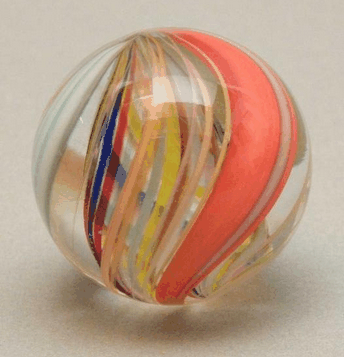
The marbles I remember were glass, with little swirls of color. I remember them as more beautiful than they surely were: clear bubbled glass enclosing small colored fragments, scattered starbursts, whirls and resplendent cosmic dust. But, as I was to learn later, we didn't have too many varieties. Most were a few variations on a simple pattern. There were also “milkies”, which were white marbles, more expensive and highly prized, but that cracked easily and broke hearts in doing so. Once, my father brought me some marbles from a trip to Australia. They were impossibly intricate, much more than the ones we had: a mixture of shiny surfaces, crystals, pockmarked little golf balls, and solid surfaces in multiple colors. I think this contributed to a complicated lifelong relationship with the West.
The marbles were sold in jars at the shop across the road, a small shack that had marbles, a few varieties of sticky sweets in jars and cheap cigarettes (sold individually, mostly to the boys a few years older). Like the sweets, the marbles lived in jars and I remember a disembodied hand plunging into the jar to pick out marbles for us; I guess I never paid attention to the person attached to that hand. The shopkeeper wouldn't allow us to choose which we got, and it was always exciting to examine them afterwards and see if any were special. When we had money we'd fill our pockets with them. They weighed you down, clinking in your pockets as you moved. The temptation to put your hand into your pocket and caress them was irresistible: smooth, cool spheres that shifted around your fingers and fell through them, that you could grab and release and rub through your hands and exult in. I'd pull them out in class to admire them (at great risk of confiscation): miniature artifacts from some alien civilization. I'd spend hours organizing them at home.
The game we played with them was simple. One marble, the target, was tossed onto the ground somewhere. The marbles of the players (generally two or three, or teams of two, but some games were bigger) were tossed far away and then the players took turns (starting with the furthest player) shooting their marbles towards the center marble, using only their middle fingers. The most common stroke was to pull your middle finger back with the other hand, holding the marble against it, and then releasing. The goal was to hit the target marble. If you did that you won, unless the opponent could hit your marble with theirs on the next turn. The winner got a marble from the loser: the target, if that belonged to the loser, or another marble, if the target was already the winner's. Along the way you could hit your opponent's marble on any shot, moving it away from the target. And, if playing with a partner, you could knock their marble towards the target with yours, allowing for complicated tactics. There was plenty of skill involved: by hitting a marble near the bottom you could move it away and leave yours in place; by hitting it near the top you could move yours far away, as you wanted to do when hitting the target.
I do not know where these rules came from, or how widespread they were. They could have been local to that particular playground, that particular climate of dust and heat, local like some New Guinean microculture that is lost a few miles away (the delight of wandering anthropologists and people who write books with the word “savage” in the title). Or they could have been the same across the country, and we could have been unknowingly participating in some grand project of nation building, perhaps laid down by Nehru. But I find it hard to conceive of another way of playing marbles, and accounts of other marble games seem bizarre unnatural transgressions. Along with the rules of the game existed a system of rituals and gestures: phrases to be said at various points; formal incantations when starting a game, deciding what sort of game it was to be, swapping out one marble for the other and so on. Again, I don't know where these arose, and they mixed languages and rhyme schemes freely.
I don't know if many children still play marbles in India. I can't imagine that they persist among those rich enough to afford more modern entertainments, the variegated and swiftly moving delights of electronic games, television and the Internet. But I do not mean to suggest that we were innocents, our minds dedicated to simple pleasures before the world fell into the arms of electronic deviance. Around the game of marbles grew a shadow economy, a microcosm of the world around that we would enter later. The winner got a marble from the loser each time, and it was quite usual for someone to lose everything (prefiguring an unhappy life and a later gambling habit, I imagine). The middle of my marble-playing days were when I experimented with capitalism and, indeed, when I peaked as a capitalist. I was quite a good player, though certainly not the best, and I knew who the best players were. A number of them lived the lives of dissolute artists, and were always inexplicably short of marbles. And so I, sober financier, bourgeois soul, would lend them marbles at the beginning of the day under the condition that they return twice the number at the end of the day. They got to keep the remainder of their winnings, of course. I don't remember many people defaulting; they must have been bound by some pre-modern code of honor and felt defined by their debts. I selected my debtors carefully, so some of the credit must go to my schoolboy self. I look back and wonder what would have happened if I had kept going. Perhaps I would today be a marble king, sitting on piles of glass and color, or perhaps I would have moved into grown-up capital and been a powerful businessman.
Like many other inhabitants of shadow economies, marbles were contraband. The Institution disapproved, though for shifting unstable reasons (an important lesson for us in the uses of power and the foundations of reason). Sometimes it was because we would get dust all over our white shorts, reddish-brown dessicated dust from the playground. Sometimes it was because it was “improper” or because we were supposed to be studying (though this wasn't used as a reason to forbid other playground activities, an ideological contradiction that stubbornly refused to lead to any sort of transcendence). Sometimes it was because of the slightly unsavory element, and of the effective gambling. Marbles were generally confiscated if found and we got good at hiding them. But, again, they weighed you down, clinking when you moved, and hiding them required stealth. And the temptation to take them out and caress them often betrayed even the most careful. There were also searches. Boys could be shaken down and their pockets emptied. More dramatically, a few times boys were hung upside down by the legs (we were small). The possession of marbles could get you kicked out of class or punished in various other ways (kneeling, standing, caning for more serious deviance).
As you would imagine, marble-players were a community and the social aspects of the game brought people together. It was a strange society, made up primarily of boys and the occasional girl (both insider and outsider, object of fascination and desire, but also subsumed in the role of marble-playing opponent; fertile ground for academic study, obviously), ranging in age from about 8 to 13, from a variety of class backgrounds and with varying degrees of academic prowess. Each person had their regular opponents, of course, but there were also many who wandered about the playground looking for games, and they were often singular individuals. I remember a tall dark stranger (no, really) who played exceedingly well and barely said a word. He was probably around 12 and so probably wasn't that tall in absolute terms, but he was much taller than me, and dark and strange. I remember the far-off expression in his eyes and his distance and reserve as he walked up to a game. I remember him now like a lone cowboy, walking up to a saloon. Such are the memories of childhood, I guess.
The memories I have of marble-playing are fragmented and impressionistic and all set against a backdrop of dust. The playground behind the school was huge, certainly large enough for soccer matches and sports days. It was a field of dusty dry mud, red mud that got kicked up and went everywhere, onto clothes and into backpacks and food, a haze that covers my memory. And against this I remember the sun, almost always hot, bright in the sky, and I, squinting through the glare, aiming at a far-off marble that shimmered slightly, while sweat trickled down my neck and the mud ground against my knee.
Who knows how many of these memories are true (in the unimaginative “correspondence to reality” sense of things)? The more I learn about memory, the more labile it seems: created in the remembering; less of a written document and more of a prehistoric oral tradition. The marbles I remember as little glass jewels were probably cheap baubles; the elaborate rules were probably the fancies of children; the swashbuckling strangers who roamed the playground were probably weedy boys. But, to misquote (and misremember) someone (Borges?), while reality has no obligation to be interesting, our memories do, and for that much I am grateful.