
| ABOUT US | ARCHIVES | LINKS | RSS FEED | MONDAYS | |

3quarksdaily

An Eclectic Digest of Science, Art and Literature

« The Architects of the War on Islam | Main | Requiem for Roscoe »

August 06, 2012

Footprints and Debt

by Kevin S. Baldwin

With the recent global economic troubles, bail-outs of various kinds, and hand-wringing about passing financial debt onto future generations, it seems like as good a time as any to think about other debts that may be at least as important. Don't get me wrong: I too am concerned about the long term implications of deficit spending by national, state, and local governments, but believe these may be overshadowed by what we are doing to the natural world.
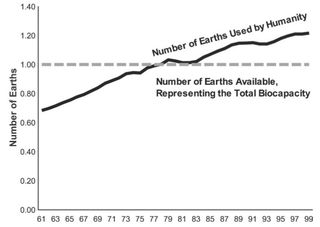
BiocapacityNearly 20 years ago, Mathis Wackernagel and his collaborators began formulating a measure of human impact on the earth's ecosystems. Eventually they arrived at an index called the "ecological footprint," which summarizes food and fiber production, animal feed, timber harvest, fishing, infrastructure, and fossil fuel consumption and expresses this in "global hectares." Thus a typical American would require nearly 10 global hectares in order to be supplied with all goods and services (Note how this compares to the global average of nearly 2.0 gha  ecological footprint).

Using the index of ecological footprint, Wackernagel et al. 2002 estimated that humans crossed the threshold of sustainability into unsustainability around 1980 (see figure).

More recent estimates place our consumption of the earth at 150% of its biological capacity. In other words, we have been in ecological overshoot for three decades. Imagine having a retirement account that yielded 5% per year, while you spent 7.5% of it annually.  Probably not a good idea if you have just retired and want to maintain a certain standard of living for two or three decades. Not so bad if you are clearly nearing the end of your life and can't take it with you; but truly a terrible idea if you are planning to bequeath an inheritance that would be the sole source of income for your descendants!

Many fiscal conservatives insist that deficit spending is immoral yet don't seem to mind that we are blowing through environmental capital/principal at an ever increasing rate. Conversely, many greens focus on the environment but tend to overlook deficit spending especially as it relates to issues of social justice and income redistribution. So we have this interesting situation in which groups that tend to be polar opposites are making the same arguments about debt in two different spheres. The result is that we will be leaving our children with the worst of both: high fiscal debt and degraded ecosystems. How then to reconcile these views?

The idea of a triple bottom line was first developed in the early 1990's by Elkington and promoted the three P's: Planet, People, and Profit or three E's: Ecology, Equity, Economy. Taking these three things into account for our decision-making process may help to bridge the chasm between the financial and natural worlds. Ecology and Economy have the same etymological roots after all! Until then, I will be more willing to discuss deficit spending with people when they acknowledge ecological overshoot.

References

 Elkington, J. 1997. Cannibals with Forks: the Triple Bottom Line of 21st Century Business. Capstone.

Wackernagel et al. 2002. Tracking the ecological overshoot of the human economy. PNAS. 99 (14) 9266-9271.

Posted by ksbaldwin at 12:30 AM | Permalink

Comments

Any smart 10 year old can tell you where this is going.
Economists, like madmen, think we can expand indefinitely in a finite world.

Boy are they going to be surprised!

Posted by: Dave Ranningdd | Aug 6, 2012 11:35:41 AM

Agreed. Cornucopians (e.g., Julian Simon) seem to believe that if we have a large enough population, someone will be born who will be clever and creative enough to triumph over the laws of thermodynamics.

Posted by: Kevin Baldwin | Aug 6, 2012 8:31:57 PM

Post a comment


Subscribe to this blog's feed  

PayAnywhere with iphone credit card swiper

Android Tablet

Bluetooth Headset

2013 New Style Dresses

Compare Car Rental Prices

DHgate.com Wholesale

3QD on Facebook

3QD on Kindle

3QD by Daily Email

Receive all blogposts at the same time every day.

Enter your Email:


Preview 3QD Email

3QD on Twitter

Miscellany

Lijit Search

AddThis Social Bookmark Button

Add to Google

Recent Comments

Sundar on Syria: Inventing a Religious War

Jim on Why Shouldn't I Work for the NSA?

Stuart Mathieson on Why Steven Pinker Is Wrong

j_93 on Syria: Inventing a Religious War

j_93 on Syria: Inventing a Religious War

Lusine on Rajesh Rao: A Rosetta Stone for the Indus script

Norman Costa on Why Steven Pinker Is Wrong

Lusine on Syria: Inventing a Religious War

Raza Husain on Syria: Inventing a Religious War

j_93 on Why Steven Pinker Is Wrong

martina_j on Syria: Inventing a Religious War

Raza Husain on Why Steven Pinker Is Wrong

Bill on Why Steven Pinker Is Wrong

roger gathmann on Why Steven Pinker Is Wrong

Doogle on Why Steven Pinker Is Wrong

Kyle on Syria: Inventing a Religious War

Peter John on Gezi Park

dthoko on The History of Typography - Animated Short

Richard on John Gray’s Godless Mysticism

Abbas Raza on Why Steven Pinker Is Wrong

nogodrod on Syria: Inventing a Religious War

Lusine on Quest for 'Genius Babies'?

Bill on Syria: Inventing a Religious War

j_93 on Gezi Park

j_93 on Syria: Inventing a Religious War

Acclaim For 3QD


"I couldn't tear myself away from 3 Quarks Daily, to the point of neglecting my work. Congratulations on this superb site."—Steven Pinker, Johnstone Professor of Psychology, Harvard University.

"I have placed 3 Quarks Daily at the head of my list of web bookmarks."—Richard Dawkins, Charles Simonyi Professor of the Public Understanding of Science at Oxford University.

"Just wanted you to know I’m one of many who reads and enjoys 3 Quarks....almost daily."—David Byrne, musician, former lead-singer of the Talking Heads, artist, intellectual.

Read more here.

The 3QD Prizes

Subscribe to this blog's feed