
As the Republican Party begins its national convention today in Florida, I offer this brief history of political conventions and examine their relevance to modern American politics.
The founders believed that in order for the republic to survive and be healthy, citizens must sublimate their selfish interests for the sake of the general welfare. In line with this, they imagined that the nation’s politicians would be citizen servants: men, who for a temporary period of time, sacrificed the profits and joys of their personal pursuits so that they might shoulder the responsibility of governing the nation, the states, and localities, offering their wisdom and insight for everyone’s benefit.
There was nothing of political parties in this vision. Neither the Articles of Confederation nor the U.S. Constitution made any mention of them. They are, in the strict sense of the term, extra-constitutional political organizations, and they are most decidedly not what the new nation’s architects had in mind when they fashioned this republic. Indeed, they did not even use the term “party” for the most part, instead referring to the political alliances that soon formed as “factions.” George Washington especially despised the new factionalism, even in its nascent form, and he refused to ally with any group. To this day, he is the only president listed on the roll of chief executives as Independent.
Perhaps it was näive of Washington and other purists to scoff at the emerging political gangs. Perhaps the constitution’s framers should have better anticipated this development and done something to temper it, to keep it from warping their beloved system of checks and balances. Regardless, the move towards modern parties was underway as the nation’s politicians began to lineup behind the philosophies and reputations of top leaders such as Thomas Jefferson, Alexander Hamilton, and John Adams.
During the early 19th century, Jefferson’s Democrat-Republicans began to eclipse the less popular Federalists, who were largely relegated to New England. Along the way, the Democrat-Republicans pioneered some modern ele
During the half-century following the Declaration of Independence, the new factions-cum-parties were still rudimentary things, not yet forming into full-fledged institutions. Though unchallenged, the Democrat-Republicans still lacked the organization, discipline, and resources to create a one-party state. They unraveled during the 1820s and then re-emerged under the tumultuous leadership of Andrew Jackson.
By the time Jackson first ran for president in 1824, there was no longer any Federalist party to speak of. Everyone, by default, was a Democrat-Republican. When none of the four presidential candidates got a majority of electoral votes, the election was thrown into the House of Representatives. The initial stalemate was broken when candidate Henry Clay implored his supporters to back John Quincy Adams. It was enough to get Adams over the top, and Jackson’s supporters decried it as the “corrupt bargain.”
Jackson ran again in 1828 against the incumbent Adams. This time, however, his campaign was more organized. To help out, he brought New York’s Martin Van Buren on board. The son of a Dutch tavern keeper in the upstate town of Kinderhook, Van Buren had risen to the zenith of New York politics by helping assemble the nation’s first statewide political machine, known as the Bucktails. Members were loyal first and foremost to each other, and used their power as a voting bloc to dominate the state legislature and indulge in the spoils system of political patronage and payoffs. Van Buren and the other leaders of the Bucktails were known as the Albany Regency.
By then a two-term U.S. Senator, Van Buren brought his relatively sophisticated party apparatus to Jackson’s 1828 campaign. Gimmicks included planting hickory trees and handing out hickory sticks at rallies, to remind people of their candidate, who was nicknamed “Old Hickory.” More substantial organizational techniques featured the hiring of a committee chair in each state who divided their state up into districts, and appointed leaders who rounded up volunteers to politick for Jackso
When Jackson had a falling out with his own vice president, John C. Calhoun of South Carolina, he tabbed Van Buren to replace him in the next election. Van Buren got the nod at the party’s first ever national convention, held in 1832 in Baltimore. Van Buren himself had been instrumental in organizing the first convention, and he would go on to win the presidency in 1836 after Jackson retired.
Jackson’s followers now dropped “republican” from their name and simply called their party the Democrats. Democrats would continue to hold conventions as the place where they nominated their political candidates. Rising from the ashes of the Federalists, the new opposition party known as the Whigs followed suit. They held their first convention in Harrisburg, Pennsylvania in 1839 and nominated General William Henry Harrison for the following year’s presidential election. Harrison would go on to defeat Van Buren in 1840.
By the 1850s, the Whigs were already on the on the road to extinction, unable to remain viable as the issues of slavery, nativism, and moral reform swept the nation. Those opposed to slavery, immigration, and America’s supposed moral decay formed the new Republican Party, which emerged on the national stage after holding its first convention in Jackson, Michigan in 1854.
As political parties became entrenched in the American political landscape, national conventions became de rigeur. Soon, state conventions followed as the parties stretched their tendrils ever further down to the local level. Aside from developing a political platform, the main purpose of these conventions was to select political candidates to represent the party in upcoming elections. And generally speaking, the process was highly undemocratic.
From the mid-19th to the mid-20th century, high level party operative dominated the selection of major political candidates in most elections. But since parties were private, extra-constitutional organizations, they were free to set their own rules about just how those candidates were nominated. And for the most part, that meant ignoring the voting electorate.
Large national and state conventions were usually dominated by political bosses who negotiated with each other to come up with a party slate. This process is now often romanticized by the image of hazy backrooms filled with cigar smoke and the stench of bourbon, where men with extensive facial hair rolled up their sleeves and wen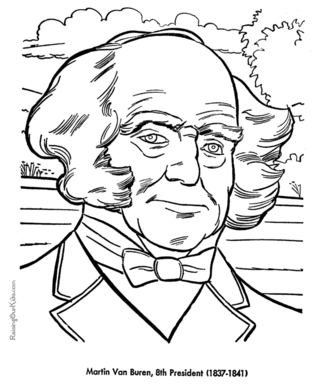
At the local level, it was even worse. Local leaders competed and negotiated to select nominees not only for important municipal and state offices like mayor and state legislator, but for also for every elected office, no matter how minor, including the proverbial dog-catcher. Party primaries for city elections were often held at late hours in unadvertized, hard to find locations. And since the list of favored party nominees was usually negotiated in advance behind closed doors by party leaders, what followed was often little more than a coronation of those decisions.
During the Progressive era (ca. 1890-1917), pro-democracy reformers in the United States began to call for changes. In 1910, Oregon became the first state to override parties. It required them to send delegates to their national conventions who supported the nominees chosen by Oregon voters. The modern presidential primary had been born. Eleven states followed Oregon’s lead within two years, though most of them offered voters only non-binding primaries. And by the mid-1960s, the number states employing presidential primary elections (most of them non-binding) was still just twelve. Thus, the conventions were still where everything got decided as party leaders from around the nation bargained and bullied to get their men nominated.
When television burst on the scene in the 1950s, gavel-to-gavel coverage of the Republican and Democratic national conventions every four years was the norm. And it was mandatory viewing for interested citizens. The cameras never went behind the closed doors where many of the decisions were actually made, but nevertheless, the decision unfolded live on TV.
The turning point came with the Democratic Party’s fiasco at their 1968 national convention in Chicago, which is best remembered for Chicago police beating the shit out of anti-Vietnam war protesters on live, national television, while the bloodied but defiant marchers repeatedly chanted “The whole world is watching!” But that convention was also import
In response to widespread party discontent over this development, compounded by Humphrey’s subsequent defeat to Republican Richard Nixon in the general election, the Democratic National Committee created the McGovern-Fraser Commission to assess the situation. It recommended that the party should have more (though not all) of its national delegates be selected by its registered electorate. The Republican National Committee soon made a similar recommendation. Not coincidentally, McGovern-Fraser Committee co-chair George McGovern, who was intimately familiar with the new rules, made the most of it to successfully win the Democratic presidential nomination in 1972. He too lost to Richard Nixon.
Television networks continued to cover the national conventions even though the candidates were now unofficially chosen long before the conventions took place. Consequently, the purpose of the conventions shifted. Instead of selection, the focus now shifted to revelation. Under the glare of television lights, conventions now became the place where the major parties unveiled their new political platforms and showcased their star politicians, including a crescendo featuring its candidates for the White House.
For most of the remainder of the 20th century, the quadrennial national party conventions continued to be must-see TV for the politically engaged. However, slowly but surely, the once mighty party conventions have lost their luster for most Americans. Here in 2012, the major television networks are according a scant three hours of live coverage to each party’s party. They’ve determined that they can garner better prime time advertising revenues by airing the usual fare of crime dramas and sitcoms, some of them repeats. Each convention only got three hours from the major networks in 2004 as well, though slightly more in 2008 amid the excitement surrounding Barack Obama.
Without any meaningful decisions to be made, the conventions have lost most of their pizzaz. And in the modern age of mass communications, they have become tightly scripted and highly predictable. Aiming to be engaging spectacles, they miss the target by a wide mark, as they’re typically short on surprises, long on dogma, and chock full of frozen smiles, stilted oration, and wooden stage presence. These are, after all, modern politicians, and most of them boast a level of charisma that pales in comparison even to the cast from reconstituted Hawaii Five-O; a repeat episode of that turgid drama is bumping the Republicans from CB
Since their inception, private political parties have done far more harm to American politics than good. Their nominating conventions, which dominated the political landscape for well over a century, in many ways epitomized their near monopoly on politics and the corruption that flowed from it. So to the extent that the conventions’ sinking popularity and growing irrelevancy represent a strike against the anti-democratic bulwark of political parties, let us celebrate. However, to the extent that it represents a general decline of citizens’ interest in the political life of the republic, let us mourn, and note that the parties themselves have much to anser for on this count.
—
Akim Reinahardt blogs regularly at The Public Professor.