From Nature:
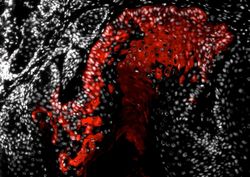 Cancer researchers can sequence tumour cells’ genomes, scan them for strange gene activity, profile their contents for telltale proteins and study their growth in laboratory dishes. What they have not been able to do is track errant cells doing what is more relevant to patients: forming tumours. Now three groups studying tumours in mice have done exactly that1–3. Their results support the ideas that a small subset of cells drives tumour growth and that curing cancer may require those cells to be eliminated. It is too soon to know whether these results — obtained for tumours of the brain, the gut and the skin — will apply to other cancers, says Luis Parada at the University of Texas Southwestern Medical Center in Dallas, who led the brain study2. But if they do, he says, “there is going to be a paradigm shift in the way that chemotherapy efficacy is evaluated and how therapeutics are developed”. Instead of testing whether a therapy shrinks a tumour, for instance, researchers would assess whether it kills the right sorts of cell. Underlying this scenario is the compelling but controversial hypothesis that many tumours are fuelled by ‘cancer stem cells’ that produce the other types of cancer cell, just as ordinary stem cells produce normal tissues. Previous studies have tested this idea by sorting cells from a cancer biopsy into subsets on the basis of factors such as cell-surface markers, and injecting them into laboratory mice. In principle, those cells that generate new tumours are the cancer stem cells. But sceptics point out that transplantation removes cells from their natural environment and may change their behaviour. “You can see what a cell can do, but not what cells actually do,” says Cédric Blanpain of the Free University of Brussels, who co-led the skin study1.
All three research groups tried to address this knowledge gap by using genetic techniques to track cells. Parada and his co-workers began by testing whether a genetic marker that labels healthy adult neural stem cells but not their more specialized descendents might also label cancer stem cells in glioblastoma, a type of brain cancer. When they did so, they found that all tumours contained at least a few labelled cells — presumably stem cells. Tumours also contained many unlabelled cells2. The unlabelled cells could be killed with standard chemotherapy, but the tumours quickly returned. Further experiments showed that the unlabelled cells originated from labelled predecessors. When chemotherapy was paired with a genetic trick to suppress the labelled cells, Parada says, the tumours shrank back into “residual vestiges” that did not resemble glioblastoma.
More here.
