
| ABOUT US | ARCHIVES | LINKS | RSS FEED | MONDAYS | |

3quarksdaily

An Eclectic Digest of Science, Art and Literature

« Race, IQ, and Wealth: What the Facts Tell Us About a Taboo Subject | Main | Why Do We Hate Seeing Photos Of Ourselves? »

July 28, 2012

Where Does Nature's Wisdom Lie?

IMG_2378R. Ford Denison in Berfrois:

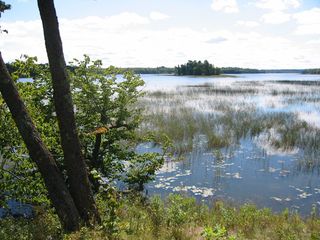
Consider wild rice, shown above growing near the headwaters of the Mississippi River. Natural selection has been improving this species, by evolution’s criteria, for millions of years. Better-adapted plants (those best at extracting nutrients from flooded soils, defending themselves against pests and pathogens, and producing seeds in warm and cold years, in deep or shallow water), had more surviving offspring. Their descendants inherited those adaptations. So plant breeders developing new rice varieties (especially for farmers who can’t afford fertilizer or control water depths) might learn something useful from research on how wild rice faces similar challenges.

What about nature’s “lies”? Notice that wild rice grows naturally almost as a monoculture, not mixed with other plant species. Tropical forests, on the other hand, have much greater species diversity. Can we conclude that aquatic plants, like rice or taro, should be grown as monocultures, while tree crops should be grown as diverse mixtures of species? Or maybe cold climate crops should be grown as monocultures (many northern forests aren’t very diverse either), while tropical crops should be grown as mixtures.

These hypotheses implicitly assume that natural selection, or other natural processes, have improved the overall organization of natural plant communities, not just the individual species that live there. Most evolutionary biologists, however, tell us that natural selection is much better at improving trees than forests. This is especially true when the interests of individuals conflict with those of the community as a whole. A more diverse forest might be less susceptible to disease outbreaks, but that won’t stop individual redwood trees from growing taller and shading out competitors of other species. Similarly, the low diversity of wild rice stands doesn’t prove that more diverse plant communities wouldn’t be more productive, more efficient in the use of scarce resources, or more sustainable over decades.

Posted by Robin Varghese at 08:41 PM | Permalink

Comments

Post a comment


Subscribe to this blog's feed  

PayAnywhere with iphone credit card swiper

Android Tablet

Bluetooth Headset

2013 New Style Dresses

Compare Car Rental Prices

DHgate.com Wholesale

3QD on Facebook

3QD on Kindle

3QD by Daily Email

Receive all blogposts at the same time every day.

Enter your Email:


Preview 3QD Email

3QD on Twitter

Miscellany

Lijit Search

AddThis Social Bookmark Button

Add to Google

Recent Comments

seth edenbaum on Habermas, Adorno, Politics

Raza Husain on If Only We Had A Leader Like Chavez, Who Solved Real Problems -- Instead Of Debating Fake Ones Like The Deficit

Raza Husain on Think About Nature

Raza Husain on Getting Smarter

johnnyred on Getting Smarter

Lou on Throwing away ancient wisdom, painting with sound and staying awake: a conversation with radio dramatist and ZBS Foundation president Thomas Lopez

Sundar on If Only We Had A Leader Like Chavez, Who Solved Real Problems -- Instead Of Debating Fake Ones Like The Deficit

flowers rainbows on Lift up your voices: The century-long battle for women's freedom

mr.ed on wagner in new york?

mirel on Here’s how to change the world

mirel on If Only We Had A Leader Like Chavez, Who Solved Real Problems -- Instead Of Debating Fake Ones Like The Deficit

X on Getting Smarter

Ross Williams on Getting Smarter

oroboe on Lennon's "Imagine" and McCartney/Wings' "Band on the Run" overlaid: One way of reuniting (some of) the Beatles

Richard H. Randall on Obama must Make Fighting Climate Change National Project, or Die the death of a thousand Scandals

seth edenbaum on The First New Atheist? Kierkegaard

waqnis on Mortify Our Wolves

nogodrod on KFC smugglers bring buckets of chicken through Gaza tunnels

waqnis on Here’s how to change the world

Fernando on Mortify Our Wolves

seth edenbaum on The case against empathy

Dredd on Mortify Our Wolves

Max on Here’s how to change the world

Rohana on Mortify Our Wolves

Raza Husain on If Only We Had A Leader Like Chavez, Who Solved Real Problems -- Instead Of Debating Fake Ones Like The Deficit

Acclaim For 3QD


"I couldn't tear myself away from 3 Quarks Daily, to the point of neglecting my work. Congratulations on this superb site."—Steven Pinker, Johnstone Professor of Psychology, Harvard University.

"I have placed 3 Quarks Daily at the head of my list of web bookmarks."—Richard Dawkins, Charles Simonyi Professor of the Public Understanding of Science at Oxford University.

"Just wanted you to know I’m one of many who reads and enjoys 3 Quarks....almost daily."—David Byrne, musician, former lead-singer of the Talking Heads, artist, intellectual.

Read more here.

The 3QD Prizes

Subscribe to this blog's feed