
July 16, 2012
Poetry in Translation: A Couplet of Ghalib
by S. Abbas Raza
This post is dedicated to my wife, Margit Oberrauch.
A couple of weeks ago I came upon a Ghalib couplet in Urdu which evoked pangs of recognition in me. Ghalib captures so simply and so well a discomfort that I like to imagine nearly everyone has experienced: that of having to ask a favor from an enemy, a rival, a cruel person, a nemesis, or even the object of one's unrequited love. Reading (or hearing) it one immediately and viscerally and empathetically feels the immensity of Ghalib's effort in overcoming embarrassment and shame, having recognized the necessity of doing it, and this is complicated by other layers of agonizing sentiment generated by the imminent exposure of vulnerability, having to act obsequious, as well as the risk of further public insult if the person refuses to grant the favor. Having to ask for help is bad enough when the person being asked is not someone you hate (or hates you). (It reminded me a bit of Nabokov's Pnin.)
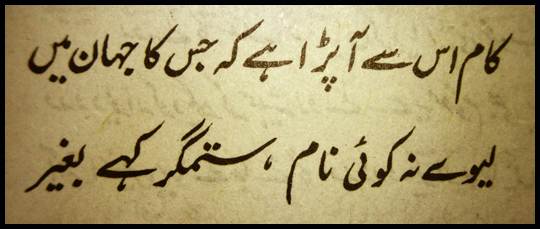
It is truly masterful, a fragile gem of a couplet in Urdu, in the sense that not only can it not be improved, changing a single word anywhere destroys it. (Yes, I had the temerity to try.) But when I tried to explain the meaning of the couplet to my wife I found it near-impossible to translate into English in any straightforward way. I hemmed and hawed and went into a ten-minute lecture on what it is about but never managed to say in two decent lines of English what Ghalib has said so easily in Urdu.
Here is my transliteration into Roman Urdu:
Kaam uss say aa paraa hai keh jiss ka jahaan mein
Layvay nah koee naam sitamgar kahay baghair
And finally, here is the best I could do as an English translation, using three lines:
I am obliged to seek help from him
to whom no one in the world refers
without also referring to his cruelty
I invite you, if you speak Urdu, to suggest your own translation.
Posted by S. Abbas Raza at 12:25 AM | Permalink


Comments
A quick translation could be:
I am to seek succor from one whom in this world
No one refers to without also adducing unkind
Posted by: aquila ismail | Jul 16, 2012 9:35:32 AM
"Ghalib captures so simply and so well a discomfort that I like to imagine nearly everyone has experienced: that of having to ask a favor from an enemy, a rival, a cruel person, a nemesis, or even the object of one's unrequited love."
I wanted to ask a question about this sentence. If that was really Ghalib's intention in this poem why would he write the words "no on in the world", as if this is a person/being which is universally acknowledged? If he were referring to asking advice from someone who is acknowledged by others as being cruel, then instead of "no one in the world" it could be "no one in the town/country/village" etc. and convey that meaning.
By using "no one in the world" it seems to me like Ghalib is referring to God and how people speak of God as being cruel at times, even though you also ask God for help. I'm not a religious person at all but that seems to be more in line with the meaning of the poem, as you have translated it.
Posted by: philosophking | Jul 16, 2012 9:47:20 AM
philosophking, you bring up a very interesting interpretation. Ghalib indeed does say "in the entire world, no one" but I suspect this is just a case of hyperbole for effect. It is not in the tradition of Urdu poetry to refer to God as "cruel" and it is not as if no one in the world ever refers to God without calling Him cruel, either. But nice try! :-)
Posted by: Abbas Raza | Jul 16, 2012 9:53:28 AM
A shot in the dark, since I know no Urdu: two lines based on your English....
I'm oath-bound to ask him for help, whom no one
in the world mentions without mentioning his cruelty.
Posted by: Joseph Hutchison | Jul 16, 2012 10:32:18 AM
Thanks Abbas. I understand now. A friend of mine also likes to translate Ghalib so I am familiar with his style, so I can see how hyperbole would be appropriate for him here.
Posted by: philosophking | Jul 16, 2012 10:43:31 AM
Aquila, your second line does not seem to be defensible English.
Joseph, I like it.
Posted by: Abbas Raza | Jul 16, 2012 10:52:35 AM
'oath- bound' is not being true to the couplet[it is interpretation]. mention/mentioning in the same sentence is sort of lazy!
Also why 'him'? I think it should be left gender -neutral
Another attempt at the translation:
I am to seek succor from one whom in this world
No one refers to without also using the word 'unkind'
Posted by: aquila ismail | Jul 16, 2012 11:20:33 AM
Find myself asking a favor of one
A brute he is they all say
Whenever they hear his name
Not the greatest, and can't seem to get it down to two lines, but maybe helps in getting across the meaning of the original.....
Posted by: Shahzad | Jul 16, 2012 11:29:47 AM
In trying to translate Ghalib one must keep in mind the state of his mind during the mid 1800 s .Fall of Delhi (end of Muslim Raj..,death of his kids at or a few days after birth,loss of pension by the new Master "The East India Company "totally broke and unable to get his beloved wine ..Ghalib s mind raced like a steed while his environment closed in on him...I Feel the use of the word "sitamgar " guides the whole share towards a new direction --sitamgar refers to one who "withholds ,would tantalize ,not give in yet would lead on..a tease "
Translation:
"damm it ,here I stand infront of this "Entity ,Person ,British Raj Officer or Dancing girl".....who already has a reputation for being a tyrant...some luck I am going to have here .....this is my personal attempt at Ghalib ...my flash light pointing to the Sun. :)
Posted by: Yousaf | Jul 16, 2012 12:01:39 PM
Few things arouse the passions as disagreements over translation in my experience (many a famous literary fight has occurred over them.) I expect this thread to get exciting! :-)
Posted by: Abbas Raza | Jul 16, 2012 12:03:54 PM
Good point about the British, Yousaf. That may well have been what Ghalib had in mind!
Posted by: Abbas Raza | Jul 16, 2012 12:09:29 PM
Abbas, more than anyone else should know, since he is fluent in the language of d'Anunnzio, of the old adage:
traduttore, traditore
Nice posting, but it's most unlikely that I'll learn Urdu to enjoy this poem even more.
Posted by: Félix E. F. Larocca, MD | Jul 16, 2012 12:34:13 PM
Also, in the tradition of ghazals, the sky [asmaan] is called cruel/unkind or 'berehem' as in 'berehem asmaan', and is a metaphor for god and fate/destiny et al. Sitamgar is generally used as the wounds and emotions inflicted by a lover. Ghalib with his very modern, urbane verses is more concerned with lambasting the earthly [hence the raj, the court, etc] rather than the godly.So maybe we should not read spirituality into the couplet. I would rather think of him writing about a woman. Much more exciting!
I am translating Hali's Yaadgar-e-Ghalib into English but am unable to translate the Persian verses. Can anyone help.
Posted by: aquila ismail | Jul 16, 2012 12:39:35 PM
"Also why 'him'? I think it should be left gender -neutral."
Aquila, I understand your point. I was using the male pronoun "him" in the same gender-neutral way that Ghalib would have done so. So one can imagine Ghalib saying about a male or female (even a lover) "Kaash wo aisa sitamgar na hota", for example, but it is impossible to imagine him saying, "Kaash wo sitamgar na hoti".
Perhaps I should have explained that in the post itself. Thanks for pointing it out. :-)
I know no Farsi, so can't help you there. But I'll put you in touch with someone who can by email later.
Posted by: Abbas Raza | Jul 16, 2012 12:56:44 PM
I have no option but to ask favour from a person who is notorious for his cruelty.
Posted by: shabbir hussain | Jul 16, 2012 1:19:23 PM
I like it, Shabbir. But maybe too prosaic? Could one break it into lines to give it an explicit rhythm, maybe? Just sayin'...
Posted by: Abbas Raza | Jul 16, 2012 1:24:50 PM
Brilliant Abbas, I second your effort.
Posted by: ali | Jul 16, 2012 1:49:57 PM
Thanks, Ali! You, of course, have easy access to the master of Ghalib explication, SYK himself... Ask him to weigh in on this next time you see him. And say Hi to Jr. :-)
Posted by: Abbas Raza | Jul 16, 2012 1:54:56 PM
Abbas, in making the 'gender-neutral' comment I was alluding to the couplet in question. If you put in him/her you have interpreted the couplet and given it a specific meaning.Ghalib's genius in keeping things general and yet making it so specific is violated.
The only times one is allowed [!] to interpret a word/verse is when the translated version is problematic in the translated language [ case in point: tere badan ki haldi ( exquisite imagery in Urdu) if translated as the turmeric of your body in English is comical. So here one interprets that the effect of the haldi is to impart a golden hue to the skin and hence the phrase 'the golden hue of your body' which maintains the imagery.
Thanks for this fab thread.
Posted by: aquila ismail | Jul 16, 2012 2:13:03 PM
This is wonderful. I wish I could participate, but its lovely to watch.
Posted by: Mara | Jul 16, 2012 2:52:02 PM
Many versions are better than one - since the possible interpretations are so many.
Is there any indication of the gender of the cruel person? It strikes me (in most of these English versions) that it might be a love poem.
"Everyone says you're a cruel bitch, but hey, give me some?" might be one dimension of it.
Posted by: Mike Cope | Jul 16, 2012 3:26:11 PM
The word Sitamgar and variations of the word as you know seems to be deployed by Ghalib to mean the beloved. In the language and culture that Ghalib was part of Sitam was a state of being totally irrational and infatuated or in the throes of love. Sitamgar was the one who inflicted this affliction. This state of devastation! In fact in the vocabulary for expressing love, in Urdu the beloved is the one that wreaks havoc, agony and cruelty on the lover. The lover who desires without requital so is in agony. Also, Ghalib constantly plays with concepts and plays on words--juxtapositioning them such that they mean something completely different....
So here I think he does this:-- He seems to indicated here that those who takes God’s name all the time are often the cruelest obliterating all else. And those who pray are those who are so steeped in irrational love for their God that they refer to God as the beloved and therefore surely they are in this agony in this state of love which is unrequited. And at the same time he throws a punch at the concept of God: is there any entity crueler than the concept of God? And he suggests that there is no way to discuss God without first professing that one loves God—and therefore if God is really one’s love than God is the Sitamgar.
Here he comments on his entire works---that he is in conversation with this whole concept of what is love and what is God. And the hypocrisy and cruelty that goes on in the name of God
He says that the cruelest take God’s name the most often—in fact they can’t say any other name before saying God.
He pokes fun at the fact that no one can discuss or question God except in this realm of the Beloved.
And he pokes fun at the concept of God. If he is indeed the beloved than he must be cruel.
He pokes fun at those who profess religion.
He pokes fun at their reason for devotion.
And so my two offers of translation for the moment are thus:
A task to me has befallen with one, in the world
Takes, whose name no one, without a cry: giver of pain.
Or,
To me has fallen to task with the one, whom in the world
No other name, a giver of pain, takes, But his name.
I think I am partial to my second version.
Posted by: Maniza | Jul 16, 2012 4:55:34 PM
How great to see a thread going about issues of Urdu translation!
I'm surprised no one has brought up Frances Pritchett's Ghalib site, which for me is the first place I go to get the information on vocabulary, grammatical points, and varying scholarly interpretations of any Ghalib couplet: http://www.columbia.edu/itc/mealac/pritchett/00ghalib/059/59_03.html?urdu
From this, it seems as though with the inherent ambiguity of meaning of the word "kam" (i.e. work, help, desire) the verse could be talking about either a rival or a cruel beloved (or as in often the case with Ghalib, both at once). I like the above comment suggesting a connection to the colonial administration. However, that would complicate the interpretation of the object of this verse as the beloved figure - which would seem to be suggested by "kam" and "sitamgar" - and I'm not sure that Ghalib would associate the Raj with the sweet cruelties of the beloved so much as just straight-up cruel.
If I had to take a crack at it, I would do so as follows:
I have to go to him - that one
whose name, in this world,
no one says without calling him cruel.
I think the English "to go to someone" can connote either romance or simple obligation. If you read the couplet as a lover-beloved dynamic, which I'm inclined to do, it's more like the speaker just has to be involved with the beguiling beloved, even though s/he is commonly known to be cruel and to toy with the speaker's feelings, which is par for the course of the Urdu ghazal universe. Let me know what you all think!
Posted by: Francesca | Jul 16, 2012 5:20:02 PM
Mike Cope, spot on. However, replacing 'but hey, give me some' with 'but hey, help me out here will ya," might hew closer to the couplet. Love your post-'romantic' version.
Posted by: aquila ismail | Jul 16, 2012 5:32:57 PM
For the two interpretations, Lover and God:
I cannot help being in love
O' Cruelty, thy name is Woman
I need from Him, the One
Whom the world calls a Tyrant
Posted by: Raza | Jul 16, 2012 7:29:22 PM
How low can I get
to ask favor from one
who neither care nor fear
teases me at his will
which is hard to bear
well known for his cruelty
to all and sundry.
Posted by: shabbir hussain | Jul 16, 2012 8:32:28 PM
"
It has fallen on me to call on
the one who all the world
always calls a Tyrant.
"
I've tried to keep it close to the original, keep it gender-neutral, and use english idioms that are roughly equivalent.
Posted by: VirtualMachine | Jul 16, 2012 9:14:32 PM
He's a real piece of work, but I gotta ask him a favor anyway.
Posted by: Sagredo | Jul 16, 2012 9:54:05 PM
My humble attempt:
Today, we are in need of support from those
Whose name itself's synonymous with our woes
The "our" in the second line isn't right, but I can get nothing else to scan quite right.
Posted by: Shanth | Jul 16, 2012 10:47:45 PM
I must turn to someone who the World
Cannot call by any other name but Tyrant
Posted by: Raza | Jul 16, 2012 10:51:43 PM
When the poet's stance is effectively "it's hard to get my mind around this piece of information I'm about to impart", it sometimes works to turn a statement into a question, as in
"Am I to seek help from him whom no one names
Without also naming his cruelty?"
Posted by: Zara | Jul 16, 2012 11:46:02 PM
Interesting commentary. I'll put in my two cents.
Time has come for me to ask a favor of,
The One whose name is not uttered without adding the word cruel
Posted by: Ashad | Jul 17, 2012 12:05:15 AM
What a beautiful word "sitamgar" is. This is not a literal translation but my understanding of the essence of the couplet:
What I had needed / was from the one the world had labelled cruel.
I think present day translations should make use of the simple rather than using archaic words from English. I find it useful to provide readers with something that complements their everyday experience of the world. Simple does not have to mean that the value of the poetic line becomes minimised. Of course I am a believer of the contemporary...
Posted by: zrk | Jul 17, 2012 4:31:55 AM
I like Maniza's reading of the couplet and her translation #2 is definitely my favourite.
Posted by: zrk | Jul 17, 2012 4:47:52 AM
I totally agree with zrk. Translations should not use archaic, old world terms but more 'in-use' idioms/metaphors/terms etc.
Also there is a tendency in many to over-interpret a verse/text to the extent that the melody of the verse is lost.
Posted by: aquila ismail | Jul 17, 2012 7:38:27 AM
Two words then in this stanza are drivers: Sitamgar and Kam.
Indeed Sitamgar is a beautiful word...Hai Sitam hai ghazab--hai kyamet--all these are used often to express sheer pleasure--and admiration as we know and therefore to mean the opposite of the literal translations: ah cruelty, ah travesty, oh catastrophy!
Kam though literally work can mean as in humara kya kam idhar--what need is there here for us--or we have no meaning here. This is not our place. This is not for us, We have no say here: need, meaning, place, belonging, association, input, contribution, say. Or, Humey aap sey kuch Kam hey--could mean I have soemthing to say to you--
Posted by: Maniza | Jul 17, 2012 10:34:39 AM
@Abbas. From my dad:
This is very interesting specially the comments and discussion on certain aspects of Ghalib's couplet. Abbas's interpretation of Ghalib's couplet in prose is good.
However, there are difficulties in translating the couplet in English mainly because the idiomatic expression kam aa parta hai is not translatable. Ralph Russell has translated the couplet as follows:
I have to do with her of whom no man in all the world
Have ever spoken yet without calling her 'cruel' one
The phrase, 'I have to do' does not catch the element of unexpectedness in the phrase 'kam aa para hai'.
There is lot of discussion under the comments on the use of the words 'jahan' (all the world) and 'sitamgar' (cruel). But these words are commonly used in Ghazals; for example the following Ghalib's couplets:
'Yun hein gar rota raha Ghalib to aye ahl-e hahan
Dekhna in bastiyoun ko tum kay weran ho gayain'
and
Tu dost kisi ka bhi sitamgar na houa thah
Auroun pa hai woh zulm jo mujh par ne huoa thah
Posted by: Maniza | Jul 17, 2012 2:30:11 PM
Maniza, your father has nailed the difficulty here with lapidary precision. Bravo.
Posted by: Abbas Raza | Jul 17, 2012 3:48:40 PM
lapidary...had to look it up. Like it.
Posted by: Maniza | Jul 17, 2012 4:23:45 PM
...however, I don't agree with Abu that something is not translatable.
And I do think Kam a parta hai is translatable.....
Posted by: Maniza | Jul 17, 2012 4:28:10 PM
Kam aa parta hai = "[sometimes] the need arises?"
Not a fluent Urdu speaker; so my attempt may be more dromedary than lapidary.
Posted by: Ruchira | Jul 17, 2012 7:51:14 PM
Poetry is not about writing "lines." There is a milieu, an ethos and poetry captures all that, (mostly) implicitly. Hence the economy of poetry. If you want to translate these two lines you would need to translate the relevant milieu and ethos.
Even in the sub-expression "Kaam aa parta hai" one can see the part played by the implicit ethos. It is a polite way of asking for a favor in a society, a "Lakhnavi" society of that time. And it is the "politeness" that makes translations difficult because a literal translation would get that wrong. That is perhaps what was meant by "Abu" when he said it was untranslatable. You would somehow need to "know" Lakhnavi manners. (I put know in quotes because if language is not learnt but is "innate" then ...
Posted by: shamim naqvi | Jul 17, 2012 8:26:06 PM
Find myself having to ask a favor of one
Whom they call a sadist when they hear thy name
Posted by: Shahzad | Jul 17, 2012 9:39:40 PM
It is my misfortune
That I must seek the kindness
Of a despised tyrant.
Posted by: Ruchira | Jul 17, 2012 9:57:07 PM
Ghalib Lakhnavi? In what sense? he was from Agra and lived in Delhi.
Posted by: Maniza | Jul 17, 2012 11:37:43 PM
Or
It is my misfortune
That I am compelled to seek the kindness
Of a well known tyrant.
Posted by: Ruchira | Jul 17, 2012 11:41:14 PM
Frances Pritchett, with her usual brilliance, has highlighted kaam as both 'work' and 'Eros' (Kama Deva- is the Hindu Love God). The Hindu God, Shiva, is known as the destroyer of Kaama Deva. Another name for Kaama is 'Smara' which means both memory and Love- the Punjabi name Simran is derived from Smara.
Within Islam as well, Death itself can be seen as the sweet cruelty which parts one from delights but only as a prelude to the Joy of Paradise.
At the same time, Ghalib is making a very acute political observation. The British 'sitamgar' was also the one the Mughals had to apply to either just to survive or to at least gain an honorable death.
But is this what Ghalib was getting at?
From a Malamati Sufi point of view it may be that since only God can grant Death, even infidels are obliged to call upon Him though, in their ignorance they call him 'sitamgar'.In this way, even against their own will, they are saved.
How can anyone translate this couplet which has so many meanings? Prof. Pritchett says its impossible. Still, even making the attempt and failing abjectly is more rewarding than any other type of literary exercise.
The Work demands I now depend on the caprice of One
The World deems Cruel, till their Work be done.
Posted by: windwheel | Jul 19, 2012 2:51:00 PM
I was using Luckhnavi in a stylistic sense, not geographic.
Posted by: shamim naqvi | Jul 19, 2012 9:07:56 PM
woe to me that I am befallen to seek favor ....from someone who is known but as a villainous brute.
Posted by: mazhur | Jul 20, 2012 3:07:11 PM
Without naming him cruel...........and in the 1st misra obliged be changed into Compelled....However it is almost impossible to translate Ghalib in any other language...Every language has its own cultural and historical back ground...Dr Huma
Posted by: Dr Humayun Huma | Jul 21, 2012 8:54:59 AM
Ha Ha ! Very interesting, please learn urdu,then persian . The serendipity and subtleties in these languages are immense. Their are limits in translations.
" Yaa rab na woo samjhe hey na samjhe gey mere baat ---
Posted by: Nasreen R | Jul 21, 2012 3:35:13 PM
Post a comment