
July 01, 2012
Physics heavies, including Peter Higgs, invited to CERN press conference on Wednesday, leading to widespread excitement that the Higgs Boson has been definitively discovered
Rob Cooper in the Daily Mail:
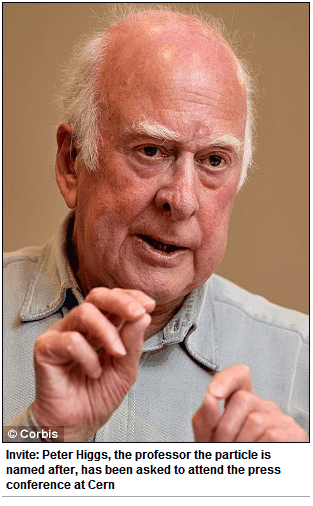
Peter Higgs, the Edinburgh University emeritus professor of physics that the particle is named after, is among those who have been called to the press conference in Switzerland.
The management at Cern want the two teams of scientists to reach the 'five sigma' level of certainty with their results - so they are 99.99995 per cent sure - such is the significance of the results.
Tom Kibble, 79, the emeritus professor of physics at Imperial College London, has also been invited but is unable to attend.
He told the Sunday Times: 'My guess is that is must be a pretty positive result for them to be asking us out there.'
The Higgs boson is regarded as the key to understanding the universe. Physicists say its job is to give the particles that make up atoms their mass.
Without this mass, these particles would zip though the cosmos at the speed of light, unable to bind together to form the atoms that make up everything in the universe, from planets to people.
The collider, housed in an 18-mile tunnel buried deep underground near the French-Swiss border, smashes beams of protons – sub-atomic particles – together at close to the speed of light, recreating the conditions that existed a fraction of a second after the Big Bang.
If the physicists’ theory is correct, a few Higgs bosons should be created in every trillion collisions, before rapidly decaying.
More here. More about the Higgs here, here, and here.
Posted by S. Abbas Raza at 11:55 PM | Permalink


Comments
Here is the most intelligent comment on the Huffington Post propaganda article on this subject:
"HUFFPOST SUPER USER
Mark Mark
.
40 Fans
.
17 minutes ago ( 4:30 PM)
Of course they'll find it. They said it exists, they spent all this money, if they don't find it, they'll make it up.
As Gracie Allen said, when she ran for president in 1940. "Come November I'll be in the White House, if I have to paint the one I'm in now." "
Posted by: WJAbbe | Jul 2, 2012 4:55:50 PM
WJAbbe's quoted comment has a point which is the difference between a discovery and an invention.
A discovery is something you come across and an invention is something you build. With an experiment designed and the resources spent to find just one thing and finding only 300 Higgs particles in 1600 trillion collisions, is it any surprise that we found what we were looking for? With that many collisions how do we know that many more other particles were not created that we did not "discover" because the experiment was not designed for it?
If the experiment just created the exotic environment and they came across Higgs then one can say it is a discovery, but if the experiment is looking for a Higgs as well (which is what it is about, isn't it?) then it is a biased experiment and one can argue the experiment could have created it and the headlines could be God Particle Invented. I am not saying anyone is making it up, just raising a question of epistemology or displaying my lack of knowledge about the LHC experiment.
Posted by: Raza | Jul 2, 2012 6:03:55 PM
Raza. I don't think you need to be so concerned. I would think almost all experiments are designed to find, or rule out, precisely the very thing your theory says you should be looking for. Experiments verifying Einstein's theories of relativity come to mind: Atomic clocks on the ground falling out of sync with clocks at altitude, the precession of Mercury, gravitational lensing around the sun, etc. All were design to be able to falsify the predictions of the theory, but things happened just as predicted.
At these prices, happy accidents are probably not the preferred way of doing science.
But the many terabytes of tata recorded by these experiments can certainly be plumbed to find evidence supporting other theories.
Ecce Higgs? We shall see.
Posted by: Carlos | Jul 3, 2012 8:54:37 AM
Post a comment