
| ABOUT US | ARCHIVES | LINKS | RSS FEED | MONDAYS | |

3quarksdaily

An Eclectic Digest of Science, Art and Literature

« Wednesday Poem | Main | More Splintered Than Common Sense »

July 04, 2012

Myths of the American Revolution

John Ferling in Smithsonian:
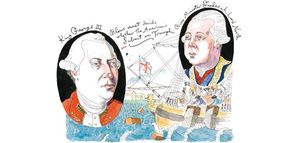
MythWe think we know the Revolutionary War. After all, the American Revolution and the war that accompanied it not only determined the nation we would become but also continue to define who we are. The Declaration of Independence, the Midnight Ride, Valley Forge—the whole glorious chronicle of the colonists’ rebellion against tyranny is in the American DNA. Often it is the Revolution that is a child’s first encounter with history. Yet much of what we know is not entirely true. Perhaps more than any defining moment in American history, the War of Independence is swathed in beliefs not borne out by the facts. Here, in order to form a more perfect understanding, the most significant myths of the Revolutionary War are reassessed.

I. Great Britain Did Not Know What It Was Getting Into

In the course of England’s long and unsuccessful attempt to crush the American Revolution, the myth arose that its government, under Prime Minister Frederick, Lord North, had acted in haste. Accusations circulating at the time—later to become conventional wisdom—held that the nation’s political leaders had failed to comprehend the gravity of the challenge. Actually, the British cabinet, made up of nearly a score of ministers, first considered resorting to military might as early as January 1774, when word of the Boston Tea Party reached London. (Recall that on December 16, 1773, protesters had boarded British vessels in Boston Harbor and destroyed cargoes of tea, rather than pay a tax imposed by Parliament.) Contrary to popular belief both then and now, Lord North’s government did not respond impulsively to the news. Throughout early 1774, the prime minister and his cabinet engaged in lengthy debate on whether coercive actions would lead to war. A second question was considered as well: Could Britain win such a war?

More here.

Posted by Azra Raza at 07:43 AM | Permalink

Comments

Nice post, which to say the least is gentle.

Posted by: Dredd | Jul 4, 2012 6:53:56 PM

Post a comment


Subscribe to this blog's feed  

PayAnywhere with iphone credit card swiper

Android Tablet

Bluetooth Headset

2013 New Style Dresses

Compare Car Rental Prices

DHgate.com Wholesale

3QD on Facebook

3QD on Kindle

3QD by Daily Email

Receive all blogposts at the same time every day.

Enter your Email:


Preview 3QD Email

3QD on Twitter

Miscellany

Lijit Search

AddThis Social Bookmark Button

Add to Google

Recent Comments

Jonathan on Daniel Dennett's seven tools for thinking

Bill on Daniel Dennett's seven tools for thinking

Check here on The Nominees for the 2010 3QD Prize in Science Are:

Louise Gordon on The need for critical science journalism

omar on Mohsin Hamid: 'Islam is not a monolith'

Jonathan on Daniel Dennett's seven tools for thinking

Bill on Daniel Dennett's seven tools for thinking

jo smith on Mohsin Hamid: 'Islam is not a monolith'

carlos on Daniel Dennett's seven tools for thinking

freddie on Daniel Dennett's seven tools for thinking

Eli on "Everybody Hurts" by Sachal Studios, Lahore, Pakistan

Jalees Rehman on The need for critical science journalism

Dredd on Why Rational People Buy Into Conspiracy Theories

Dredd on Why Rational People Buy Into Conspiracy Theories

Scrutineer on Why race as a biological construct matters

prasad on the culture animal

Mitt Romney's Dog on Why race as a biological construct matters

Elatia Harris on The Moral Status of Rocks

prasad on The Moral Status of Rocks

Raza Husain on The Moral Status of Rocks

Fred on Unknown Mathematician Proves Elusive Property of Prime Numbers

Joel Grant on Why Rational People Buy Into Conspiracy Theories

Tomboktu on Why is Europe so Messed Up? An Illuminating History

Joe on Why Rational People Buy Into Conspiracy Theories

Jalees Rehman on The Science Mystique

Acclaim For 3QD


"I couldn't tear myself away from 3 Quarks Daily, to the point of neglecting my work. Congratulations on this superb site."—Steven Pinker, Johnstone Professor of Psychology, Harvard University.

"I have placed 3 Quarks Daily at the head of my list of web bookmarks."—Richard Dawkins, Charles Simonyi Professor of the Public Understanding of Science at Oxford University.

"Just wanted you to know I’m one of many who reads and enjoys 3 Quarks....almost daily."—David Byrne, musician, former lead-singer of the Talking Heads, artist, intellectual.

Read more here.

The 3QD Prizes

Subscribe to this blog's feed