From Science:
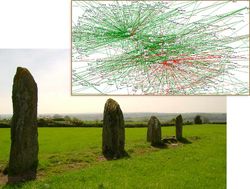 How can you tell if an ancient story is completely fictional or based on reality? One method, says a team of physicists, is to map out the social network of the characters and test whether it looks like a real social network. When they used that method for three ancient myths, they found that the characters have surprisingly realistic relationships. Ancient stories are called myths for a reason. No one believes that Beowulf, the hero of the Anglo-Saxon epic, slew a talking monster named Grendel. Or that the Greek gods described in The Iliad actually appeared on Earth to intervene in the Trojan War. But historians and archaeologists agree that much of those ancient narratives was based on real people and events. The supernatural features of the narrative were then layered onto reality. Ralph Kenna and Pádraig Mac Carron, physicists at Coventry University in the United Kingdom, wondered if reality leaves its mark on mythological narratives through the relationships between characters. So they built social network maps for three ancient texts. Along with Beowulf and The Iliad , they included an Irish epic, Táin Bó Cúailnge. The Irish epic's origins are murky. Most scholars assume that it is completely fictional, but recent archaeological evidence suggests that it could be based in part on a real conflict in Ireland 3200 years ago.
Kenna and Mac Carron started by building a database for each story that captures all the characters—Beowulf, The Iliad, and Táin contained 74, 716, and 404 characters, respectively—and the interactions between them. (If two characters met or clearly knew each other, that counted as a relationship.) As a control, they also mapped the social networks for modern works of fiction: Les Misérables, Shakespeare's Richard III, The Fellowship of the Ring, and the first book in the Harry Potter series. Once the social webs were mapped, Kenna and Mac Carron applied the standard statistical toolkit used to study real social networks such as Facebook. For example, one universal feature of real social networks is that they are highly clustered, with tight clumps of people who all know each other. These groups are linked to each other by highly social people known as “connectors.” Real social networks also have a property called “small world,” which indicates that there is never more than a few degrees of separation between any two people. Such statistical properties have been found in networks of movie actors, jazz musicians, and even scientific collaborators. If the ancient myths were based on real people, Kenna and Mac Carron expected to find the same patterns.
More here.
