
| ABOUT US | ARCHIVES | LINKS | RSS FEED | MONDAYS | |

3quarksdaily

An Eclectic Digest of Science, Art and Literature

« Perceptions | Main | The Gaffe that roused Blighty »

July 30, 2012

Cosmopolitanism and the Colonial Imagination

by Leanne Ogasawara

6a00d834535cc569e2016768d6e2fb970b-320wiThe other day on Facebook, I posted an article from the Atlantic, A  Land Without Guns: How Japan Has Virtually Eliminated Shooting Deaths.

In the wake of Aurora, I thought there was a lot that was of interest in the article. But almost immediately the first comment I got was the old “same-old” about how “different” the Japanese are and that, “Holding up Japan as an example of how the US should handle guns is quixotic in the extreme, as nice as it may sound.” He explained, “Japanese are raised to be docile subjects of their government while America is based on the idea that the citizens can rise up against a tyrannical government and overthrow it. Distrust of the government is as American as apple pie. To do that, you need weapons.”

Setting aside what I think is a really unfair characterization of Japan, I wondered why people are always so quick to think that there is nothing that could be learned from other countries. I am not speaking about my friend on Facebook but rather about a pattern that I have seen again and again after returning from two decades overseas. Granting that there are indeed different cultural approaches to issues of authority that would make passing gun laws more difficult here than say in Japan; but let’s face it; the right to bear arms doesn’t include the right to bear grenades, military drones or anti-aircraft, so why couldn’t assault weapons also be regulated? Of course, they can and to wit, they already have been regulated in the past by law. But perhaps more to the point, I think the Japanese case does have much to offer in terms of gun license procedures and accountability that we could learn from—different culture and history notwithstanding.

This unwillingness to be open to what other cultures can teach us is something particularly apparent concerning China, where the push for change is overwhelmingly one-sided, but even the stories we read in the media about Japan are mainly prescriptive concerning what Japan needs to do and how Japan should change to become more like the US ---with all but a few people seemingly unconcerned with the question about how we instead could learn and be changed by Japan. And, this is all the more maddening since we are so pushy exporting our own way of life. Indeed, fashioning the world in our image seems to be a significant part of the neo-liberal project and this push is done by politicians, by the media, by corporations and sometimes by intellectuals. Even in Japan, a country not in an adverserial relationship with the US but rather in a cooperative one, the pressure to conform to the Washington Consensus—particularly in terms of American style economic and financial systems, as well as to certain political values—is overwhelming.

I was recently at a conference in Shanghai on the topic of cities as one possibility for counter-balancing the hegemonic powers of nation-states and one of the participants who is involved in city branding projects at Macao University grew frustrated and said, “In China, we feel relentlessly critiqued and told how to change, and we try and change and become more Western but no matter what we do, it is just more criticizing.”  I wondered whether she wasn’t thinking that with China on the rise and more people having been pulled out of poverty by a government than in any time in history, why there is so little talk of possible places where the world could learn from China—or perhaps Singapore …?

This very recent CS Monitor article by Daniel Bell is refreshing in the sense that it at least opens the door for a more two-way dialogue. I haven’t read the article yet, just noticed the inflammatory title, which you can bet was probably not chosen by the author, and then the comments.

Hong Viet Dung (Girl with bird)Maybe there is really nothing to learn from places like China and Japan but I think being open to the possibility is more crucial than ever before in today’s world-- a world which is more and more linked and inter-dependent.  This is especially important for a country that makes it its business to dictate to other countries how things should be—both politically but also vis-à-vis a media, which has helped create a market for seemingly unending prescriptive narratives. (What ever happened to just the facts ma’am? Journalists no longer seem happy with reporting for some reason and instead are tied to official narratives and worldviews).

Manan Ahmed has written very thoughtffuly about "empire’s  way of knowing." He says, “Empires impart the belief that there is “a dominant ‘core’ that rule[s] over a conquered ‘periphery’” and that it is the “right of the Emperor to create and execute laws universally, i.e. absolute sovereignty.” What he is describing is the universal application of cultural values as the de-facto consensus.

Japanese scholar, Hatori Eiji (of UNESCO) is also interested in empire and put forward in the 1990s as an alternative to the "Globalization as Americanization" model, his UNESCO Silk Road Project positioned the “Silk Road;” so that:

Pax/Empire                                      versus               Silk Road
Monopoly                                                                       Two-Way Trade/International Relays
Monologue/Propaganda                                           Dialogue            
National                                                                            Cities/International
Robbery                                                                         Mutual Profit/Equal Partnership/Co-Dependence  

Japan was, after all, on the terminus of the Silk Road and the nation experienced its greatest cosmopolitan flowering during the Nara period, when the Silk Road was in its heyday. In contrast to the modern "melting pot" of pluralistic societies we see today, people during Silk Road times are described as having interacted with each other from standpoints of their own unique city-cultures. Hattori's main point is that during Silk Road times, dialogues between cultures were two-way. That is, it was not a power relationship dominated by one side talking/dictating/taking/imposing but rather the Silk Road is being held up a model for two-way dialogue based on trade; one in which trade was an international accomplishment achieved by people from many nations working for mutual benefits cooperatively.

It is not that in Japan you don’t see critical media reports about China or the US, nor is it that Japan totally lacks hegemonic ambitions, but I think it can be said that there is less will to export its culture or to fashion the world in its image and more willingness to take up excellent models from overseas and be changed by foreign ideas and this is a basic stance held in most of the places I have lived or spent time in Asia.

From cutting edge recycling technologies and laws concerning the environment to education and business, there is so much we in the US could learn from the Japanese. In my work as a translator, in addition to telecommunications content, which despite Japan’s so-called “lost decade” Japan has invested massively in telecommunications infrastructure to the result that it has both the cheapest and the fastest Internet speeds on earth,  I have also translated a surprisingly large number of documents which have also taken up geographic and cultural rootedness as themes. Whether in my work for the Japanese government; for academia or for business, again and again I have translated things which have called for a more relativized form of globalization. Themes from my work have included:

--From business: a rejection of American-style quarterly performance bottom lines and a commitment to local contribution and corporate responsibility as rooted firmly in plant or business city. Strategies have been in the form of a direct rejection of “American-style capitalist practice”. Right now, so thoroughly does Wall Street dominate in business that corporations in America find it hard to get out of this short term performance mentality. What is happening in Japanese companies now in their push to emphasize that stakeholders are not just shareholders could be a significant hint for addressing the American corporate excesses that we are seeing.

--From government:a commitment to reject American food practices from hormones in American beef to fast food. (The slow food movement is gaining momentum in Japan as well as in Europe. Indeed, Japan is naturally drifting ever-closer to Europe—away from China and the United States in terms of approach and sensibility). Japan has also taken recycling practices from Germany and improved upon them creating what is some of the most cutting edge technologies and practices on the planet. Translating on this topic (both in government but in business to), I have wondered again and again why we don't hear about this in the US.

--In Adademia: To see art history move beyond the categories and definitions imposed by Kant and the European tradition to embrace a traditional East Asian approach.

I am a great fan of the writing of William Dalrymple. In 2009, he had another thought-provoking article in The Guardian about the future of travel writing. One paragraph in particular caught my attention:

"It's no accident that the mess inflicted on the world by the last US administration was done by a group of men who had hardly travelled, and relied for information on policy documents and the reports of journalists sitting interviewing middle-class contacts in capital cities. A good travel writer can give you the warp and weft of everyday life, the generalities of people's existence that are rarely reflected in journalism, and hardly touched on by any other discipline. Despite the internet and the revolution in communications, there is still no substitute.”

Reading this, I thought that nothing much has changed since the last Administration either and that US policy remains in the hands of a cabal of monoglots and cultural provincials. Ahmed also suggested that today rather than academic experts or those with any significant expertise in a given area and language, more and more it is journalists who are affecting policies. He wrote that,

Such an “expert” is usually one who has not studied the region, and especially not in any academic capacity. As a result, they do not possess any significant knowledge of its languages, histories or cultures. They are often vetted by the market, having produced a bestselling book or secured a job as a journalist with a major newspaper. They are not necessarily tied to the “official” narratives or understandings, and can even be portrayed as being “a critic” of the official policy. In other words, this profile fits one who doesn’t know enough.

Hannah Arendt looked at universalist narratives as being behind much of the political pathologies of her time and felt that being derived from abstract reasoning, which stands apart from the world, the universalist thinking aims to create blueprints for how we think the world “ought” to be; and that this becomes a political project that aims to manipulate how the world is to change it to how one thinks it should be. In that way, she urged people to be engaged with the world as it truly is—and it seems that in order to do that one must start with looking, listening and learning. For as Eiji Hattori said in a 2004 UNESCO speech, “Civilizations never clash. Ignorance does.” 

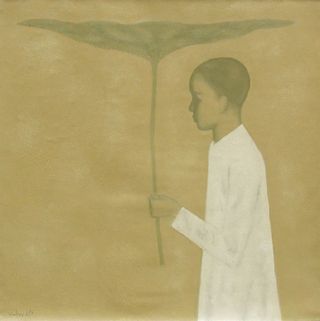
Paintings by Hong Viet Dung 

Recommended: SALMAN ADIL HUSSAIN's Empire's Way of Knowing &  Robert Harrison's May 2006 Entitled Opinions show on the philosophy of corporations

Leanne Ogasawara is a writer who studied philosophy at U.C. Berkeley and Japanese literature as a graduate student at the University of Wisconsin-Madison. She has spent most of the last twenty years in Japan and also blogs at Tang Dynasty Times.

Posted by S. Abbas Raza at 12:12 AM | Permalink

Comments

Leanne,

You make some great points -- particularly about the credentials of "experts". There was once a period where Presidents sought top intellectuals and the cream of the Foreign Service for their advisers on Foreign Policy. Presidents like Nixon and Bush Sr. took foreign policy very seriously, often having studied it and even having experience in it. After all, George H. Bush had been an ambassador to China and the Director of the CIA.

Nowadays presidents rarely have the foreign policy acumen of Nixon, the experiences of Bush or Johnson or even the intellectuals chosen by Kennedy and Truman.

More importantly, our media stilts and stunts our dialog by manipulating information, making news out of sound-bytes and making controversy of minutia while real issues and idea go unreported and undiscussed.

Posted by: Eric F | Jul 30, 2012 4:43:39 PM

I live in Japan, and would be the last to argue that xenophobia does not, from time to time, rear its ugly head here. Hand in hand with that, though, is a real and seemingly unquenchable interest in other cultures. Sometimes that interest springs from a desire to learn something from foreign cultures, but just as often it is motivated by the fact that other cultures are, well, interesting. I would love to see the xenophobic strain in Japan eradicated, but at the same time I'd love to see the USA learn from, and adopt, the xenophilia that also characterizes the archipelago.

Posted by: David | Jul 30, 2012 6:27:18 PM

American cultural chauvinists need to know that China, once the most advanced country in the world, began to decline when it decided that it no longer needed to learn anything from other countries.

Posted by: Karen Sandness | Jul 30, 2012 9:57:48 PM

Great to see you here, Leanne! Thanks for a wonderful post.

On the insularity of American culture, I think it's partly due to America's large size and geography, partly due to the lack of a significant colonial past. But the biggest reason may be its triumphalist sense that the West has "won". This differs from the Silk Road era when no culture dominated as much. For better or for worse, no strong alternatives with wide appeal have yet emerged to rival Western models of economics, politics, law, science, medicine, technology, etc. There is yoga and sushi, yes, but when it comes to the big societal trends, hasn't it been a mostly one-way street for at least two centuries? This can lull Americans into thinking that there is little to learn from others.

I'm going to reuse this gem: "Civilizations never clash. Ignorance does." :-)

Posted by: Namit | Jul 30, 2012 11:09:44 PM

Leanne, I'm rather torn over some of your comments here. Let me start from the top:

Your gun-lobby friend would say that no matter what you suggested. That's the way they think, that guns are there to protect the freedom of the individual from government. It has nothing to do with Japan or anything else. In effect, the starting-point of your piece is rather irrelevant to the rest.

The fact that America is trying to force its ways on the rest of the world is basically a kind of hubris, or lack of humility. It comes with being top dog and the leader of the pack. This hasn't stopped foreign cultural influences from making an impact on the U.S. For example, sushi made it in New York despite not being American. But American hubris does tend to close the mind to the possibility that there are things that Americans might learn from others.

I don't come from America, but where I come from there is a mindset that has similarities but differences as well. In Australia, the general direction of cultural influence is 1) from English-speaking countries (the old country and the U.S.) 2) from Europe (at a pinch) 3) the rest. I suspect it's a hangover from the colonial British mentality of the 19th century, without the American triumphalism.

I would suggest that all cultures have their pecking orders for accepting foreign influences. Japan's is broader than most, with 欧米 (Europe and the U.S.) for modernity, old China for traditional reasons, and then anything else that catches someone's fancy from the rest of the world. I remember some time back when Australia invented a 'bionic ear' for the partially deaf, Australian specialists had to ask British specialists they knew to recommend the invention to Japanese specialists, as that was the only way to get the Japanese to take it seriously. In other words, channels of influence are still 'fixed' in certain ways. (Notice also how Australians at the time were obviously more familiar with their British peers than American ones, another 'cultural pattern').

Incidentally, one interesting remark I remember about the Japanese is that they are totally open to taking in ideas and things from the rest of the world, but quite closed to taking in people.

At any rate, I agree that there are things that can be learnt from the Japanese. When I was much younger I was taken by the way that Japanese bus stops are named (in Australia they are numbered), so much so that I went in to the transport department in the city I lived, Brisbane, and put it to them as a recommendation. I'm not sure how interested they were, but one comment by the man who patiently listened to my presentation sticks in my mind: "They're really advanced in America. They have bus rodeos!" (Many years later I discovered that Brisbane had actually switched to naming its bus stops, but I have no idea whether it was due to my suggestion or to some completely different factor).

Another aspect of Japan that I have often felt could be emulated is the way that railway stations have been built into thriving commercial hubs, instead of being isolated from towns as they are in Australia.

As for America and other Western countries being open to influences from China, I am sure that Chinese traditional culture (food, medicine, etc.) has a lot to offer. But I shuddered when I read your endorsement of the Christian Science Monitor article. Being open is fine, but that should not extend to uncritical admiration of things you know nothing about, as that article was. The Useless Tree has a post debunking the idea that China is a meritocracy, which is recommended reading. Unfortunately, apart from traditional things (of which there a lot!), I don't think China as yet has a lot to offer the world. Most people looking from the outside don't have much sense how atrocious some things in China are, even though it has made vast improvements. (I would suggest that a system that nobody trusts to deliver safe food for public consumption is not a system to be widely emulated.)

So while I would agree that being open to ideas and influences from other countries is a good idea, I think we have to be realistic about the ways in which these influences flow. All cultures are open in certain set ways (set by tradition, mindset, history) and closed in certain set ways, some more than others. And being open to anything simply because it's 'foreign' or 'different' should be careful to avoid uncritically naivety.

Posted by: Bathrobe | Aug 25, 2012 10:44:24 AM

I'm not sure what I was thinking when I wrote that last sentence. It should have read:

And openness to foreign cultures simply because they are 'foreign' or 'different' runs the risk of uncritical naivety. Openness needs a certain amount of hardheadedness.

Posted by: Bathrobe | Aug 29, 2012 10:57:01 PM

Post a comment


Subscribe to this blog's feed  

PayAnywhere with iphone credit card swiper

Android Tablet

Bluetooth Headset

2013 New Style Dresses

Compare Car Rental Prices

DHgate.com Wholesale

3QD on Facebook

3QD on Kindle

3QD by Daily Email

Receive all blogposts at the same time every day.

Enter your Email:


Preview 3QD Email

3QD on Twitter

Miscellany

Lijit Search

AddThis Social Bookmark Button

Add to Google

Recent Comments

Stuart Mathieson on Why Steven Pinker Is Wrong

j_93 on Syria: Inventing a Religious War

j_93 on Syria: Inventing a Religious War

Lusine on Rajesh Rao: A Rosetta Stone for the Indus script

Norman Costa on Why Steven Pinker Is Wrong

Lusine on Syria: Inventing a Religious War

Raza Husain on Syria: Inventing a Religious War

j_93 on Why Steven Pinker Is Wrong

martina_j on Syria: Inventing a Religious War

Raza Husain on Why Steven Pinker Is Wrong

Bill on Why Steven Pinker Is Wrong

roger gathmann on Why Steven Pinker Is Wrong

Doogle on Why Steven Pinker Is Wrong

Kyle on Syria: Inventing a Religious War

Peter John on Gezi Park

dthoko on The History of Typography - Animated Short

Richard on John Gray’s Godless Mysticism

Abbas Raza on Why Steven Pinker Is Wrong

nogodrod on Syria: Inventing a Religious War

Lusine on Quest for 'Genius Babies'?

Bill on Syria: Inventing a Religious War

j_93 on Gezi Park

j_93 on Syria: Inventing a Religious War

Norman Costa on The Insanity Virus

Dave Ranning on Political Ideology and the Avoidance of Dissonance-Arousing Situations

Acclaim For 3QD


"I couldn't tear myself away from 3 Quarks Daily, to the point of neglecting my work. Congratulations on this superb site."—Steven Pinker, Johnstone Professor of Psychology, Harvard University.

"I have placed 3 Quarks Daily at the head of my list of web bookmarks."—Richard Dawkins, Charles Simonyi Professor of the Public Understanding of Science at Oxford University.

"Just wanted you to know I’m one of many who reads and enjoys 3 Quarks....almost daily."—David Byrne, musician, former lead-singer of the Talking Heads, artist, intellectual.

Read more here.

The 3QD Prizes

Subscribe to this blog's feed