
| ABOUT US | ARCHIVES | LINKS | RSS FEED | MONDAYS | |

3quarksdaily

An Eclectic Digest of Science, Art and Literature

« Absurd Wars? | Main | perceptions »

July 23, 2012

Burmese Days

by Maniza Naqvi

“… How does our affair progress? I hope that, as dear Mr. Macgregor would say—U Po Kyin broke into English—eet ees making perceptible progress?”
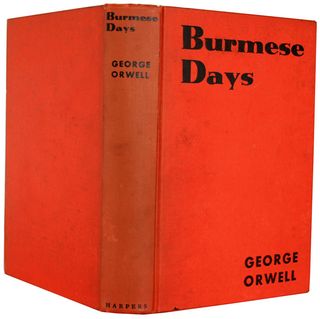
Burmese-Days-3Burmese Days by George Orwell remains relentlessly relevant and a touchstone for cynics eight decades after it was written. The novel opens with U Po Kyin at age 56 thinking of his achievements with satisfaction—and plotting intrigue to further his interests. He thinks back to his first memory of the British troops with their weapons entering victoriously into Mandalay in 1885. “To fight on the side of the British, to become a parasite upon them, had been his ruling ambition even as a child. He does this by playing one side against the other, planting intrigues and solving them, always putting himself in the position of the problem solver, the loyalist to all—taking bribes and ruthlessly controlling everyone."   U Po Kyin's memory of British troops marching into town is set in the moment in which the oil company Burmah Oil is born in 1886 and when Burma became a province of Imperial India. (here, and here and here.)

George Orwell was in Burma in the Indian Imperial Police from 1922-1927  Eric Arthur Blair or George Orwell was born in India, on June 3, 1903 in Motihari Bihar (here).  Orwell’s novel follows the trajectories of the ambitions and the psyches of Imperial administrators, their military officers, wives, concubines, their merchants and those who served them. The title of “U” has been bestowed on U Po Kyin for his services enroute his own trajectory from a lowly clerk to a minor official to a Sub divisional magistrate, through planting seditious activities and creating rebellions and quelling them himself so that he can demonstrate his loyalties to the Imperial masters by jailing adversaries while havig his fingers in every pot in his subdivision for personal gain and pleasure.

His good works of building Pagodas will ensure his next life. But in this life his most ardent desire is to be a member of the British Club:

 “There was an English cemetery within a white wall half way down the hill, and nearby a tiny tin-roofed church. Beyond that was the European Club, and when one look at the Club—a dumpy one storey wooden building—one looked at the real centre of the town. In any town in India the European Club is the spiritual citadel, the real seat of the British power and the Nirvana for which native official and millionaires pine in vain. It was doubly so in this case, for it was the proud boast of Kyauktada Club that, almost alone of Clubs in Burma, it had never admitted an Oriental to its membership. Beyond the Club, the Irrawaddy flowed huge and ochreous, glittering like diamonds in the patches that caught the sun; and beyond the river stretched great wastes of paddy fields, ending at the horizon in a range of blackish hills.”

“How does our affair progress?” Eet ees making perceptible progress?” U Po Kyin asks a minion this question about the intrigue he has planted of sedition—against a British officer in a local newspaper. He does this to destroy his rival a Burmese doctor favored for the membership at the club. Only one native, if any, can be chosen to join. He will create a situation, quell it himself and then be a hero to the British and demonstrate his worthiness and loyalty to be a member of the club. He wants to prove the doctor’s disloyalty to the British. He is questioned on the impossibility of this eventuality by his co-conspirator. “Nonsense, nonsense, said U Po Kyin comfortably “No European cares anything about proofs. When a man has a black face, suspicion is proof.”

The much loved, adulated, embraced, respected, accepted Oxford educated Daw Aung San Suu Kyi who was confined for twenty years in her lake side family home in Rangoon, by the ruling military Junta which had confined Burma from the rest of the world---was released by the Junta in late 2010. She is the daughter of the late Major General Aung San who led the Guerrilla fight against the Japanese occupation and is considered the father of the Burmese Army. Ms. Aung San Suu Kyi’s release was followed by visits to Myanmar by Mrs. Clinton on November 30, 2011 at the heels of the visit by the British International Development Minister on November 15, 2011. The UK Foreign Secretary William Hague was there after Mrs. Clinton on January 2012.  

Since then, she has spoken eloquently in many forums abroad and at home. She visited Thailand in May 2012 (here).  In June Ms Aung San Suu Kyi traveled to much applause and fanfare to International forums in Europe. She addressed both houses of the British Parliament on June 21, 2012 (speech video) in Oslo she accepted her Nobel Peace Prize on June 16, 2012(speech video) and she sent a message to the World Economic Forum in Davos (message here). She is to visit the US in September 2012 (here).

The US has in July 2012 lifted the embargo on US companies mainly Oil and Gas to make investments in Burma. “Today, the United States is easing restrictions to allow U.S. companies to responsibly do business in Burma." The announcement came hours after Derek Mitchell, the first U.S. ambassador to Myanmar in 22 years, presented his credentials in the Asian nation’s remote capital. Washington has normalized diplomatic relations, the culmination of a three-year push to help Myanmar out of international isolation and lessen its reliance on its chief but distrusted ally, China.” The Washington Post reported this on July 11, 2011 (here.). The newspaper commented that “the statement credited reformist President Thein Sein and democracy leader Aung San Suu Kyi for continued progress toward democracy but also voiced deep concern over the murky investment environment.”  President Thein Sein who was a Lt. General in the Burmese military was appointed as interim Prime Minister in 2007 and  was sworn in as President in March 2011. (Here)

In Burmese Days, Orwell writes in, a detail which, becomes even more vivid now and stands out in the July of 2012, as the US ends the embargo on US business investments in oil and gas, Aung San Suu Kyi emerges as a member in the establishment and the violence against the Rohingya erupts.  The Orwellian detail is right there in his second paragraph of the novel Burmese Days written in the 1920s:  U Po Kyin a 56 year old Subdivisional Magistrate of the fictional Kyauktada in Upper Burma (most probably Katha in the now Sagaing Division) wears an Arkanese longyi.  "It is a vivid Arkanese longyi with green and magenta checks which the Burmese wear on informal occasions."

The name of Rakhine state was Arakan, whose ancient name was Rohang from which the word Rohingya is derived. There are two communities in this State:  the Rohingyas who are Muslims and the Rakhines who are Buddhists. The State’s name was changed to Rakhine state.  There is an important detail that needs to be mentioned here, the Rohingya happen to have oil beneath their homeland. (Arakan Oil Watch: Youtube documentary in Burmese Part I and Part II)

In Burmese Days, U Po Kyin achieves the Club membership, through much tragedy caused to others and is finally promoted to a Deputy Assistant Commissioner and is decorated by the Raj for his services. At the award cermony the commendation which is read out appreciates:  "To U Po Kyin, Deputy Assistant Commissioner, retired, for long and loyal service and especially his timely aid in crushing “a most dangerous rebellion in Kyauktada district.”

Hillary Clinton, after much hugging and kissing of Daw Aung San Suu Kyi, and photographs with the human rights icon and cause célèbre during the visit in November 2011 later told reporters in April 2012 that she had told Aung San Suu Kyi that Aung San was moving from being an icon to a politician (here). There is, of course the Hollywood film, The Lady, about Ms. Aung San Suu Kyi which was released in April 2012 (trailer here) and Secretary Clinton made this remark to reporters at the premier for the movie.  

Ms. Aung San Suu Kyi won a by-election for a seat in Parliament in April 2012 and joined the Parliament as an MP in early July 2012. In June this year the violence began anew against the Rohingyas who have faced systematic discrimination and what can be termed as acts of ethnic cleansing by the State. (here, here, here).

Daw Aung San Suu Kyi lauded by the world for her twenty year confinement to her home, is in her homeland, confining her thoughts and remaining silent about the systematic ethnic cleansing, statelessness and homelessness of her countrymen, the Rohingyas.

“How does our affair progress?”  


Other Writings by Maniza Naqvi:

Particles

Socks and Holes

“Baby Where’s My Cash”  

The Middle Way, the Difficult Way—Sharper than a Sword and Narrower than a Hair

A Matter of Detail: The Masonry of Graffiti and Symbols

Red Moon Rising 

Mother 

Impossible Shade of Home Brew 

The Kreutzer Sonata in Addis Ababa

Permit Me to Protest 

Battle Songs: These Children Can’t Be Bought

Notes On Zuccotti Park

 Hitched In History to Crimes Against Humanity

 Cracking

The Great Land Grab: Beyla

The Kiss

Amber

Rahima's War

Imagining Lyari Through Akhtar Soomro

The Boxer

Abatabad

Divining Water

Rimbaud and Insider Information on Disasters Foretold

Expressing Fidelity Through Sorrow's Hope

Jijiga Nights

Fanaa

Moharram and Me

Genetics of Blueberries 

0

At the End of a Match

Who in Hell is Imam Feisal

Tomyris

Static Kill

The Trappers and the Trapped

Hosed

A Hit at the Bambino

Interview with Tariq Ali

Shame on Us  

Losing the Plot: Habits of the Heart (Complete Novel)

The Art of Resistance: Under Siege

A Brief Acquaintance

The DMV

That Sara Aziz (A Play)

The Leftist And The Leader (A Play)

Posted by Maniza Naqvi at 12:15 AM | Permalink

Comments

chilling.....

Posted by: salima hashmi | Jul 23, 2012 10:57:34 PM

When the narrative changed to suit purpose and overnight Burma became a courted state from being a pariah state, I recalled Orwell then, not for his Burmese Days book, but for the Ministry of Truth in his book 1984.  http://en.wikipedia.org/wiki/Ministry_of_Truth

Posted by: Raza | Jul 24, 2012 1:52:08 AM

The more things change the more they remain the same.

Posted by: seema jaffer | Jul 24, 2012 3:29:35 AM

Burma Oil Company PLC, Burmah Shell, British Petroleum: They are the Ministry of Truth.

Posted by: BP | Jul 24, 2012 10:28:48 AM

You don't here the term "Extremist Buddhist" do you? More than 20,000 Rohingya have been killed but you don't here this term.

News reports say that Human Rights group Amnesty International has accused security forces and ethnic Rakhine Buddhists of carrying out fresh, targeted attacks against Rohingya, the Muslim minority group in Myanmar.

Violence in the last six weeks has been "primarily one-sided, with Muslims generally and Rohingya specifically the targets and victims,'' Benjamin Zawacki, a Bangkok-based researcher for Amnesty, said on Friday.

"Some of this is by the security forces' own hands, some by Rakhine Buddhists with the security forces turning a blind eye in some cases,'' he said.

The violence, which reached its bloodiest point in June, constituted some of the country's deadliest sectarian bloodshed in years and raised international concerns about the Rohingya's fate inside Myanmar.

Following a series of isolated killings starting in late May that left victims on both sides, bloody skirmishes quickly spread across much of Myanmar's coastal Rakhine state.

The government declared a state of emergency on June 10, deploying troops to quell the unrest and protect both mosques and monasteries.

The worst of the violence subsided two weeks later, and authorities said at least 78 people were killed and thousands of homes were burned down or destroyed, with damages roughly split evenly between Buddhists and Muslims.

Refugee problem

Thein Sein, Myanmar's president, said earlier this month that the solution to ethnic enmity in Rakhine state was to either send the Rohingya to a third country or have the United Nations refugee agency look after them.

UNHCR chief Antonio Guterres said, however, that it was not his agency's job to resettle the Rohingya.

One month after sectarian violence swept across northwestern Myanmar, Rohingya refugees are now fleeing to Bangladesh by the boatload, in a bid to escape the violence.

Despite their plight, Bangladesh is stepping up its efforts to stop refugees from crossing over.

Amnesty called on Myanmar to accept the Rohingya as citizens, something the government has staunchly opposed because it does not consider them an ethnic group native to Myanmar.

"Under international human rights law and standards, no one may be left or rendered stateless,'' Amnesty's Zawacki said.

"For too long Myanmar's human rights record has been marred by the continued denial of citizenship for Rohingya and a host of discriminatory practices against them.''

Posted by: Carntlos | Jul 24, 2012 1:14:38 PM

@ all

Chilling. No you don't hear the words "Extremist Buddhists." That's not part of the narrative for now. The more things just don't change. And now Food Aid has arrived into the conflict. Its text book and Orwellian perfect...

Please see the article in the Washington Post:
BANGKOK — Communal violence is grinding on in western Myanmar six weeks after the government declared a state of emergency there, and Muslim Rohingyas are increasingly being hit with targeted attacks that have included killings, rape and physical abuse, Amnesty International said.

A government spokesman for coastal Rakhine state, which was engulfed by a wave of bloody unrest in June, called the allegations made Friday groundless and biased. Amnesty’s claims are “totally opposite of what is happening on the ground,” spokesman Win Myaing said, adding that the region was calm.

Also Friday, the new U.S. ambassador to Myanmar announced a donation of $3 million in food aid to northern areas of the country affected by fighting between government troops and ethnic militias.

Amnesty International accused both security forces and ethnic Rakhine Buddhists of carrying out new attacks against Rohingyas, who are seen as foreigners by the ethnic majority and denied citizenship by the government because it considers them illegal settlers from neighboring Bangladesh.

After a series of isolated killings starting in late May that left victims on both sides, bloody skirmishes quickly spread across much of Myanmar’s coastal Rakhine state. The government declared a state of emergency June 10, deploying troops to quell the unrest and protect both mosques and monasteries. Authorities said at least 78 people were killed and thousands of homes were burned down or destroyed — with the damage roughly split evenly between Buddhists and Muslims.

The worst of the violence subsided late last month, but communal violence has ground on. Now, Amnesty said, it is being directed mostly at the Rohingya population.

Attacks over the last six weeks have been “primarily one-sided, with Muslims generally and Rohingyas specifically the targets and victims,” Benjamin Zawacki, a Bangkok-based researcher for Amnesty, told The Associated Press. “Some of this is by the security forces’ own hands, some by Rakhine Buddhists with the security forces turning a blind eye in some cases.”

The group also said security forces, including the police and the army, had conducted massive sweeps and detained hundreds of Rohingyas who are being held “incommunicado.”

“While the restoration of order, security, and the protection of human rights is necessary, most arrests appear to have been arbitrary and discriminatory, violating the rights to liberty and to freedom from discrimination on grounds of religion,” Amnesty said in a statement.

Win Myaing, the government spokesman, said security forces had arrested at least 100 Muslims in the northern Rakhine state town of Maungdaw, but he said the arrests were not discriminatory. Muslims account for more than 95 percent of the population in the town, he said, and it is natural they would comprise most of the arrests there.

Iran urged the United Nations to take action to protect the Rohingyas.

“We believe that ethnic and religious cleansing against Muslims under whatever pretext is unjustifiable and inexcusable under international law, and the United Nations must take urgent measures” to protect the Rohingyas by calling on Myanmar’s government to end its “crackdown,” Iran’s U.N. ambassador, Mohammad Khazaee, said in a letter Friday to U.N. Secretary-General Ban Ki-moon.

http://www.washingtonpost.com/world/asia_pacific/amnesty-international-myanmars-muslim-rohingyas-being-targeted-as-violence-continues-in-west/2012/07/20/gJQARph0yW_story.html

Posted by: Maniza | Jul 24, 2012 2:14:13 PM

So what else is new. Its all about Oil, always has been. Iraq, Sudan. And the great champion of human rights sits as a pawn in the hands of the Junta and US Carpetbaggers. But don't underestimate the Chinese, they move slowly and surely, or have we forgotten Vietnam ? Thank you for this Maniza, as there is a wall of silence around this latest hunt for oil, at any price.

Posted by: Adeel | Aug 16, 2012 12:34:38 PM

Post a comment


Subscribe to this blog's feed  

PayAnywhere with iphone credit card swiper

Android Tablet

Bluetooth Headset

2013 New Style Dresses

Compare Car Rental Prices

DHgate.com Wholesale

3QD on Facebook

3QD on Kindle

3QD by Daily Email

Receive all blogposts at the same time every day.

Enter your Email:


Preview 3QD Email

3QD on Twitter

Miscellany

Lijit Search

AddThis Social Bookmark Button

Add to Google

Recent Comments

Elatia Harris on Daniel Dennett's seven tools for thinking

Abbas Raza on Daniel Dennett's seven tools for thinking

Jonathan on Daniel Dennett's seven tools for thinking

Bill on Daniel Dennett's seven tools for thinking

Louise Gordon on The need for critical science journalism

omar on Mohsin Hamid: 'Islam is not a monolith'

Jonathan on Daniel Dennett's seven tools for thinking

Bill on Daniel Dennett's seven tools for thinking

jo smith on Mohsin Hamid: 'Islam is not a monolith'

carlos on Daniel Dennett's seven tools for thinking

freddie on Daniel Dennett's seven tools for thinking

Eli on "Everybody Hurts" by Sachal Studios, Lahore, Pakistan

Jalees Rehman on The need for critical science journalism

Dredd on Why Rational People Buy Into Conspiracy Theories

Dredd on Why Rational People Buy Into Conspiracy Theories

Scrutineer on Why race as a biological construct matters

prasad on the culture animal

Mitt Romney's Dog on Why race as a biological construct matters

Elatia Harris on The Moral Status of Rocks

prasad on The Moral Status of Rocks

Raza Husain on The Moral Status of Rocks

Fred on Unknown Mathematician Proves Elusive Property of Prime Numbers

Joel Grant on Why Rational People Buy Into Conspiracy Theories

Tomboktu on Why is Europe so Messed Up? An Illuminating History

Joe on Why Rational People Buy Into Conspiracy Theories

Acclaim For 3QD


"I couldn't tear myself away from 3 Quarks Daily, to the point of neglecting my work. Congratulations on this superb site."—Steven Pinker, Johnstone Professor of Psychology, Harvard University.

"I have placed 3 Quarks Daily at the head of my list of web bookmarks."—Richard Dawkins, Charles Simonyi Professor of the Public Understanding of Science at Oxford University.

"Just wanted you to know I’m one of many who reads and enjoys 3 Quarks....almost daily."—David Byrne, musician, former lead-singer of the Talking Heads, artist, intellectual.

Read more here.

The 3QD Prizes

Subscribe to this blog's feed