
by Sarah Firisen
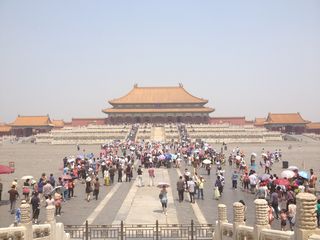
I expected China to be different; exotic, challenging, overwhelming in its otherness. But, in many ways, it was depressingly familiar; the mall next to my apartment building had a Gap, an H&M, a Subway and a Baskin Robbins. The New York Pizza restaurant was always at least as busy as the excellent Dim Sum restaurant a few doors down from it. Beijing and Shanghai each have a 5th Avenue equivalent sporting a Louis Vuitton, an enormous Cartier, an equally huge Tiffanys, gigantic Apple stores and all the brands that you'd expect to accompany these. I saw a few Aston Martin and Porsche dealerships and it seemed like every other person was driving an Audi.
My tour guide at the Great Wall of China, Leo, looked at my iPhone and asked, “4S?” I replied yes and he bemoaned the fact that his was only an iPhone 4. By the way, you can get great 3G phone reception at the Great Wall. The Pudong area in Shanghai, which was all farmland 20 years ago, is now adding fantastical skyscrapers so quickly that, when I left for a week to go to Beijing, I thought buildings would pop up while I was away.
There is restricted access to the Internet in China, but it wasn't as bad as I thought it would be and clearly the barriers are pretty easy to work around. Leo asked if I'd like to be his Facebook friend and told me he'd friend me when he got home and could get on the VPN that went around the country's firewall.
But in ways that I wasn't expecting, China was as foreign and incomprehensible as anywhere I've ever been in my life. In the roughly 5 weeks (on and off) that I was there, I had more truly inexplicable encounters and conversations than in the rest of my life put together. My colleague Diana and I coined a phrase, WTF in China (WTFIC). We'd say this to each other every time there was really nothing else to say because words failed us.
One day in Beijing, we were sitting in a taxi in heavy traffic. We noticed a few vendors going between the cars selling mobile phone car chargers. This seemed like a clever idea. Then Diana noticed that each vendor had chargers in one hand and a live turtle in the other. What was the deal with the turtles? Were they selling them? Were they a marketing gimmick? We emailed Leo, who had offered to help us post-tour with any questions. Before I got his reply back, I said to Diana, “you know, even once he answers us, we're not going to be any more illuminated. I just know it's going to be a WTF in China issue.” And indeed, this was Leo's answer, “For turtles, they are the symbol of longevity and fortune, so people may buy when they get bored in traffic!” Clearly, this answer made perfect logical sense to Leo. And to all the people sitting in rush hour traffic jams making a spur of the moment purchase of an animal that would probably outlive them.
And talking of driving in China…sometimes driving down the road, it was very hard to tell the difference between “something major has happened” and just the normal everyday chaos. Every day I felt like I took my life in my hands just getting a taxi to the office. Every taxi driver drives insanely fast and wildly, honking his horn even if there are no other cars on the road. It turns out that most of the Shanghai taxi drivers are living and working there illegally from other provinces and none of them seem to know how to get to almost anywhere in Shanghai. I became conversant in enough Mandarin to communicate and direct them to my office and back to my apartment building because this seemed to be a survival tactic.
When I was able to move beyond my fear for my life on these car rides and ones in Beijing, I noticed that cars often stopped, seemingly in the middle of the road or lined up on the hard shoulder, particularly at the weekend. This never helped the terrible traffic congestion. We asked Leo what that was all about. He told us that driving is a pretty new phenomenon for most people in Shanghai and Beijing and they see it as a social activity. When they go out for the day, they want to drive along with their friends. So they'll park in the meridian or by the side of the road to wait for them to catch up. Given that they all have cell phones, I'm not sure why they can't just track each other via GPS or phone and say, “where are you?” But again, this seemed a perfectly reasonable activity to Leo.
It was an interesting time to be in China: the Bo Xilai scandal was unravelling and the saga of the blind Chinese dissident Chen Guangcheng was unfolding. I only knew this because I read the New York Times every day. From what I saw of the China Daily (an English language Chinese newspaper), these events were not happening as far as the average Chinese citizen was concerned. And yet, I never sensed that most people felt oppressed by the regime, at least not on a daily basis. Reading the China Daily and talking with people, it's clear that there is a general sense, not necessarily unreasonably so, that the US talks a good game on freedom and civil rights, but that we're not always the torch bearers that we like to think we are.
I'm sure that Westerners are as inexplicable and seemingly bizarre to the Chinese as they often seemed to us. One day, I took my colleague's three daughters out shopping. We got a cab back to our apartment building and after I'd paid the fare, the taxidriver kept gesturing at the three girls sitting in the back. At first, I thought that he wanted to charge me more for the extra people in the car (it sometimes feels like everyone is running a scam in China). But, I finally realized that he thought that the three girls were my daughters and he was marvelling that someone might have three children and that those children would all be girls! Those crazy Westerners!
While I was in China, I facilitated some sessions on the use of storytelling as a leadership and business skill for our Chinese colleagues. We also ran some other soft skill sessions: graphics, executive presence and others. The local participants showed a real eagerness to participate in these sessions, far more so than when I've run these in the US or Europe. Shanghai is becoming a modern city of skyscrapers seemingly overnight and this expedited pace is often palpable in much else about the Chinese and their eagerness to be modern; they want to take on western ways and skills, drive Audis and wear their Prada outfits while talking on their iPhones . But they'll do it on their terms, taking our expertise and elements of our lifestyle and synthesizing them into something that works for their uniquely Chinese sensibilities and ways of thinking.
In many ways, the best metaphor for China is the electrical outlets: they will take a plug from almost any other country (maybe all countries, I wasn't in a position to exhaustively test this). Most days, I've had a UK plug in one outlet and a US plug in another and everything charged just fine. China really does aims to be all things to all people. We may not fully understand its ways, but we underestimate it at our peril.