
June 13, 2012
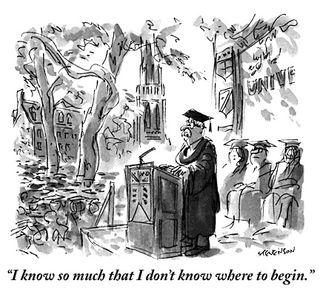
Why Smart People Are Stupid
Jonah Lehrer in The New Yorker:
Here’s a simple arithmetic question: A bat and ball cost a dollar and ten cents. The bat costs a dollar more than the ball. How much does the ball cost?
The vast majority of people respond quickly and confidently, insisting the ball costs ten cents. This answer is both obvious and wrong. (The correct answer is five cents for the ball and a dollar and five cents for the bat.)
For more than five decades, Daniel Kahneman, a Nobel Laureate and professor of psychology at Princeton, has been asking questions like this and analyzing our answers. His disarmingly simple experiments have profoundly changed the way we think about thinking. While philosophers, economists, and social scientists had assumed for centuries that human beings are rational agents—reason was our Promethean gift—Kahneman and his scientific partner, the late Amos Tversky, demonstrated that we’re not nearly as rational as we like to believe.
When people face an uncertain situation, they don’t carefully evaluate the information or look up relevant statistics. Instead, their decisions depend on a long list of mental shortcuts, which often lead them to make foolish decisions. These shortcuts aren’t a faster way of doing the math; they’re a way of skipping the math altogether. Asked about the bat and the ball, we forget our arithmetic lessons and instead default to the answer that requires the least mental effort.
More here. And Tauriq Moosa adds some thoughts.
Posted by S. Abbas Raza at 09:41 AM | Permalink


Comments
Is it just me, or is anyone else perpetually underwhelmed by the Kahneman & Tversky research? These findings have been all the academic rage for years, but to me they've never seemed that groundbreaking. Maybe they're only interesting if you begin with an assumption that humans are rational thinking robots.
Posted by: Eli | Jun 13, 2012 12:45:44 PM
This article comes as a great relief since it implies that stupid people, like me, are really smart.
Posted by: Olavi Valo | Jun 13, 2012 1:09:29 PM
Dear Eli, being underwhelmed by something you just read is hindsight bias.
Posted by: Kirk | Jun 13, 2012 1:31:28 PM
A great review of Lehrer's new book, and a powerful indictment of the pop-science writing that is currently undermining public confidence in science:
http://www.tnr.com/article/books-and-arts/magazine/103912/bob-dylan-jonah-lehrer-creativity
Posted by: Joe | Jun 13, 2012 1:54:32 PM
Some smart people are also biased and prejudiced; they may be called professors in the Academy. Here is a current scandal at UCLA:
http://www.wnd.com/2012/06/ucla-accused-of-firing-prof-for-criticizing-pollution-agenda/?cat_orig=education
“What’s academia’s response to a whistleblower who exposes fraudulent research and faked credentials on a panel of experts?
Fire the whistleblower, of course.
That’s the allegation in a new complaint filed against the regents of the University of California by the American Center for Law and Justice on behalf of former professor James E. Enstrom.”
“According to the ACLJ, Enstrom, a research professor in UCLA’s Department of Environmental Health Sciences, published peer-reviewed research showing that fine particulate matter does not kill Californians.
However, much of the “anti-pollution” research is based on the assumption that those fine particulates, like those that make up Denver’s infamous “Brown Cloud” during the winter, are injurious to all who breathe them.
Enstrom also assembled evidence that claimed powerful UC professors systematically exaggerated the adverse health effects of diesel particulate matter in California, “knowing full well that these exaggerations would be used by the California Air Resources Board to justify draconian diesel vehicle regulations.”
Further, a lead author of a report from the CARB didn’t earn a UC Davis Ph.D. as he claimed but had purchased a fake degree for $1,000, Enstrom documented.
“Finally, Dr. Enstrom discovered that several activist members of the CARB Scientific Review Panel on Toxic Air Contaminants have exceeded the legislatively mandated three-year term limits by decades,” ACLJ said.”
“Enstrom’s Ph.D. from Stanford is in physics. He’s worked in the university system for more than 30 years. His difficulties started after his peer-reviewed inhalation toxicology report titled “Fine Particulate Air Pollution and total Mortality Among Elderly Californians 1973-2002,” the claim explains.
That study “found no relationship between PM2.5 (particulate matter) and total mortality in California,” the lawsuit said.”
Posted by: WJAbbe | Jun 15, 2012 6:50:13 AM
Post a comment