Mark Halpern in The New Atlantis:
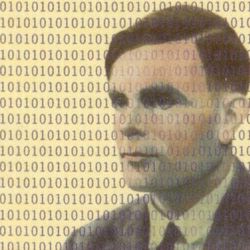 In the October 1950 issue of the British quarterly Mind, Alan Turing published a 28-page paper titled “Computing Machinery and Intelligence.” It was recognized almost instantly as a landmark. In 1956, less than six years after its publication in a small periodical read almost exclusively by academic philosophers, it was reprinted in The World of Mathematics, an anthology of writings on the classic problems and themes of mathematics and logic, most of them written by the greatest mathematicians and logicians of all time. (In an act that presaged much of the confusion that followed regarding what Turing really said, James Newman, editor of the anthology, silently re-titled the paper “Can a Machine Think?”) Since then, it has become one of the most reprinted, cited, quoted, misquoted, paraphrased, alluded to, and generally referenced philosophical papers ever published. It has influenced a wide range of intellectual disciplines—artificial intelligence (AI), robotics, epistemology, philosophy of mind—and helped shape public understanding, such as it is, of the limits and possibilities of non-human, man-made, artificial “intelligence.”
Turing’s paper claimed that suitably programmed digital computers would be generally accepted asthinking by around the year 2000, achieving that status by successfully responding to human questions in a human-like way. In preparing his readers to accept this idea, he explained what a digital computer is, presenting it as a special case of the “discrete state machine”; he offered a capsule explanation of what “programming” such a machine means; and he refuted—at least to his own satisfaction—nine arguments against his thesis that such a machine could be said to think. (All this groundwork was needed in 1950, when few people had even heard of computers.) But these sections of his paper are not what has made it so historically significant. The part that has seized our imagination, to the point where thousands who have never seen the paper nevertheless clearly remember it, is Turing’s proposed test for determining whether a computer is thinking—an experiment he calls the Imitation Game, but which is now known as the Turing Test.
More here.
