
June 18, 2012
On Eating Animals
by Namit Arora
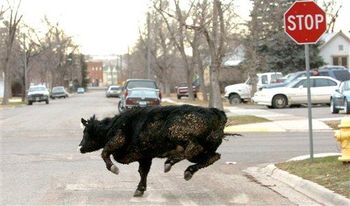
Some years ago in a Montana slaughterhouse, a Black Angus cow awaiting execution suddenly went berserk, jumped a five-foot fence, and escaped. She ran through the streets for hours, dodging cops, animal control officers, cars, trucks, and a train. Cornered near the Missouri river, the frightened animal jumped into its icy waters and made it across, where a tranquilizer gun brought her down. Her "daring escape" stole the hearts of the locals, some of whom had even cheered her on. The story got international media coverage. Telephone polls were held, calls demanding her freedom poured into local TV stations. Sensing the public mood, the slaughterhouse manager
made a show of "granting clemency" to what he dubbed “the brave cow.”
Given a name, Molly, the cow was sent to a nearby farm to live out her days
grazing under open skies—which warmed the cockles of many a heart.
Cattle trying to escape slaughterhouses are not uncommon. Few of their stories end happily though. Some years ago in Omaha, six cows escaped at once. Five were quickly recaptured; one kept running until Omaha police cornered her in an alley and pumped her with bullets. The cow, bellowing miserably and hobbling like a drunk for several seconds before collapsing, died on the street in a pool of blood. This brought howls of protest, some from folks who had witnessed the killing. They called the police’s handling inhumane and needlessly cruel.
It’s tempting to see these commiserating folks as animal lovers—and that's how they likely see themselves—until one remembers what they eat for dinner. A typical slaughterhouse in the United States kills over a thousand Mollys a day—lined up, shot in the head, and often cut-open and bled while still conscious, an end no less cruel and full of bellowing—all because Americans keep buying neatly-packaged slices of their corpses in supermarkets. Raised unnaturally and inhumanely, over a million protesting birds and mammals are violently killed in the U.S. every hour (that's 300 per second!). Is it then unreasonable to say that nearly all meat-eaters in America participate quite directly in a cycle of suffering and cruelty of staggering scale?
Yet the idea persists that Americans love animals, largely because of their love and concern for a class of animals called "pets" (and other "cute animals" like dolphins, polar bears, and pandas). Most Americans have had at least one pet at some point in their lives, and many see their pets as extensions of their families; they photograph their pets, swap stories about them, buy them gifts and treats, spend money on their sicknesses, support taxes to build shelters for them, and mourn their deaths. Yet, the question continues to rankle, as Elizabeth Kolbert put it:
"How is it that Americans, so solicitous of the animals they keep as pets, are so indifferent toward the ones they cook for dinner? The answer cannot lie in the beasts themselves. Pigs, after all, are quite companionable, and dogs are said to be delicious."[1]
What might explain this disjunction? From humankind's long community with farm animals, how has it come to this?
A Brief History of Farm Animals
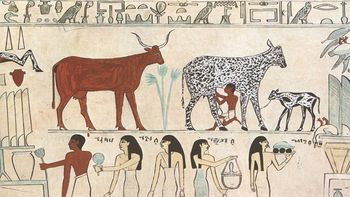
For much of our settled history—and even today in parts of the world—most people lived in close proximity to farm animals. Animals fertilized our crops, shared our labors, and nourished our bodies, helping us enlarge our settled communities. Families commonly kept a few farm animals, gave them names, and saw them as individuals with distinct temperaments. Children grew up around them, related to them effortlessly, and came to know their cycles of birth, aging, and death. Our obligations to domestic animals arose in part from a sense of kinship, community, and mutual dependence; we saw in them our own instincts, physical vulnerabilities, and social-filial attachments. They frequently inhabited our myths and polytheistic beliefs. Each time we killed and ate one of them, we also silently paid the price, however small, of having known the animal in life and in its dying moments. Children were often saddened by the slaughter of an animal they knew, and missed the animal for a while. Ritual animal sacrifices occurred only on special occasions. Abuse of animals occurred too but it was neither systematic nor centrally organized, and depended on the moral compasses of their owners. Like people, animals had their own luck in ending up with a severe human family or a gentler one.
In later millennia, urbanization, specialization, and new economic, religious, and humanistic ideas began altering our relations with farm animals. Ownership of farm animals became concentrated in fewer hands, flocks and herds grew larger. As a result, the individuality of animals was lost to their owners and they began receding from most people's everyday lives.[2] Over time, farm animals became yet another natural resource managed by specialists, who harvested their material value and transferred it to others via the market. It would hardly be an exaggeration to say that a hallmark of our modernity is a drastic loss of first-hand knowledge and experience of nature's beats and rhythms, including knowledge of animal lives. Most people today have no experience with farm animals. Generations of us have grown up in urban housing, public parks, and city streets, and rarely around the animals we eat. From a young age, we socialize our children—rather indoctrinate them, for there is nothing natural about it—to dearly love and fuss over some domesticated animals while eating others without thought, not unlike eating carrots.
In the twentieth century, the inexorable logic of modern economics and the assembly-line turned farm animals into number-tagged bodies, to be fattened, disinfected, and processed as quickly and cheaply as possible. We found new uses for animal parts in plastics, detergents, tires, cosmetics, dyes, contraceptives, crayons, and more. This went hand-in-hand with our portrayals of them as "dumb animals", making it easier to overlook their abuse and ignore their manifold social and emotional lives. Only animal behaviors with an economic impact merited attention. For example, factories had to deal with the tendency of animals to injure others or themselves when forced to stand in cramped feedlots in ankle-deep excrement, or when packed in tiny cages.
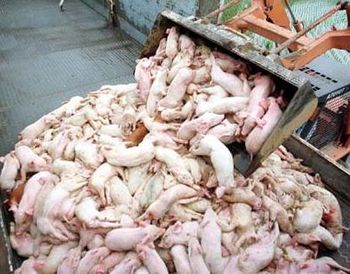
To raise efficiency and cut costs, farm animals began to be engineered for abnormally rapid weight gain, fed unnatural corn-based diets that cause metabolic disorders and liver damage, and injected with preemptive antibiotics and growth hormones. To reduce fights and injuries due to overcrowding, animals began to be routinely mutilated—for instance, their beaks, horns, or tails might be chopped or burned off without anesthesia—and they were often confined in tiny crates in windowless rooms. All of these procedures are now standard and legal. As with so many aspects of our economy, the full cost of this enterprise, whether ethical, environmental, or health-wise, has never been factored in. The tragedy was complete when raising and killing animals for meat came to be seen as agriculture, which is why the U.S. Department of Agriculture regulates this industry.
What might have arrested this decline in the fortunes of farm animals are big cultural ideas, both religious and secular, that for whatever reasons opposed killing animals. But those did not arise in the West as they did, for example, in India. Depending on whom you ask, Western monotheistic religions, while seeing humankind as God's special creation, ranged in attitude from passive disaffection to active malice towards animals. Christian doctrine has practically no injunctions against treating animals as a means to human ends, so sin is committed when mistreating or killing animals. Rather, animals were declared vastly inferior, incapable of possessing souls, and created for the use of humans, who stood right below the angels. And so Western monotheisms have long seen animals as dispensable for human interests, desires, and whims.[3]
In the modern age, even secular humanism, with its nearly exclusive focus on humans, has shown little regard for the treatment of animals. "In the West," writes Mary Midgley, "both the religious and the secular moral traditions have, till lately, scarcely attended to any non-human species."[4] With notable exceptions like Jacques Rousseau, Jeremy Bentham, Arthur Schopenhauer, and contemporary animal welfare organizations like the Society for the Prevention of Cruelty to Animals (SPCA), the dominant strands of Western culture have remained heavily invested in denying moral consideration to animals. Rather conveniently, animals are presumed to lack feelings, thoughts, emotions, memory, reason, intelligence, sense of time, language, consciousness, or autonomy. Until the 1980s scientists entertained the idea that animals do not feel pain. Such self-serving presumptions, enabled by our estrangement from farm animals, certainly made our conscience rest easier, even though our precious pets are not known to be any different in these terms. This helps explain why the animal rights movement focuses so hard on demonstrating many of these capacities in animals (sometimes overstating their case). So tenacious can our habits of life and mind be that even today, despite everything we know and the genuine alternatives we have for a nutritious diet, less than one percent of American adults have turned away from factory-farmed meat for ethical reasons.
The Modern Business of Killing

Slaughterhouses today operate behind closed doors, their violence increasingly concealed from society at large. Even their design tells a revealing story: careful division of labor, compartmentalized zones, non-unionized immigrant labor (especially on the kill floor), with few workers ever witnessing a killing despite working there for years. Language, too, cushions the psychological impact of the job, writes Timothy Pachirat, who worked in a slaughterhouse:
"In addition to spatial and labor divisions, the use of language is another way of concealing the violence of killing. From the moment cattle are unloaded from transport trucks into the slaughterhouse's holding pens, managers and kill floor supervisors refer to them as 'beef.' Although they are living, breathing, sentient beings, they have already linguistically been reduced to inanimate flesh, to use-objects. Similarly, there is a slew of acronyms and technical language around the food safety inspection system that reduces the quality control worker's job to a bureaucratic, technical regime rather than one that is forced to confront the truly massive taking of life. Although the quality control worker has full physical movement throughout the kill floor and sees every aspect of the killing, her interpretive frame is interdicted by the technical and bureaucratic requirements of the job. Temperatures, hydraulic pressures, acid concentrations, bacterial counts, and knife sanitization become the primary focus, rather than the massive, unceasing taking of life."[5]
In the United States, farm animals make up a whopping 98 percent of all birds and mammals humans use, the rest being pets, victims of research and sport, or held in zoos. We can’t ignore this 98 percent and still claim to be serious about animal welfare. The factory farming industry "has persuaded legislatures to amend criminal statutes that purport to protect farm animals from cruelty so that it cannot be prosecuted for any farming practice that the industry itself determines is acceptable, with no limit whatsoever on the pain caused by such practices. As a result, in most of the United States, prosecutors, judges, and juries no longer have the power to determine whether or not farm animals are treated in an acceptable manner. The industry alone defines the criminality of its own conduct."[6] Veterinarians who report abuses against farm animals risk liabilities. A report last year found that "The FBI Joint Terrorism Task Force has kept files on activists who expose animal welfare abuses on factory farms and recommended prosecuting them as terrorists."
"The Axe for the Frozen Sea Inside Us"
What can shake up our colossal indifference? Clearly, most people don't even know about the horror and pain we inflict on billions of birds and mammals in our meat factories. But there’s no good excuse for this, is there? It's more likely that we don't want to know—cannot afford to know for our own sake—so we turn a blind eye and trust the artifice of bucolic imagery on meat packaging. Some see parallels here with the German people's willful denial of the concentration camps that once operated around them, or call those who consume factory-farmed meat little Eichmanns. "For the animals, it is an eternal Treblinka", wrote Issac Bashevis Singer (who also used to say he turned vegetarian "for health reasons—the health of the chicken").
Predictably enough, many others are offended by such comparisons. They say that comparing the industrialized abuse of animals with the industrialized abuse of humans trivializes the latter. There are indeed limits to such comparisons, though our current enterprise may be worse in at least one respect: it has no foreseeable end. We seem committed to raising billions of sentient beings year-after-year only to kill them after a short life of intense suffering.[7] Furthermore, rather than take offense at polemical comparisons—as if others are obliged to be more judicious in their speech than we are in our silent deeds—why not reflect on our apathy instead? Criticizing vegetarians and vegans for being self-righteous—or being moral opportunists in having found a new way of affirming their decency to themselves—certainly doesn’t absolve us from the need to face up to our roles in perpetuating this cycle of violence and degradation.
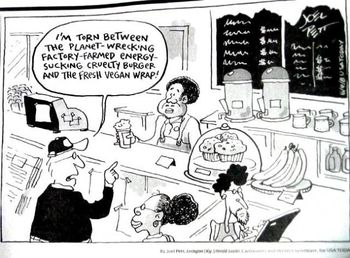
Not long ago a Humane Society sting operation at a California slaughterhouse (see the video) caused a large public outrage and media hubbub. A cynic might say that the outrage was motivated less by the cruelty, and more by concerns about the nutritional safety of meat from downer cattle. But genuine disgust at the cruelty was also evident in the response and in the flurry of donations to animal welfare groups. So it's not that farm animals get no sympathy in the United States, only that Americans somehow don’t realize that cruelty is the norm, not an exception and is, in fact, infused into the very idea of factory farms. What makes meat cheap meat is the assembly-line processing of animals who essentially subsidize it for us with their suffering.
Treating animals humanely requires natural diets, open spaces for living, eliminating the use of hormones that explode body weight and mutilations like chopping off beaks, tongues, and tails, together with more stringent training for caretakers and inspectors, surveillance cameras, professionals who enforce laws and prosecute violators, and so on—all of which make meat more expensive. Our desire for cheap products is often at odds with our desire to be ethical and humane. Few things strike me as more absurd than calling oneself an animal lover while patronizing industrialized meat, though people will surely continue to deceive themselves and even offer variously lame justifications to defend their habit (for example: many other animals also eat animals, humans are at the top of the food chain, people need meat protein to live, our traditions or religions sanction meat eating, and so on; David J Yount has compiled many good responses to such arguments).
The modern animal rights movement has certainly impacted a range of concerns—such as reducing the use of animals for furs and cosmetics testing, and enforcing laws against wanton hunting and certain cruelties—but not quite factory farming, which seems a more difficult case. This may well be because the industry is tied up with big corporate interests and serves more widely entrenched cultural habits. Another reason may be that the rights movement has not fostered enough discussion on where animal rights come from. What’s needed in my view are not theories of rights or liberty for animals, nor talk of "speciesism" or utilitarian optimization—at least not primarily—but narratives and experiences that reawaken us to a sense of kinship with farm animals, which is the ground upon which we build our obligations to them. (I can recommend the documentary film, The Emotional World of Farm Animals, as a place to begin.) There is no evidence that farm animals suffer any less than dogs or cats. They too are lovable, intelligent, and have individual personalities and social-emotional lives; many of them even bond with humans. They too have behaviors that in our pets we describe as fear, elation, loneliness, anxiety, playfulness, and so on. More of us rediscovering this may be a prerequisite to bringing greater dignity to their lives and deaths—and in doing so, greater dignity to our own.
It's also possible that even if we really took the time to discover how we treat farm animals, most of us might in good faith still decide to patronize factory-farmed meat. We might conclude that the price we make animals pay, and the price we pay in sacrificing part of our humanity, are worth the benefits to us. Such honest deliberation would require that we make our meat factories open to the public—give them glass walls, so to speak—even visit them with our kids, so they too can decide for themselves. That might be a step towards a clear conscience. But meanwhile how terribly dishonorable we look by averting our gaze and choosing ignorance—and in a surreal twist, going sentimental for cows that escape—while callously sponsoring the anguish and pain of billions of our fellow animals.
(Video: Farm to Fridge)
Notes:
- Elizabeth Kolbert, "Flesh of Your Flesh: Should you eat meat?", The New Yorker, Nov 2009.
- Lesley J Rogers, "Minds of their Own", p 182, 1998.
- This is also true for the "Confucian zone" of East Asia, about which I've written here.
- Mary Midgely, "Animals and Why They Matter," p 10, 1998.
- Timothy Pachirat, "Working Undercover in a Slaughterhouse: an interview", Boing Boing, 8 Mar 2012.
- Cass Sunstein and Martha Nussbaum, Editors, "Animal Rights: Current Debates and New Directions", p 206, 2004. From chapter titled "Foxes in the Hen House: Animals, Agribusiness and the Law" by David J. Wolfson & Mariann Sullivan, 2004.
- JM Coetzee, "The Lives of Animals", 1999.
- Stanley Cavell, Cora Diamond, John McDowell, Ian Hacking, Cary Wolfe, "Philosophy & Animal Life", 2008.
- A video interview with Jonathan Safran Foer.
_______________________________________________________
Read a companion piece: The Inner Lives of Animals.
See Namit's pictures of animals. More writing by Namit Arora?
_______________________________________________________
Posted by Namit Arora at 12:45 AM | Permalink


Comments
The pregnant Tyson pig in the top right-hand corner is still stuck in her cage, unable to turn around.
Great article, Namit. Thank you.
Posted by: Louise Gordon | Jun 18, 2012 5:33:44 AM
Namit, I'm sorry reality so offends you.
I'm lucky enough to live on a farm and to raise my own pork, beef, turkey and chicken. However, I don't ever moralize against city people who are dependent on "factory farming." If everyone tried to live like we do, there would be no land left for any other creature.
If the human species is going to continue to copulate and foal like there's no tomorrow, then other creatures are going to continue to suffer and die to feed us, period.
Get the hell over it.
Posted by: Mike | Jun 18, 2012 6:09:37 AM
Mike—
If some aspects of reality did not offend us we would not be moral beings.
Thanks very much Namit for enlightening us about one of those offending aspects.
Posted by: Jim | Jun 18, 2012 7:20:34 AM
Thank you for this. I am not quite sure eating meat is wrong (the question as to why we shouldn't engineer ecosystems to prevent animals from eating animals seems like a sharp objection to the utilitarian case) but it's plausible enough, and the joys of eating meat are sufficiently small and easy to give up that I try to be vegetarian as much as I can.
Re pets, to be honest people who fetishize their Molly's (or their pet dogs or cows or cats or horses or what have you) are even more frustrating than those like Mike above who don't see that there's a moral question to begin with. At least he's being straightforwardly consistent.
But this I'm skeptical of. For sheer bloody minded callousness toward animals it'd be hard to out-do the very non-monotheistic Confucian / Buddhist / Taoist East Asian societies (think only of live fish sushi). Nor have I seen particular kindness toward animals in India. People worship sacred animals sure, but that's always been consistent with treating them badly, and with eating the non-sacred beasties.
Posted by: prasad | Jun 18, 2012 7:52:30 AM
I started wondering about whether I should really be eating meat about three or four years ago. I'm afraid to say I mostly decided to ignore the question because of what it would require of me. Then when I read 'Dominion' I finally decided I had to decide whether my ethics could allow eating meat or not. Since then, about eight months ago, I've been a vegetarian.
Posted by: Jason Bosch | Jun 18, 2012 8:03:01 AM
As a side point, research into lab meat is very underfunded (if I recall, we're talking at most a few tens of millions a year) and niche, and that research seems like the most obvious hope for terminating the non-ending suffering currently caused. Actually, on that subject I don't understand quite why they want to grow meat from scratch instead of starting with the animal and taking away the things one cares about in it. Make cows with negligible brain capacity and blocked off pain receptors, and it seems like you get the same ethics, but with the formidable difficulties of taste, texture and disease control made easier.
Posted by: prasad | Jun 18, 2012 8:04:24 AM
I'm lucky enough to live on a farm and to raise my own pork, beef, turkey and chicken. However, I don't ever moralize against city people who are dependent on "factory farming." If everyone tried to live like we do, there would be no land left for any other creature.
Or, y'know, the city people could eat meat less often. Not sure how much of a cutback would be required, but the report discussed here claims: "A diet equivalent to eating meat three times a week would allow for sustainable land use -- no need for more Amazon deforestation, for example -- as well as for enough pasture for free-ranging livestock, and acreage to grow crops without extensive use of GMOs, pesticides, and other industrial farming methods."
Posted by: Jesse M. | Jun 18, 2012 9:09:49 AM
This needed to be said. Thank you Namit, for this article.Posted by: M73 | Jun 18, 2012 10:05:15 AM
Temple Grandin?
Posted by: Tan | Jun 18, 2012 10:42:42 AM
Should anyone be interested in doing research in the relevant literature, I have a bibliography (articles and books) on "animal ethics, rights, and law" available that I will send along to anyone on request. It's been updated (to about 2011) since it was first posted back in 2008 on the Ratio Juris blog. It's a little more than 20 pgs.
Posted by: Patrick S. O'Donnell | Jun 18, 2012 10:47:13 AM
When I look at cave paintings of the animals humans hunted 40,000 years ago I see nothing immoral about it. Humans, at great risk of injury simply hunted for nutritional needs like any other predator. We are, after all, animals. Having said this, factory farming is a sad and distasteful thing in comparison to those paleolithic hunts. The animals are not the same - they have been bred by us and really designed by us. Most could not even survive without humans. People who choose to avoid eating meat for moral reasons have my respect. I choose, however, to eat meat. I do agree that their are far too many of us on this planet and there is a need to control births, which seems to be happening. I also agree that the conditions of farm animals should be improved by legal mandate and they should be killed with the minimum of suffering. Other than that, there is no ethical question here.
Posted by: Olavi Valo | Jun 18, 2012 10:53:34 AM
A wonderful article, Namit. A while ago I made up my mind to eat to no animal I could not be sure was raised and killed in a humane environment -- easy to see how that led to very low consumption of meat and poultry. I had all the usual vegetarian-leaning motivations, but the one act that counted most to undermine the status quo was taking my money out of systems that were personally revolting and ecologically disastrous. I may soon commit to not eating any creature I would not be cool with personally raising and butchering for food, and this will make me 100% as opposed to 90% vegetarian, since I would not be able to kill an animal unless doing so stood between me and death by starvation. Getting informed is the first best step towards eating to create the world you want to see -- the world within and without. Once they get informed, people may choose not to be caught up in the very cycle of waste, cruelty, environmental disregard that provokes their own doom. This article is a superb resource for people who want to think it all through.
Posted by: Elatia Harris | Jun 18, 2012 11:14:17 AM
Excellent article that should be widely shared, read, and acted on. As president of Jewish Vegetarians of North America, I think it should be stressed that in addition to the very cruel treatment of animals on factory farms, animal-based diets are contributing to an epidemic of diseases and animal-based agriculture is contributing to climate change and other environmental threats to all of humanity, as well as shortages of food, water, energy, and other resources.
Posted by: Richard Schwartz | Jun 18, 2012 11:23:35 AM
To avert a climate catastrophe, it is essential that there be a major societal shift to plant-based diets.
Posted by: Richard Schwartz | Jun 18, 2012 11:25:07 AM
Patrick, I would love the article you mention. Ratio Juris is fabulous. I will check to see if I can find and download it. If not --
elatiaharrisATgmailDOTcom
I think hunting for animals as a way to survive is a case apart, unless the taking of animal life is the only thing that really matters. But there is some early evidence humans knew this question required thought and even religion. In very ancient times in the Middle East, a goddess was posited -- potnia theron, the mistress of the animals. She lived deep in the forested mountains, below the tree line but high enough to remain mostly hidden. She gathered and protected animals, fending off their human hunters with her murderous looks, for like her animals she was wild to see, and fierce. Until time and the imaginations of men made her girlish and beautiful, but kept her fierce. For a hunt to succeed, she needed to be won over to the side of the hunters -- propitiated to release enough animals to their arrows and clubs. If only our demands on nature had stayed so modest: enough for survival, not for systematic slaughter.
Posted by: Elatia Harris | Jun 18, 2012 11:54:41 AM
There's no doubt that early hunters and modern people who still hunt for survival like the Inuit had a lot of respect for the animals they hunted. I think you can see this respect and even awe in the cave paintings. We have lost this vital link and grown fat and stupid as a result.
Posted by: Olavi Valo | Jun 18, 2012 12:07:01 PM
I find some of the low hanging fruit flavored cliches people post here to be sadly humorous: 'humans are carnivores', 'animals must die for us to propagate as a species', 'our cave dwelling ancestors hunted and ate animals so it's part of our nature'...some of you are like children believing in the tooth fairy or the Easter bunny.
Vegetarianism is the only way we ARE going to survive as a species resource-wise and health-wise. Educate yourselves before publicly displaying your thoughtlessness.
'Meat, the number one drug on the street' KRS-ONE
Posted by: Kim Cascone | Jun 18, 2012 12:36:25 PM
Heifer whines could be human cries
Closer comes the screaming knife
This beautiful creature must die
A death for no reason
And death for no reason is murder
And the flesh you so fancifully fry
Is not succulent, tasty or kind
It's death for no reason
And death for no reason is murder
And the calf that you carve with a smile
Is murder
And the turkey you festively slice
Is murder
Do you know how animals die ?
Kitchen aromas aren't very homely
It's not comforting cheery or kind
It's sizzling blood and the unholy stench
Of murder
It's not natural normal or kind
The flesh you so fancifully fry
The meat in your mouth
As you savour the flavour
Of murder
No, no, no, it's murder
Oh...and who hears when animals cry ?
- The Smiths
Posted by: Eli | Jun 18, 2012 12:41:49 PM
Animal Enterprise Terrorism Act
http://jurist.org/hotline/2012/01/will-potter-aeta-terrorism.php
Can't let anything interfere with corporate profits.
Posted by: Louise Gordon | Jun 18, 2012 12:59:16 PM
@patrick O'Donnell. I'd like that biblio.
bdrljm1976 at google mail
Posted by: Dorn76 | Jun 18, 2012 1:06:37 PM
Here's the post that contains the link to the first draft of the animal ethics, rights, and law bibliography: http://ratiojuris.blogspot.com/2008/06/animal-ethics-rights-law-bibliography.html
I'll send out the latest version to those who have requested it later today. Thanks, Patrick
Posted by: Patrick S. O'Donnell | Jun 18, 2012 1:26:39 PM
Kim, you are so right -- people who are unmoved by cruelty to animals are yet involved, whether they accept it or not, in crafting the kind of future we _can_ have, before it is either compulsory or simply too late. And don't tell me it's natural to eat meat -- I KNOW that. It's also natural to procreate, yet many people do not do that, not from distaste for child-rearing but from knowing the Second Earth needed to support a disastrous population is not on supply.
Posted by: Elatia Harris | Jun 18, 2012 1:42:59 PM
For lots of free info and links about the *many* benefits of vegetarianism (and the many problems with the production and consumption of meat), please visit (and share)
Eco-Eating at www.brook.com/veg
Posted by: Dan Brook | Jun 18, 2012 1:58:03 PM
Thank you, Dan. That's just what I needed.
Posted by: Louise Gordon | Jun 18, 2012 2:16:09 PM
Kim,
You will be wildly applauded on 3QD for towing the politically correct line. That doesn't make you right, or any less patronizing.
Posted by: Olavi Valo | Jun 18, 2012 2:27:12 PM
"Christian doctrine has practically no injunctions against treating animals as a means to human ends."
Depends on who you talk to. Try asking your friendly neighborhood Rastaman.
http://en.wikipedia.org/wiki/Ital
Posted by: Andy Deviner | Jun 18, 2012 2:50:33 PM
@Olavi - I prefer to think of not killing as spiritually correct
Posted by: Kim Cascone | Jun 18, 2012 3:01:05 PM
also,
http://www.forksoverknives.com/
Posted by: Kim Cascone | Jun 18, 2012 3:02:41 PM
Excellent piece, Namit♥ You specifically bring in Americans to the discussion but didn't really illuminate what is particular about America or Americans or Americanisms in terms of the topic. If you ever do a follow up I think it would be interesting to pursue the way the American model --like the Soviet model before it-- has seen more disapprearance of small farms and crop-diversity as part of the centralization and financialization of farming than pretty much anything we have seen in history. It is scary because this is the model that is held up for export to other countries and I would argue the coporate model (where high profit is the bottom line) is also being applied to education and to employment--so it goes beyond animals. Not only is it cruel but the impact on social and environmental eco-systems is unforgivable.
Posted by: Leanne Ogasawara | Jun 18, 2012 3:13:46 PM
"Spiritually correct". Luckily we do not live in a theocracy or other form of totalitarian state. People who disagree with someone's position are not necessarily "incorrect". While I respect the vegetarian point of view I also expect them to respect my point of view. I would not say that vegetarianism is "incorrect" - it just isn't for me.
Posted by: Olavi Valo | Jun 18, 2012 3:26:32 PM
@Olavi: good luck with that!
Posted by: Kim Cascone | Jun 18, 2012 3:28:28 PM
J M Coetzee makes the case against animal slaughter in "Lives of Animals". It would be worth re-visiting his arguments, or perhaps even inviting him to contribute on the subject to 3QD.
Posted by: Mike Cope | Jun 18, 2012 4:03:50 PM
Even accepting that animals are in some sense "sentient" in a way that distinguishes them from e.g. plants and bacteria, you fail to establish that such sentience imbues them with any sort of moral standing. Why does "sentient" == "worthy of moral consideration"? Animals themselves (carnivores, anyway) certainly don't make that connection, and I certainly don't see why we should do it for them.
Posted by: wtinasky | Jun 18, 2012 7:10:27 PM
Just to clarify my previous post: I certainly understand the impulse that leads from "I believe that X suffers" to "X deserves moral consideration". It's an emotionally compelling leap to make, and one that the empathy centers of our brains have been evolved to make. But just because it feels moral doesn't necessarily make it so. My point, I guess, is that a subjective feeling of empathy is not a valid foundation for moral reasoning. It is, after all, just a feeling.
That's not to say that a rational argument for The Moral Purpose of Animals can't be made. It's just that this essay doesn't make it.
Posted by: wtinasky | Jun 18, 2012 7:49:39 PM
wtinasky, the connection you may be seeking was found by Jeremy Bentham, who bade us not ask whether animals could reason or speak, but whether they could suffer. When animals experience abuse, and are terrorized, especially en route to a death they can see and hear being dealt to others of their kind, I'll wager they can suffer. Or else, they are so clever in giving that appearance that, like the cow in Namit's story, they may successfully demand a reprieve from extinction. If we conceive of animal suffering as real, but not significant because they themselves cannot conceive of it as we do, we are making several errors beyond a failure of empathy. To require them to be moral beings like ourselves before we would see the good of preventing their suffering, is solipsistic. And, if we _are_ the unique possessors of moral natures as we understand them, we should still take care to do as little moral damage to ourselves as possible.
Posted by: Elatia Harris | Jun 18, 2012 9:49:07 PM
"My point, I guess, is that a subjective feeling of empathy is not a valid foundation for moral reasoning. It is, after all, just a feeling."
Don't all reasoned moral arguments require us to start from some axioms that just have to be taken as a given? Can you provide a reasoned argument for why causing needless suffering in humans is immoral? Personally, I would just accept that as an axiom based on broadly shared moral intuitions and feelings that doesn't depend too much on the specifics of culture and history--is this not a "valid foundation" in your eyes?
Posted by: Jesse M. | Jun 18, 2012 10:22:43 PM
Eating meat is a matter of choice. To raise animals humanely to slaughter them eventually is bourgeois morality and perpetuates their killings.
How do we know that our sense of morality is greater than that of animals, if anything it appears to be otherwise.
Morality: http://en.wikipedia.org/wiki/Morality
Posted by: Raza | Jun 18, 2012 10:51:25 PM
what a load of crap!
Posted by: eric | Jun 18, 2012 11:18:06 PM
"Can you provide a reasoned argument for why causing needless suffering in humans is immoral?"
Yes, actually, I can. There are a number of arguments that can be made, though this isn't really the forum.
The problem with "broadly shared moral intuitions" is that they go awry from time to time. Just look at the various histories of race relations for obvious examples. Besides, while everyone may agree that there exist broadly shared intuitions it's rare that anyone can agree on exactly what they actually are. That's one of the many problems that comes with relying on feelings in the first place.
I also find it odd that you'd take the position you have on this subject - the proponents of Animal Rights represent a trivial minority, really almost a fringe even in this country. If there's a shared moral intuition in this country (or any other) surely it's that factory farming is just fine.
Posted by: wtinasky | Jun 19, 2012 2:17:18 AM
@Elatia: I'm aware of Bentham but I find his arguments, in short, unconvincing. Animals surely suffer in the wild (ever see a wildebeest eaten alive by lions, or a cheetah slowly starve?). Should we therefore have UNICEF missions to relieve the Horror of the Savannah? Why not? If all suffering is equal don't we have a moral imperative to save the starving cheetah?
I do find something to agree with in your last point however - if there is an argument to be made it's one in defense of our own consciences. As Aquinas argues, we have a duty to avoid the willful infliction of cruelty, as such behavior corrupts the person committing it (and if you can torture a dog you can probably torture a person - a danger to be avoided). However, I believe that the only thing necessary to avoid that risk is to avoid the _perception_ of cruelty. Ie as long as we (as a culture) view animals as un-moral then no harm befalls us from treating them as un-moral. Amusingly, this position makes the Animal Rights movement itself that which is to be repudiated, for it wakes us up to a horror that exists solely because we are awakened to it. They both create the nightmare and tell us to fear it, as it were.
Posted by: wtinasky | Jun 19, 2012 2:55:55 AM
Really good article.
I agree, eating less or no meat, and being honest where it comes from would be a very good step.
For my in-laws in the rural Philippines, killing a farm chicken is quite normal. I always thought it's incredible hypocritical by the tourists who travel there to avert their eyes in disbelief, while they are happy to have the chicken breast on their plate. We as humans should at least man up (or woman up) and realize what we are doing.
Posted by: Klausi | Jun 19, 2012 3:38:10 AM
Excellent and thought-provoking article, Namit.
I also find wtinasky's comment that "Animals surely suffer in the wild (ever see a wildebeest eaten alive by lions, or a cheetah slowly starve?). Should we therefore have UNICEF missions to relieve the Horror of the Savannah? Why not? If all suffering is equal don't we have a moral imperative to save the starving cheetah?" very compelling and worth thinking about.
Posted by: Abbas Raza | Jun 19, 2012 4:51:45 AM
Sentient Meat -- Who knew?
http://youtu.be/Ya6UCAy3LDs
Posted by: John Ballard | Jun 19, 2012 6:06:40 AM
Gosh. Such a good article, and excellent comments too! Thanks, All. I suppose it comes down to acknowledging sentience, taking suffering seriously, and then taking steps in our own lives to reduce or eliminate the suffering of others. It is entirely up to each of us as to whether we should incorporate ethical value into our private economies. If we can do so globally we may actually prove ourselves a special species after all. Something tells me we are on the way there.
Posted by: Christopher Holvenstot | Jun 19, 2012 7:30:51 AM
Several general points:
Some of the skeptical remarks above betray a lack of familiarity with the existing philosophical literature on animal ethics, which is covered in the bibliography I mentioned above.
As to wild animals, this too has been discussed in the literature, the point being rather the suffering animals experience as a result of the animal-industrial-complex as it were, in other words, suffering that human beings are causally (directly and indirectly) responsible for, it is thus not a question of suffering simpliciter.
The arguments in the literature include ethical theories that are, for example, (strictly or loosely) Kantian, utilitarian, theological, Buddhalogical, spiritual, and ecological, even perhaps Wittgensteinian in some sense (Cora Diamond). In other words, the arguments are not simply grounded in feelings: although these do count for something as do intuitions, for feelings are treated with respect by philosophers cognizant of moral psychology, and ethicists in contemporary philosophy have once again (moral psychology was essential to ancient Greek philosophers and had an important role to play up until Hume and the ‘moral sense’ philosophers) begun to appreciate the role of moral psychology in ethical reasoning; and intuitions are given their due in works like Robert Audi’s The Good in the Right: A Theory of Intuition and Intrinsic Value (2004). Moral intuitions like emotions, never stand alone in the ethical arguments, but they nevertheless often have an indispensable role to play.
Other recent comments are addressed, among other places, in what follows in an article by Jeff Leslie and Cass R. Sunstein, “Animal Rights Without Controversy:”*
* The paper is available here: http://papers.ssrn.com/sol3/papers.cfm?abstract_id=890666
Of course theirs is only one approach to addressing the issues raised here but I think there’s much to be said for it.
Posted by: Patrick S. O'Donnell | Jun 19, 2012 9:23:58 AM
"In short, consumers should be informed of the treatment of animals used for food, so that they can make knowledgeable choices about what food to buy."
Warning labels on factory farmed meat, as on cigarette packs, seems like a good idea, including images of wholesale slaughter, along the same line as blackened cancerous lungs in anti-smoking labels. Also, restaurants should be required to post the provenance of the meat they serve. The end result of course, is going to make meat more scarce and more expensive. Not a bad thing, if economically disadvantaged people can be educated about balanced nutrition. After all, a $3.25 hamburger fills the stomach more adequately than a salad at the same price.
Thoughtful article, Namit.
Posted by: Ruchira | Jun 19, 2012 10:26:23 AM
Thank you, Patrick.
In my youth, capital punishment was outlawed in the UK. This caused much commentary around the world. After all, Brits of my parents' age had long seen it as their right to attend the public execution of a wrongdoer and look on as he was "hanged by the neck until death." This provided the public with a great deal of satisfaction, on many levels, as, in previous centuries, a Sunday trip to Bedlam, to be entertained by the outlandish suffering and deep disorder they saw among the lunatics there, had done. It's easily seen in retrospect that some "pleasures" are so unseemly that we must enjoy them either not at all or without the legal right to do so, but it is not so easy to survey the present landscape of pleasures and rights with an eye to what the future will see as gravely wrong. When an important British judge was interviewed just after capital punishment was overturned, he was asked, "So, now we know it is wrong?" The judge replied, "Yes, now we know it is wrong. More than that, we know that it was always wrong." Dismantling systems that depend on the torture and slaughter of animals, no matter the pleasures lost to ourselves, may well be a parallel evolution.
Posted by: Elatia Harris | Jun 19, 2012 10:30:14 AM
Ruchira,
Actually, the effect of warning labels on meat would be to decrease demand for meat and therefore decrease the price.
Posted by: Olavi Valo | Jun 19, 2012 10:39:44 AM
I have decided not to eat meat since I have no idea how to kill and butcher a cow or pig. In the same spirit, I will not fly since I'm not a pilot, I will not drive since I'm not a mechanic and I will not wear clothes since I really do not know how to make cloth and sew.
Posted by: Olavi Valo | Jun 19, 2012 11:03:52 AM
I think if I waded through Patrick's bibliography, I would find a good argument outlining the ethical grounds of vegetarianism based on cruelty to animals. Namit's piece, I think, doesn't make the argument. What I think Namit's piece does is persuade that in terms of cruelty, the present American industrial system of meat production is unethical (i.e., Americans cannot in good conscience claim to love animals).
In fact, this was not explored here but one could even argue this strictly from a humanistic perspective; current meat producing and consuming habits are environmentally untenable. The food companies are as predatory as oil companies so this ain't ever gonna happen but let's say, we went to an older model, small companies providing expensive products. Meat would become very expensive (as it was in Japan before pressure opened their markets to cheap US and Australian beef)... in such a case, people are careful and only buy in small quantities. This is better for human health as well as better for our human environment. And as a wonderful by-product, it is less cruel to the animals. As Abbas said, animals suffer and are killed in the wild too--for this reason, for now, I want to start with the real issue and that is the American style animal-industrial complex. It is incredibly disturbing because it is so predatory to closed foreign markets and so within time, this will take over the world--like starbucks.
Posted by: Leanne Ogasawara | Jun 19, 2012 12:40:56 PM
There is also horrendous animal suffering in product testing and medical research. The Animal Liberation Front explains some of it.
http://www.moviesfoundonline.com/earthlings.php
Posted by: Louise Gordon | Jun 19, 2012 12:52:51 PM
Yes, actually, I can. There are a number of arguments that can be made, though this isn't really the forum.
Are they arguments familiar from philosophical literature (if so perhaps you could direct me to them), or are they your own original arguments?
The problem with "broadly shared moral intuitions" is that they go awry from time to time. Just look at the various histories of race relations for obvious examples. Besides, while everyone may agree that there exist broadly shared intuitions it's rare that anyone can agree on exactly what they actually are. That's one of the many problems that comes with relying on feelings in the first place.
Again, I see no reasonable alternative to relying on intuitions. It's not that we should accept our initial intuitions uncritically--I like to imagine the ideal ethical system as a sort of attractor that different groups would tend to converge to over time after long periods of trying to find guidelines that produce the most happiness and allow groups whose ideologies differ in many ways to get along. So, I think there is an obligation to try to expand our perspectives and question intuitions that may be too rooted in parochial feelings specific to the culture we were raised in. I also think ethical philosophers are doing something useful when they look for general principles that could underly a lot of more specific moral intuitions about different situations, and imagine ethical thought-experiments to try to probe proposed principles. Still, I don't think ethical intuitions can be dispensed with, even if they are subjected to this sort of critical questioning to see which intuitions stand up to it and which don't.
I also find it odd that you'd take the position you have on this subject - the proponents of Animal Rights represent a trivial minority, really almost a fringe even in this country. If there's a shared moral intuition in this country (or any other) surely it's that factory farming is just fine.
I would say that most people see it as a necessary evil, and also that most people avoid thinking or learning too much about the conditions in those farms. I think a lot more people would try to minimize their use of factory-farmed meat if they had affordable alternative meat sources available, and if they had really investigated what things are like in those farms. And if we're trying to avoid just having a bunch of specific intuitions about specific situations, and instead look for broader principles, do you think "animal suffering is morally irrelevant" would be likely to be broadly accepted? Most people don't like seeing animals suffer "unnecessarily", when it isn't an unavoidable consequence of something else people need, like meat or medical research.
Posted by: Jesse M. | Jun 19, 2012 12:53:51 PM
Non-factory farmed animals. I don't know how they kill the animals when it's time.
http://www.eatwild.com/products/massachusetts.html
Posted by: Louise Gordon | Jun 19, 2012 1:25:10 PM
http://www.pcrm.org/research/
Posted by: Louise Gordon | Jun 19, 2012 1:29:11 PM
When the embedded video is viewed on You Tube the sidebar and thumbnails at the end present the most terrible depictions of depravity imaginable, some of which may even be made up. One need not look far to discover suffering, both in the natural world and as the consequence of human activity.
I approach the question of cruelty to animals in much the same way that I react to war, capital punishment, human trafficking and any number of -- I can't find a word big enough to embrace it all...
But I come away with the same pitiful conclusion I came to in the cases of capital punishment and my decision to become a conscientious objector years ago. I will live, work and argue against these and other evils but with no expectation that they will vanish in my lifetime. I am not excused from pressing the issue, but it is clear that I will never eradicate these evils and cannot expect my metric of morality to become normative for everybody else.
In the end I have control over one human being, myself. So my objections to animal cruelty, like that of capital punishment, has less to do with the cruelty itself than what that does to me as a participant.
Objections to capital punishment take many forms, but for me the one that is inescapable is what it does to me as a citizen-participant in that punishment. There are many poster-child examples purporting to justify capital punishment, but for me even for the most "deserving" of those cases the worst I can advocate for them would be life in prison, not execution.
Likewise, I recognize that waging war is one of mankind's most cherished traditions. I realized when I was drafted that there are plenty of people who actually look forward to killing others, for whatever reason. And if I have seen them with my own eyes wearing the same uniform, there is no reason to think there are plenty of others among those we call "enemy." My conclusion was that they need one another for balance, in the same way that nature has predators to manage populations and furnish food for carnivores.
But some of us are not warrior material. There is no shortage of warriors, and the population of those not fit is (and will likely continue to be) too small to matter. So I find myself being on the side of compassion, peace and all the rest of those qualities so many find out of reach.
So now, having been reminded once again about the evils of factory farms, I will not likely become vegan, but will continue to spread the word about the agricultural-industrial complex.
We all owe Namit our deepest gratitude for this provocative post and one of the most stirring comment threads in recent weeks.
Posted by: John Ballard | Jun 19, 2012 1:36:51 PM
I think Michael Polanyi's tacit knowing is related to what is being called intuition here:
http://www.sveiby.com/articles/Polanyi.html
Posted by: Louise Gordon | Jun 19, 2012 1:37:02 PM
I'd rather be executed than live life in the prison-industrial complex in solitary confinement or as a slave laborer.
Posted by: Louise Gordon | Jun 19, 2012 1:46:30 PM
When animals grant other animals 'rights' then I will understand this article. If chickens weighed 1,000 pounds they would eat humans like they now eat insects,do sharks and tigers kill and eat humans,hell yes they do.....ever hear of the law of the jungle?? If cows are so damn smart why do they allow themselves to be fenced in with a few strands of wire?? Ever see two bulls take out 1/4 mile of fence while fighting,I have!!Ever hear the old time phrase "I haven't had this much fun since the hogs ate my little brother" How do the experts explain how the so-called 'factory farm' animals grow, reproduce and rest if they are sooooo miserable? Ever see a 'free range' chicken running around with no wings after a racoon tore them off??.....I have,ever see a big fat hens misery after an opossum ate out a lot of its
internal organs,at night,when the hen couldn't escape?? I have.....the entire animal rights issue is another big time scam....check out the funds controlled by hsus and then check and see what they actually do for individual animals!!
Posted by: sls | Jun 19, 2012 1:47:52 PM
sis,
It is not permitted to let reality intrude when 3QDers are engaged in philosophizing. (See the Case Against Kids for a prime example)
Posted by: Olavi Valo | Jun 19, 2012 2:05:53 PM
Like John and some others here, I don't think I am going to give up meat entirely based on what has been argued here. But I have thought about some of these issues for a while and based on that I have modified my consumption of meat to the extent that I do investigate what kind of meat I buy and how much I consume (not very much) quite carefully. I also find the size of portions served up at the average American restaurant quite appalling. It is either a recipe for obesity and poor health if you finish what is on your plate or a huge waste if you don't. Cheap (at what cost?) unethically produced meat in huge quantities is surely at the root of poor eating and wasting habits of Americans.
While I agree with much of what Namit says here, like Prasad, I disagree in placing the blame on Christianity. I think prosperity and urbanization are more to blame here. The treatment of animals in the Buddhist / Hindu east not really admirable. Please check the rate of increase in meat eating in capitalist/ communist China and animal abuse is there and in much of the far east is rampant. Heavily vegetarian India cannot brag much about its treatment of animals, both in the slaughter house and for those that roam free. While many Indians "worship" some animals, they are totally apathetic to animal welfare on the whole including by the way, that of dogs and cats. I see no great love of animals in the heart of Indian vegetarians. For most not eating meat is based on tradition and a sense of religious "purity" rather than any deeply thought out ethics.
Posted by: Ruchira | Jun 19, 2012 2:33:10 PM
Has anyone here ever watched the video showing the shooting of people,from a helicopter, while the shooters laugh and have a game of it?? Ever hear of a drone aircraft??,they are especially good for blasting limbs from little children!!!Have we devolved so far that we now put more 'value' on an animal that we do on a fellow human?? Ah but you don't get to see the blasting of the little child because the sponsors of this activity have made it illegal for journalists to show the terrors of war or the endless parade of caskets being shipped back home,wouldn't want to upset the home folk,they might not vote 'the right way' next time!!!
Posted by: sls | Jun 19, 2012 2:35:24 PM
When animals grant other animals 'rights' then I will understand this article.
This doesn't seem like much of an argument--I don't think young children have any concept of "rights" either, does that mean we adults shouldn't grant them any rights? They can be pretty brutal to one another if left unattended, does that mean it's fine for us to be equally brutal to them? Anyway, the objection to factory farming is not necessarily that it's wrong for us to put animals in situations where they will experience any suffering, some may argue that we just shouldn't expose them to lives that contain significantly more suffering than an average wild animal would encounter, or more than is "necessary" for the purposes of eventually using them for food. That's my position anyway--I don't have a problem with allowing predators to run free and eat other animals in wildlife reserves maintained by humans, for example, nor do I really have a problem with slaughtering animals for food (in a way that tries to make sure they will have a quick death) if they are raised in humane conditions up until that point. To me it's really all about not causing needless suffering. (I have a somewhat idiosyncratic perspective though--even with humans, I think of the wrongness of murder almost entirely in terms of the suffering caused to the loved ones of the victim, not in terms of harm done to the victim, who can no longer care or feel wronged.)
Posted by: Jesse M. | Jun 19, 2012 2:57:28 PM
sls and Olavi,
If you pay attention, you will note that not all of us who are arguing against the unnecessary mistreatment of animals for corporate profit are saying the same thing.
I have witnessed slaughter of animals in India - it often happens in open markets, especially chickens - and that did not launch me on a vegetarian path. But what is wrong with reducing cruelty and pain of all creatures even if you like your steak and burger? Also, why can't we be against both inhumane animal farming AND war? Your strawmen are pretty easy to spot.
Posted by: Ruchira | Jun 19, 2012 3:01:44 PM
How fortunate we are to have the luxury of debating the question of eating animals instead of having to worry all the time about being eaten by animals. This is progress.
Posted by: Olavi Valo | Jun 19, 2012 4:02:10 PM
Ruchira, you are so right. There's everyone, here, from Vegans to vegetarians, to people who are leaning vegetarian, to people who who are less (openly) concerned with their diets than they are with interference in their diet choices, from people who in good faith do not see the ethical or moral dimension of eating animals, to people who truly do not see that refraining from, or drastically reducing, eating animals would have a much needed environmental result.
What I have not seen here is what I would call a truly intelligent argument for continuing to produce and consume industrial meat, exactly as we do now. So, I would like to see anyone who remotely can make that argument.
Also, upstream somewhere, a reader commented that, what with animals killing each other, nature was cruel, and that we need not be kinder or more ethical than nature when it comes to how we regard animal life. While animals do kill each other for food, and sometimes for territory, they do not confine and raise as food species that are vulnerable to them. I think that's the issue -- I don't think the issue is whether wilderness life is harsh. And we do intervene, all the time, to make wilderness life less harsh for animals that are threatened by other conditions than human predation. These missions analogize quite nicely with purely humanitarian efforts to reduce risk and relieve suffering in war zones.
Posted by: Elatia Harris | Jun 19, 2012 4:43:52 PM
There is at least one important ethical question around eating animals and it is whether it is moral for us to deprive the labor market for factory farm animal production of a means of making money?
Basically, if we all stopped eating meat, a lot of animal meat labor market people would lose their jobs. In some countries, that would be quite destabilizing to society itself since so many people in the developing world are farmers.
To emphasize this point, just consider the following possible future. The factory farming market for meat is ripe for disruption. There are already many innovations in this space and they often involve non-killing of animals. One could easily imagine a future where the price of 'non-killed meat' appoaches that of factory farmed meat attracting a range of early adopters who eat this meat (as opposed to 'cruel meat') thereby increasing the level of research in the field to the point where 'non-cruel meat' becomes competitive with 'cruel meat' and later even cheaper.
At that point, it is conceivable that hundreds of thousands of farmers in India would lose their livelihood and given that that is all (mostly all) they know how to do, they would edge closer to starvation.
By eating meat, you at least postpone this outcome which, for all we know, might eventually come to pass.
Posted by: Anand Manikutty | Jun 19, 2012 9:23:53 PM
Interesting how folks justify eating meat by the fact that other animals eat each other. Go ahead and return to the state of nature and live by the morality of beasts. I prefer civilization. Also, no one will argue that if you're starving you should die before killing another animal. Animals eat each other out of necessity, but last time I checked it was possible for humans to survive without resorting to killing other animals.
Posted by: Eli | Jun 19, 2012 9:52:05 PM
The question of why we should hold ourselves to standards we don't hold animals to isn't that deep. We also think it'd be wrong of one of us to urinate all over someone's living room, while thinking it merely irksome or unfortunate for a baby to do it. The harder question, as Abbas says, is why we aren't given a reason to minimize the consequences of animals inflicting pain and suffering as well. We do put diapers on babies, after all...
Posted by: prasad | Jun 20, 2012 1:22:14 AM
Quite, Prasad. I haven't seen a response that's adequately addressed the point Wtinasky was actually making and which Abbas Raza picked up on, which was NOT that you and me, baby, ain't nothing but animals, so let's do it like they do on the Discovery Channel. It was, if I'm not also mistaken, that if we accept that all animal suffering is equal (I don't, btw), then we impose upon ourselves the moral imperative to reduce all animal suffering, if we can. And we can, theoretically. We can go out and engage the Horror of the Savannah, just as the NATO intervened in Libya, arguably reducing more 'units' of suffering per individual death than occurs in farming.
Posted by: Alasdair Cameron | Jun 20, 2012 4:11:57 AM
Amongst the many issues with industrial food production there's wastage as well. Tristam Stuart's 'Waste' is well worth taking a look. Western supermarkets have aggressively marketed more popular cuts (breast & thigh), discarding offal at the factory level. Similarly, shocking amounts of veggies are discarded since they are not uniformly sized for packing. Then there's poor distribution and wastage during long distance transportation. The statistics are pretty grim & the ethical dimensions are of course, pretty significant.
Posted by: Gautam | Jun 20, 2012 9:06:36 AM
Well, while I think the point Abbas excavates is a solid one, I don't think I can endorse wtinasky's actual arguments, such as:
We think it wrong to, I dunno, burn a piglet for fun, while only a crazy person would consider it wrong to burn a mannequin, though in respect of appearance the doll resembles us far more than a piglet does. To articulate why some deeds (burning piglets) corrupt a person and may increase the odds of his burning people while others (burning mannequins) don't, you have to confront that there are relevant similarities in the one case that there aren't in the other. You have to say it doesn't particularly matter whether something has the superficial shape and size of an adult human, while it matters a great deal if you're making that entity squeal in agony for no reason. You need something like an honest confrontation with the fact that these creatures and we exist on a continuum, and that they possess in some significant degree the qualities we value in ourselves. And it isn't easy at all to see why those similarities and morally significant attributes should matter so much in us, and not at all in them. Wtinasky's point certainly is a refutation of sorts when aimed at people who thoughtlessly/out of willful ignorance act abominably toward animals, but then get understandably all het up when someone does something 'gratuitous' like setting a piglet on fire. IF for one an animal is a mere mannequin, then sure, wtinasky's kind of horrible response is enough.
Posted by: prasad | Jun 20, 2012 10:00:49 AM
Getting even more interesting, people.
About Anand's point -- radical livelihood loss among farmers, owing to innovation that sounds pretty repulsive anyway, "raising" meat that was never alive. Oh get me to the lentil field ASAP...
I have heard arguments that the extraordinarily high number of people who push paper for the health insurance bureaucracy would be put out of work if society ever started to distinguish between health insurance and health care. Paying these non-medical people takes one third of every dollar an American spends on medical care. Should we leave the system intact so that these doubtlessly good people can have the jobs they do have, rather than other jobs requiring the same skills? Or, is the greater good served by affordable health care facilitated by less money paid out to non-medical people?
The only meat or poultry I will ever buy comes from small farmers/producers. Not only animals but these farmers are the ones most injured by industrial meat. If we had many fewer animals, raised without hormones and antibiotics, killed without cruelty, by small producers, then there would be meat packers working for Romney cronies needing new jobs, not small farmers.
Job loss is not trivial but tragic. But -- do you keep a monstrous and insalubrious industry alive for the sake of the people who work in it? Is it more important that American milk be free of pus owing to dairy cows with infections created by gross mishandling and unnecessary medication, or that the people who work in these industrial dairies have the jobs they do have?
Posted by: Elatia Harris | Jun 20, 2012 11:39:17 AM
As I write this, I am watching a KQED program called Orangutang Diary. The lengths to which the baby sitters and veterinarians go, to rescue an individual animal, is truly amazing. This is indeed testimony to the remarkable heights of compassion humans can achieve for their fellow beings.
Stark is the contrast between this idyllic scenario and the dark realities of the animal-industrial complex Namit has painted for us. Even more interesting is the psychology of the individuals involved in either of these enterprises. In the Orangutan case, the employees are fully invested emotionally, while in the slaughterhouse the workers are fully divested.
I will venture that in either group, a significant portion of the individuals are meat eaters. Namit wonders why one can be both an animal lover and a meat eater, which cognitively smacks of engaging in double standards. That the brain is pretty adept at suppressing cognitive dissonance by responding with rationalizations and compartmentalization is fairly well documented in the psychological literature. Pertinent to the topic, I found this interesting article (http://www.onegreenplanet.org/lifestyle/carnism-why-eating-animals-is-a-social-justice-issue/) by a social psychologist Melanie Joy. In fact, she has written a book called Why We Love Dogs, Eat Pigs, and Wear Cows: An Introduction to Carnism (I have not read it so cannot attest to its contents).
She writes "….Widespread ambivalent, illogical attitudes toward a group of others are almost always a hallmark of an oppressive ideology. Oppressive ideologies require rational, humane people to participate in irrational, inhumane practices and to remain unaware of such contradictions. And they frame the choices of those who refuse to participate in the ideology as “personal preferences” rather than conscientious objections."
In the same article, she says "….Yet most of us have no idea that when we eat animals we are in fact making a choice. When we are growing up, forming our identity and values, nobody asks us whether we want to eat animals, how we feel about eating animals, whether we believe in eating animals. We are never asked to reflect upon this daily practice that has such profound ethical dimensions and personal implications. Eating animals is just a given; it’s just the way things are. Because carnism operates outside of our awareness, it robs us of our ability to make our choices freely—because without awareness, there is no free choice…."
The general consensus on the comment thread is we all more or less agree with Namit's position and sense of outrage. But how do we effect change in the general population? The few converts, from meat eating to vegetarianism, have engaged in critical thinking (which by the way requires cognitive effort) to shift their perspective. What about the others (there are some example comments here)? I want to share a personal experience. I grew up in a vegetarian household (thankfully!) but briefly experimented with meat eating in my 20s . Funnily, meat never felt like a meal and cognitively I seemed to be asking where is the real food? I quit. Contrast this with a Hungarian lab mate I had, who was incredulous that I was vegetarian and perhaps wondered how I had even made it. My point is : we may have to catch them young, so it becomes part of your DNA. Of course, this means the parents have to be on board. Here Jonathan Safran Foer -author of Eating Animals offers some help (http://www.nytimes.com/2009/10/11/magazine/11foer-t.html?_r=2&pagewanted=1).
Lastly, Namit talks about us having lost touch with animals. If anybody doubts that animals have a lot more in common with humans, I suggest you point your browser to this article (a perspective on animals by a cardiologist who has worked with veterinarians) http://www.nytimes.com/2012/06/10/opinion/sunday/our-animal-natures.html?pagewanted=all .
As I pondered the article, I thought it highlighted another important bias - one of size. I was thinking of live lobsters and crawfish, that get thrown to their deaths in boiling water.
In essence, we are trying to motivate a change in a fundamental human behavior, what biologists would refer to as one of the four Fs (Feeding, Fleeing, Fighting and Sex).
Thanks Namit, for a thought provoking article.
Posted by: Suresh | Jun 20, 2012 11:46:03 AM
First of all, I do not believe that we can in any practical terms significantly reduce suffering in the animal kingdom. Seriously, this is not comparable to NATO intervention in Libya (which itself was much easier said than done). This argument sounds to me like, well we can't stop all suffering in the world, so we might as well just cause additional suffering. Come on, this is not a serious argument, even when made by our esteemed blog host. We should all agree that we have an individual responsibility not to personally cause additional suffering that is under our control. The better objection, which I don't think has been made here, is that my own abstention from meat will not have any significant effect on the current system of industrialized suffering. This collective action problem is at least worth thinking about. But saying we would have to stop all animals in the wild from eating each other before we could consistently refuse to eat meat seems pretty rudiculous to me.
Posted by: Eli | Jun 20, 2012 11:50:53 AM
Interesting article....and comments.
No one mentioned Upton Sinclair's "The Jungle", about meat packing industry, and the more recent "Ominivore's Dilemma" by Michael Pollan.
I am among those for whom meat (of any kind) is a very small part of the diet. That is because of the belief that a meat-based diet is unhealthy.
Find a disconnect in the position taken by vegetarians and vegans. Do they display the same passion about wars and the the killing of human beings? I hope that they do.
Posted by: waqnis | Jun 20, 2012 11:52:06 AM
Elatia, you're on the right track, but PPACA capped the "medical loss ratio" at twenty percent (more or less) which is a fifth of costs instead of a third. It seems the total package is larded with a bunch of other stuff as well. Here is a list I paste around every time I get a chance.
http://thehealthcareblog.com/blog/2012/04/01/what-if-the-supreme-court-2/comment-page-1/#comment-213509
As for jobs in the agricultural-industrial complex, think what might happen if a growing number of families decided to get their own dairy cow and a few chickens. Four or five hens can yield a couple dozen eggs a week. And they'll eat up the table scraps at the same time.
Just thinking out loud...
Posted by: John Ballard | Jun 20, 2012 11:59:10 AM
Eli - The question isn't why we shouldn't do this stuff about stopping lions from killing wildebeest painfully before becoming vegan or something. The question is why the argument from animal suffering doesn't lead much further. I can't find the link now, but there's an actual honest-to-goodness ethicist in the UK, of the Peter Singer camp, who bites the animal-eating-animal bullet and says we should try and take charge of wildlife to minimize animal suffering. I'm guessing there's no-one here (be he meat lover, or "flexitarian", or vegetarian like me or vegan or freegan or Jain or whatever) who wants to do that. That suggests maybe the argument from suffering isn't perfect. Or maybe, who knows, it is, and we should be making of the world a giant zoo.
Posted by: prasad | Jun 20, 2012 12:37:37 PM
Morality is essentially a natural phenomenon that evolved to restrict excessive individualism that could undermine a group's cohesion and thereby reducing the individuals' fitness. (http://en.wikipedia.org/wiki/Morality)
So killing, stealing, etc are "wrong" because it is in everyones interest.The main reason we are concerned about animal suffering (or human suffering) is that we can relate to it as if it was happening to us. That is why we feel the pain more when the animal is more like us say mammals rather than insects. The other reason is that as social animals we have caring instincts (which is again in everyones interest) which creates a bond between us and animals that we rear even as we steal from them or plan to kill them.
There is no such thing as morality in the animal or human world. It is one of those things we have invented to feel good about ourselves.
Posted by: Raza | Jun 20, 2012 2:08:50 PM
There is such a thing as morality and we invented it out of necessity. Humans only survived by cooperating and that required a moral sense. So morality is as real as language or music. Of course it is true that our moral sense usually goes out the window under extreme circumstances. That's why we need to avoid extreme circumstances.
Posted by: Olavi Valo | Jun 20, 2012 2:16:42 PM
perhaps someone should attempt a definition of 'cruelty' That which is cruel to one person (example,fishing) is a very normal part of life to another.If you use painful or stressful as a definition then perhaps you should quit your job and try living off the land!Personally I define it as "against ones will" but I am the first to realize that is not workable!! Cockfighting is an extremely popular activity in many places but is banned in many others as 'cruel'....the cocks fight because they want to and if they decide to quit there isn't anyway to make them continue. I believe that many people mistake 'brutality' for 'cruelty'.....cockfighting is extremely brutal but so is the NFL!!
Posted by: sls | Jun 20, 2012 3:45:47 PM
So sls, those cows, chickens and pigs that are kept immobile in small pens smothered in their feces where they can't even turn around and then are kicked, dragged, electrocuted, scalded before being killed, could just turn around and get out of their misery if they wanted to?
Posted by: Ruchira | Jun 20, 2012 4:29:14 PM
And Prasad's Giant Zoo is far from the bottom of the slope down which the argument from suffering sends us tumbling. At the bottom, I fear, is the position David Benatar stakes out in 'Better Never to Have Been', in which he argues, cogently (as my seismic cognitive dissonance will testify), that the most humane solution for humankind is to submit ourselves to programmed extinction. Of course, if his reasoning holds, it would be cruel not to take the animals with us, and for that matter all other lifeforms that might conspire to get this whole cycle of suffering going again.
Posted by: Alasdair Cameron | Jun 20, 2012 4:58:32 PM
I think some of the comments here are indicative of moral idiocy.
I once saw a dog kill a black cat. He went to dog jail for a while until his humans could get him out. When the animal control officer arrived, he brought the dead cat to him.
This is no reason to raise farm animals in gratuitously cruel factory farm conditions, then slaughter them with more cruelty.
It's as if Frederick Winslow Taylor designed the factory farm and slaughter methods. Some of you here think that's just fine.
Posted by: Louise Gordon | Jun 20, 2012 8:25:39 PM
If someone gave you a 250 pound hog what would you do with it?? This entire thing centers around one thing,more empowerment for the govt.!!!if you people don't like the way so-called 'factory farms' are being operated get organized and buy them and run them to suit yourselves,close it down or whatever but no,you want more and more 'laws' while hypocritically shouting about all the freedoms you possess.I live on a small farm but in the town just east of me there is a rule on how tall you lawn grass can be,if it exceeds that height it will be mowed and the owner will be made to pay. In this town it is now illegal to work on an automobile outside,it must be in a building!! If you burn firewood there are rules as to how that wood must be stacked!!These rules are brought about by what I call the 'LNS' that is the 'long nose syndrome,'.There is a general rule in the livestock business,a miserable animal isnt a profitable one,you cant starve a profit! I have about 60 yrs. of experience around livestock,do you??you scream about the farrowing crates but they serve a very humane purpose,maybe you should educate yourselves a bit before repeating the words of the leaders of the animal rights movement,an obviously 'for profit operation'!! Have you ever noticed the pic's of a wet miserable looking little kitten,in some magazines??....it boggles the mind how much money a garden hose soaked cat can bring in!!!
Posted by: sls | Jun 21, 2012 12:00:06 PM
Maybe we should pool our money and buy Big Pharma. That way we could prevent Joseph Biederman and his two colleagues from taking $1.6 million in undisclosed funds from Pharma while they were running clinical trials. We could get people to understand that toddler temper tantrums are not childhood-onset bipolar disorder, the affliction "discovered" by Biederman. This resulted in a forty-fold increase in the diagnosis in the space of nine years.
OK, everyone. Let's buy Cargill. And while we're at it, let's dismantle the military-industrial complex. Boeing. Lockheed. Raytheon. We can buy them all, get them to turn their swords into plowshares. No more drones or targeted assassinations.
People are trying to dismantle corporate-run government by not working for corporations.
See David Korten's When Corporations Rule the World.
Posted by: Louise Gordon | Jun 21, 2012 12:53:13 PM
big Pharma is to you what a lion is to a zebra,a predator!! keep your ears and eyes open and try to avoid being the 'prey'!!!
Posted by: sls | Jun 21, 2012 3:06:22 PM
Like the meat industry and the military-industrial complex, Big Pharma is not just a predator. It is a fraudulent predator.
Posted by: Louise Gordon | Jun 21, 2012 6:57:29 PM
Isn’t the savannah already something of a zoo, with significant human mediation conceived as a moral counterforce to our catastrophic record of species depletion? These efforts seem concerned with restoring the equilibrium of ecosystems – horror and all – that have been damaged by human activity. A concern about beast on beast violence seems a little strange given the existential threat these wild animals are facing from our own species, but perhaps a comfortable subject change for some. I think the present zoological interventions make the most sense, acknowledging a corrective moral obligation without anthropomorphism. I think one can acknowledge human induced non-human suffering and still see it as a bad thing, even if you are so inclined as to put it a peg down in the hierarchy of suffering.
Perhaps in a science fiction tomorrow we'll all intervene in the brains of the wild and the lion really will lie down with the lamb; but my cynical guess is that it is more likely there simply won't be any lions.
Posted by: Jesse | Jun 22, 2012 12:26:32 AM
http://karlammann.com/about-site.php
Posted by: Louise Gordon | Jun 22, 2012 12:46:10 AM
Right on Jesse! If we turn out not to be the most successful species, animals -- such as are left -- and vegetation of whatever kind will take back the earth. Our detritus, in that event, will long be a hazard to animal life on land and sea, and to plant life. We seem strangely at peace with the wholesale destruction of many kinds that will end in human die-offs. If we had more self-respect and less fecklessness, we would stop this destruction now. Sickening cruelty to animals is a huge part of it, but it is systemic. And too big to fight?? We'll have to remember to decide, once the truly important stuff stops defocusing us...
Posted by: Elatia Harris | Jun 22, 2012 1:40:59 AM
Jesse, to be interested in the implications - right down to the bottom - of a certain argument or principle does not mean one is not able to be concerned about the issues that principle was recruited to address. There are legitimate problems with the argument from suffering, and to examine them may seem like an abstruse activity, but focussing on the broader picture is not a subject change. I suspect the readers of 3QD can handle a peek behind the philosophical curtain while still maintaining their passion for what's going on in front of it. I find preventable animal cruelty abhorrent. I'm all for fighting for a humane, biologically diverse world. But I also want to be aware of the moral hypocrisies the positions in that fight may entail.
Posted by: Alasdair Cameron | Jun 22, 2012 4:04:48 AM
Alaisdair, I'm okay with philosophy, even the abstruse variety, but I don't see any of that here. Namit never posited anywhere "that if we accept that all animal suffering is equal (I don't, btw), then we impose upon ourselves the moral imperative to reduce all animal suffering, if we can." -as you wrote. He has only posited that animals suffer, and that they suffer from human actions in the greatest numbers. But you run with your more extreme claim, even though you confess to not believing it yourself. You are of course free to have this conversation, or game of "philosophical" drape peek-a-boo, but I don't see why I should take it seriously or be in the least impressed by it. You have taken as your starting point something that does not actually correspond to anyone's position in this thread, therefore I hold little chance for the uncovering of any hidden "moral hypocrisies."
Posted by: Jesse | Jun 22, 2012 6:30:01 AM
It is not true, Jesse, that no one else in this thread is interested in the validity of the argument from suffering. The line of thinking developed from an idea expressed by Wtinasky, which was found compelling by Abbas Raza, and which Prasad and I expanded on. From the way you've quoted me and from the inference you've drawn (an incorrect one), it's apparent you don't understand why I think this is worth some attention. But I doubt saying more will remedy that. The arguments as already expressed are pretty clear.
Posted by: Alasdair Cameron | Jun 22, 2012 8:12:19 AM
Jesse, the things you said in replying to me, while interesting, don't seem to have anything to do with what I said. I think Alasdair replied sensibly, so I'll just say, the question is not what Namit specifically said, it's how he intends to avoid what seems like a pretty reasonable implication of his arguments. I'm very far from looking for a "comfortable subject change" here. If I had my druthers, the entire meat industry would be dismantled. But surely an argument isn't watertight merely because you like the conclusion. It's not a debating point either; I'd very much like to know of good ways of thinking about animal-on-animal suffering, because I am pretty committed to the idea that we should minimize needless (and taste doesn't count as a need here) animal suffering as inflicted by people. When did it become a bad thing to harbor doubts?
Posted by: prasad | Jun 22, 2012 8:15:26 AM
Most animals are either carnivores or herbivores. Some are omnivores ( eat plants and meat). The following species are omnivores:
Mammals: Bears, Hedgehogs, Humans, Opossums, Pigs, Chimpanzees, Raccoons, Rodents, Skunks, Sloths; Birds: Cassowaries, Chickens, Corvids, Rails, Rheas, Some fish, Some lizards.
(http://wiki.answers.com/Q/Which_animals_eat_plants_and_meat)
I am not sure animal to animal suffering is our concern or even a concern in the first place. Most carnivores are by nature so and have no choice. Humans have a choice which is why we are having this discussion.
For those concerned with animal to animal suffering, it has been suggested we work for the extinction of all carnivores: http://opinionator.blogs.nytimes.com/2010/09/19/the-meat-eaters/
Btw, have we solved the problem of people to animal or people to people sufferings?
Posted by: Raza | Jun 22, 2012 10:08:34 AM
As a human I am naturally an omnivore. Choosing to be a carnivore or herbivore would be an unnatural choice for a human.
Posted by: Olavi Valo | Jun 22, 2012 11:27:27 AM
"From the way you've quoted me and from the inference you've drawn (an incorrect one), it's apparent you don't understand why I think this is worth some attention. But I doubt saying more will remedy that."
Alasdair, right, sounds good to me.
"It's not a debating point either; I'd very much like to know of good ways of thinking about animal-on-animal suffering, because I am pretty committed to the idea that we should minimize needless (and taste doesn't count as a need here) animal suffering as inflicted by people. When did it become a bad thing to harbor doubts?"
Prasad, this is where I'm getting a little lost. You want to know of good ways to think about animal-on-animal suffering, because you are committed to minimizing suffering as inflicted by people. Why not start with the latter problem then, as was the point of Namit's article? A serious debate about what might constitute animal-on-animal suffering I don't see before me. Wtinasky simply threw out a "what if" all animal suffering is equal and the race was off. Given that non-human animals are not in control of their dietary choices, I don't see much profitable thought that's going to come from this. If you wanted to start exploring animal minds, animal agency and the ethics of human moral intervention (questions like does the stymieing of a predator from hunting not actually constitute a kind of suffering for that animal and so on) I could get more interested. But the hypothetical projection of human morality onto the eating habits of the wild, with some kind of missionary intervention stemming from it just seems like a goofy sideshow, given the concrete gallery of horrors that are actually being wrought from our human choices.
Never a bad thing to harbor doubts and you know I respect your intelligence very much. Its possible the gravity of what's happening both on the farm and out in the wild is blinding me to something worthwhile here, but I'm usually a sucker for a dazzling argument no matter how weird or recondite. Just not seeing it today.
Posted by: Jesse | Jun 22, 2012 2:45:48 PM
Jesse,
"Why not start with the latter problem then, as was the point of Namit's article? "
It's not about what problem you start with - that supposes there are two problems to work on. *Are* you saying the animal wildlife zoo/engineering carnivores to become herbivore + maintaining herbivore populations artificially / make all animals die Pat Benetar style / etc schemes are basically good goals, just of lower priority than ending factory farming? I guess if that's your view, sure, there's no actual problem in these arguments. (Well, maybe two such people could still debate the issue of whether factory farms or nature are in fact more brutal and so on.) This problem is more for people who are of the view that these other schemes are not merely lesser priorities, but actually not moral obligations (or even morally salutary) at all. For them, the argument from suffering is shown to be suspect. Since I'm not sure (to put it mildly) that these other steps should be on our to-do list at all, I have a sense that an argument I believe in must be defective in some way.
I guess I'm not sure how to communicate the pull of that dilemma any better than that. I kind of like, as Raza's link shows, that Jeff McMahan finds it a hard question to wrestle with. And since I've seen him name-checked in the acknowledgements section of high profile books, I know he's a big deal :) But clearly different people have wildly different reactions to arguments on this entire topic. I'm sure there are plenty of big name philosophers who think eating industrially farmed animals is fine.
"A serious debate about what might constitute animal-on-animal suffering I don't see before me. Wtinasky simply threw out a "what if" all animal suffering is equal and the race was off."
FWIW, I don't think I believe animal suffering, as suffering, counts as much as that of a human. One only needs for that suffering to count for something significant, not for it to count equally. The previous sentence, I think, applies to animal suffering whether as inflicted by a person or as caused by another animal.
Posted by: prasad | Jun 22, 2012 3:50:57 PM
Why did I say Pat Benetar?
Posted by: prasad | Jun 22, 2012 3:52:48 PM
Well, for now, I do see myself in that second camp of not finding moral obligations to meddle in wild predator/prey relations. So no, I'm not saying that. Unfortunately, I do still see two problems and I think McMahan is guilty of a kind of obtuse, feeling sorry for the bunny and being mad at the bobcat, anthropomorphism. That, in essence, is why I don't see this as a problem that "goes all the way down". The blind instincts of a predator are different in kind to that of our decision making about what to eat today. Does the bunny suffer in the jaws of the bobcat? Very likely, but the bobcat nourishes itself and doesn't have a choice. For those of us that want to reduce human derived animal suffering, it hardly seems automatic that we need to take our custodial fingers there too. We're wired for choice, they are not. Respecting their integrity as beings, even if they are in violation of a strand of present human morality, means to me letting them get on with it and preserving habitat for their flourishing. This is a major reason why I think this chain of moral consistency argument is bogus. But enough, I've got lunch to make and reading to do before work now.
Terrific article Namit!
Posted by: Jesse | Jun 22, 2012 4:55:10 PM
Post a comment