
| ABOUT US | ARCHIVES | LINKS | RSS FEED | MONDAYS | |

3quarksdaily

An Eclectic Digest of Science, Art and Literature

« fat asses | Main | New preface to Charles Kindleberger's The World in Depression 1929-1939 »

June 16, 2012

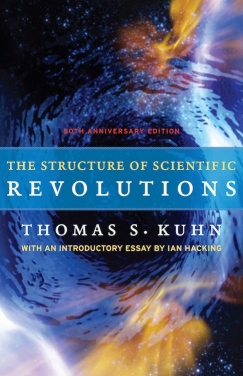
Ian Hacking on The Structure of Scientific Revolutions: 50th Anniversary Edition

1334755548An excerpt from Ian Hacking's introduction to the new edition of Thomas S. Kuhn's The Structure of Scientific Revolutions, in the LA Review of Books:

ONE THING IS NOT SAID often enough: Thomas S. Kuhn's The Structure of Scientific Revolutions, like all great books, is a work of passion, and a passionate desire to get things right. This is plain even from its modest first sentence: "History, if viewed as a repository for more than anecdote or chronology, could produce a decisive transformation in the image of science by which we are now possessed." Thomas Kuhn was out to change our understanding of the sciences — that is, of the activities that have enabled our species, for better or worse, to dominate the planet. He succeeded.

1962

The present edition commemorates the fiftieth anniversary of The Structure of Scientific Revolutions. Nineteen sixty-two was a long time ago. The sciences themselves have radically changed. The queen of the sciences, then, was physics. Kuhn had been trained as a physicist. Few people knew much physics, but everybody knew that physics was where the action was. A cold war was in progress, so everyone knew about the Bomb. American schoolchildren had to practice cowering under their desks. At least once a year towns sounded an air raid siren, at which everyone had to take shelter. Those who protested against a nuclear weapon, by ostentatiously not taking shelter, could be arrested, and some were. Bob Dylan first performed "A Hard Rain's A-Gonna Fall" in September 1962; everyone assumed it was about nuclear fallout. In October 1962 there was the Cuban Missile Crisis, the closest the world has come, after 1945, to nuclear war. Physics and its threat were on everyone's mind.

The Cold War is long over, and physics is no longer where the action is. Another event of 1962 was the awarding of Nobel prizes to Francis Crick and James Watson for the molecular biology of DNA and to Max Perutz and John Kendrew for the molecular biology of hemoglobin. That was the harbinger of change. Today, biotechnology rules. Kuhn took physical science and its history as his model. You will have to decide, after reading his book, about the extent to which what he said about the physical sciences holds true in the teeming, present world of biotechnology. Add in information science. Add in what the computer has done to the practice of science. Even experiment is not what it was, for it has been modified and to a certain extent replaced by computer simulation. And everyone knows that the computer has changed communication. In 1962 scientific results were announced at meetings, in special seminars, in preprints, and then in articles published in specialist journals. Today the primary mode of publication is in an electronic archive.

There is yet another fundamental difference between 2012 and 1962. It affects the heart of the book, fundamental physics. In 1962 there were competing cosmologies: steady state and big bang, two completely different pictures of the universe and its origin.

Posted by Robin Varghese at 02:18 AM | Permalink

Comments

Read recently released FBI files on Feynman: http://www.huffingtonpost.com/2012/06/15/richard-feynman-physicist-fbi_n_1600110.html?utm_hp_ref=science&icid=maing-grid7%7Chp-laptop%7Cdl6%7Csec1_lnk2%26pLid%3D170345

Posted by: WJAbbe | Jun 16, 2012 3:43:03 PM

What an excellent oppotunity to revisit this book and to have Ian Hacking write an essay for it means I am ordering it today. I wanted to draw people's attention to Guy Robinson's work, someone not well known, but who has drawn out some of the implications of Kuhn's work in a series of essays called Philosophy and Mystification. Kuhn expressed the view in correspondence to Guy that "You've seen to an almost unprecedented extent what I've been up to. I couldn't have identified my position so clearly at the time I wrote Structure." Someone has put some of Guy's essays on line including the key one 'On Misunderstanding Science' http://www.anti-dialectics.co.uk/Robinson_Essay_Four_On_Misunderstanding_Science.htm.

Enjoy.

Posted by: Shane H | Jun 16, 2012 11:36:54 PM

Robinson link repaired

Posted by: Carlos | Jun 17, 2012 6:22:15 AM

Post a comment


Subscribe to this blog's feed  

PayAnywhere with iphone credit card swiper

Android Tablet

Bluetooth Headset

2013 New Style Dresses

Compare Car Rental Prices

DHgate.com Wholesale

3QD on Facebook

3QD on Kindle

3QD by Daily Email

Receive all blogposts at the same time every day.

Enter your Email:


Preview 3QD Email

3QD on Twitter

Miscellany

Lijit Search

AddThis Social Bookmark Button

Add to Google

Recent Comments

Jalees Rehman on The need for critical science journalism

Dredd on Why Rational People Buy Into Conspiracy Theories

Dredd on Why Rational People Buy Into Conspiracy Theories

Scrutineer on Why race as a biological construct matters

prasad on the culture animal

Mitt Romney's Dog on Why race as a biological construct matters

Elatia Harris on The Moral Status of Rocks

prasad on The Moral Status of Rocks

Raza Husain on The Moral Status of Rocks

Fred on Unknown Mathematician Proves Elusive Property of Prime Numbers

Joel Grant on Why Rational People Buy Into Conspiracy Theories

Tomboktu on Why is Europe so Messed Up? An Illuminating History

Joe on Why Rational People Buy Into Conspiracy Theories

Jalees Rehman on The Science Mystique

Dredd on The Moral Status of Rocks

sjg on Why Rational People Buy Into Conspiracy Theories

Dredd on Why Rational People Buy Into Conspiracy Theories

Ken Pidcock on The need for critical science journalism

Louise Gordon on Why race as a biological construct matters

Louise Gordon on The stories of two Palestinian villages: From Al-Araqib to Susiya

musafir on a pretty funny book

freddie on The stories of two Palestinian villages: From Al-Araqib to Susiya

freddie on The stories of two Palestinian villages: From Al-Araqib to Susiya

Junaida on Tuesday Poem

rafiq on Tuesday Poem

Acclaim For 3QD


"I couldn't tear myself away from 3 Quarks Daily, to the point of neglecting my work. Congratulations on this superb site."—Steven Pinker, Johnstone Professor of Psychology, Harvard University.

"I have placed 3 Quarks Daily at the head of my list of web bookmarks."—Richard Dawkins, Charles Simonyi Professor of the Public Understanding of Science at Oxford University.

"Just wanted you to know I’m one of many who reads and enjoys 3 Quarks....almost daily."—David Byrne, musician, former lead-singer of the Talking Heads, artist, intellectual.

Read more here.

The 3QD Prizes

Subscribe to this blog's feed