
June 19, 2012
A Debate on Plant Ethics
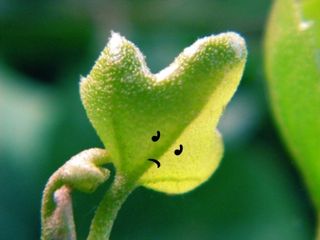
Over at Columbia University Press, Gary Francione, author of Animals as Persons: Essays on the Abolition of Animal Exploitation, The Animal Rights Debate: Abolition or Regulation?, and several other titles, and Michael Marder, author of the forthcoming Plant-Thinking: A Philosophy of Vegetal Life debate the ethics of eating plant life:
Michael Marder: As I have pointed out, contemporary research in botany gives us ample reasons to believe that plants are aware of their environment in a nonconscious way—for instance, thanks to the roots that are capable of altering their growth pattern in moving toward resource-rich soil or away from nearby roots of other members of the same species. To ignore such evidence in favor of a stereotypical view of plants as thing-like is counterproductive, both for ethics and for our understanding of what they are.
When we, humans, use ourselves as a measuring stick against which everything else in world is evaluated, then an anthropomorphic image of sentience and intelligence comes to govern our ethics. True: the life of plants resembles our living patterns to a lesser extent than the life of animals. But to use this as a cornerstone of ethics and a justification for rejecting the moral claim plants have on us is a case of extreme speciesism.
Gary Francione: Speciesism occurs when the interests of a being are accorded less or no weight solely on the basis of species. To say that a being has interests is to say that the being has some sort of mind—any sort of mind—that prefers, desires, or wants. It is to say that there is someone who prefers, desires, or wants. You cannot act with speciesism with respect to a being that has no interests, such as a plant.
Your entire argument rests on your confusing a reaction with a response. If you put an electrical current through a wire that is attached to a bell, the bell will ring. The bell reacts; it does not respond. It is as absurd to say that a bell has a “nonconscious response” as it is to say a plant does.
Posted by Robin Varghese at 01:55 AM | Permalink


Comments
I think there could be something of a "middle way" between these positions, one that recognizes the significance of all living things, including plants, but remains sensitive to several philosophical distinctions between plant life, nonhuman animals, and human animals. The end result would resemble something like Paul W. Taylor's Respect for Nature: A Theory of Environmental Ethics (Princeton, NJ: Princeton University Press, 1986).
This post about from 2008 about the "moral consideration of plants" might be of interest as well: http://ratiojuris.blogspot.com/2008/05/respect-for-nature-moral-consideration.html
Posted by: Patrick S. O'Donnell | Jun 19, 2012 2:54:52 AM
I'm with Francione on this.
It's one thing to decry anthropomorphism in the defining of sentience or awareness, for indeed it's been shown in recent years that our own human cognition is in large part (with some unique exceptions) on a continuum with other animals, especially with mammals and birds, more especially with other primates, cetaceans, and certain birds (e.g., crows) thanks to convergent evolution of some cognitive traits, and even more especially with our fellow great apes.
It's quite another to play fast and loose with the definition of consciousness, as, for instance, in a fave of the New Age crowd, a book called "The Consciousness of the Atom", by one Alice Bailey, which a bright but nutty hippie prof at Berklee threw at us in an academic elective I needed for my music degree requirements.
This is indeed a separate issue, though, from the inherent value of plants as essential to ecosystems and for the well-being of creatures other than ourselves, as perhaps indicated by the Paul Taylor book.
Posted by: Kai Matthews | Jun 19, 2012 1:54:34 PM
Post a comment