
May 03, 2012
What is College For? An Interview with The New Yorker’s Louis Menand
Matt Bieber in The Wheat and Chaff:
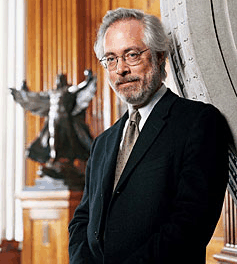
Louis Menand is a Pulitzer Prize-winning professor of English at Harvard and a staff writer for the New Yorker. His most recent book, The Marketplace of Ideas: Reform and Resistance in the American University, traces the rise of the modern university system and asks hard questions about whether higher education’s historical goals and structures are well-suited for today’s world.
In a June, 2011 New Yorker article, Menand expanded on Marketplace, laying out three theories that seek to answer the question: What is college for?
Theory 1 sees the university as a quality filter – a means of sorting young people according to their intelligence and capabilities and providing signals to society about the roles for which they might be well-suited.
Theory 2 is the classic liberal arts vision of the university – in Menand’s words, an opportunity to teach “the knowledge and skills important for life as an informed citizen, or as a reflective and culturally literate human being.”
Theory 3 is a more brass-tacks view: it sees the university as designed for professional or vocational preparation.
In this interview, Menand and I dig into Theory 2. What does an education designed to create “informed citizens” or “reflective and culturally literate human beings” actually look like? What books and pedagogical techniques might it include? How much will it seek to answer the ‘big questions’, and to what extent will it be content with simply asking them?
More here.
Posted by S. Abbas Raza at 10:28 AM | Permalink


Comments
Menand's New Yorker piece is appallingly ignorant of real life. It guess it did not cross the so called mind of this effete ivory tower hotelier that the student might not have been able to AFFORD the assigned text book. Menand is what is WRONG with university education today: serving corporativism, not people.
Posted by: Peter Byrne | May 4, 2012 11:51:09 AM
"Menand's New Yorker piece is appallingly ignorant of real life"
I noticed that. Cars have not had carburetors for about 20 years.
Posted by: reader | May 4, 2012 12:26:46 PM
Why should Menand know about what is or isn't in cars today? That has nothing to do with the point he was making with his automobile analogy. Come on, now!
I thought it was a quite interesting interview. What Menand is meditating about is a crucial problem with tertiary education in the U.S. today, I think. Universities, from their beginning in medieval Europe, have always been closely connected with their surrounding societies and responsive to their needs, especially for certain kinds of professionals: theologians, (a sort of) physicians, etc., in the Middle Ages, Empire-builders in 19th-century Britain, scientists and military experts in 19th-century Germany, and so on.
What does this country need from universities today? It's not at all clear, as the Menand interview makes clear, because it's not at all clear what sort of country it is. It feels as though the country is groping around for something that no one has a clear picture of, because the post-WW-II world, which still structures how most universities still work, has become mostly obsolete. The economy and political structure of that era don't function any more, obviously, but we haven't developed anything workable to replace them. Our computer-based technology is racing ahead along lines which it itself defines, and universities and pretty much everything else is along for the ride, but where is it going?
Menand doesn't answer any of these questions here, and I don't think any one else has answers right now, either, but they are important questions.
Posted by: JonJ | May 5, 2012 10:36:52 AM
Post a comment