
by James McGirk
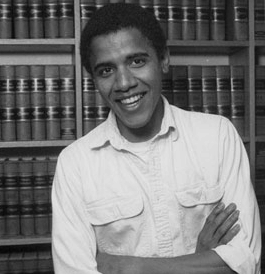
Mr. Obama spent his formative years as an outsider and that estrangement shaped his view of the United States in a profound way. At school he was peculiar, he had lived overseas and was a jangled mixture of races and cultures. His father was Kenyan, his stepfather was Indonesian and his mother was a Caucasian expatriate academic. And Hawaii, particularly in the 1960s and 1970s, was more like a forward operating base or an embassy than a state. Men and material were flowing through it en route to Vietnam and the federal government had a far more pervasive and sinister presence in Hawaii than it did elsewhere. The United States wasn’t a fundamental part of himself – not in the unambiguous, automatic way it would be for someone born in Detroit, Michigan – rather his sense of belonging to the United States was something that had to be negotiated.
My early life was equally jangled. My parents were journalists and my grandfather was a petroleum prospector for Texaco, which meant that our family was estranged from the United States for more than 70 years. Growing up, the U.S. was a highly abstract concept that was paradoxically close and accessible to me. My information about the country came from mostly headline news, and was highly polarized; this was the era of Ronald Reagan and Margaret Thatcher, and more often than not the news contained tales of the tape comparing the United States with the Soviet arsenals. What little of I saw of the real U.S. came in brief glimpses during visits to embassies or when we visited relatives in Southern California. In comparison to the bleakness of the United Kingdom, Spain and India, the U.S. was a technologically advanced paradise where everyone looked and sounded the way I did.
Being American became something that underlined how different I was from my peers. Rather than let my accent fall into the posh London grooves of my classmates, I tried to speak in as vulgar and American an accent as possible. As the countries we moved to became increasingly poor, the United States seemed to be a paragon of democracy and civic leadership in comparison. In high school, in New Delhi, I attended an American school for the first time in my life, and was deeply dismayed by how little my professors and peers seemed to appreciate it.
I was quite isolated from my peers. My fellow American classmates and most of my professors lived on antiseptic embassy compounds and had access to American produce and groceries, while we lived the way the natives did (i.e. the wealthy natives, a fair approximation of the way that Mr. Obama lived in Indonesia, or even Hawaii, where he attended Punahou School, considered the state’s most exclusive). Our school curriculum, typical of a prep school in the 1990s, preached tolerance and diversity, touted multiculturalism as the solution to the world’s woes, yet the moment we ventured beyond the diplomatic enclaves we were singled out as strange visitors from somewhere so different, so wealthy and splendid, that packs of children and beggars would follow, begging for alms and attempting to grope our hair and clothing.
I took this squishy multi-culti curriculum as personal attack. It was absurd. How could India, where people were losing limbs in the street possibly be any better than the United States? I imagined the U.S. as crystalline and technological and perfect and scrabbled for fragments of it reading science fiction or the Last Whole Earth Catalog, or while in throes of hallucinogenic drugs or stumbling drunk. I resolved to abuse my brain until it shut down and I could reanimate it once college began.
Mr. Obama and I both began our studies in the West, he at Occidental College and I at the University of Colorado at Boulder (and a year later at the University of California, Irvine) before we both drifted eastward. My first glimpse of the real United States was a rude shock. Coming home was an absolutely traumatic experience for me, I was so disappointed in the country I had claimed as home that I lost the ability to speak without a severe stutter and spent an entire year almost catatonic, living with my nonagenarian, hoarder grandparents in California. During those dark years I had nothing to cling to other than my status as a former expat. I cherished the glimpses of it I had when I visited them on vacations or did internships overseas, and let my life stall while I waited be sucked back up into the globetrotting lifestyle that my parents and grandparents lived.
I was drawn to the idea of New York City as a world city – it seemed an acceptable compromise or at least a launchpad toward something suitably grand and international – and eventually completed my stalled education at Columbia University, which had a reputation overseas as being an international university. I’m not quite sure what it was that threw me so out of loop about returning home to the United States, whether it was seeing how crass and commercial the culture could be at times, or whether I just wasn’t mentally prepared to engage with it and projected my own insecurities onto it, but as I recovered I was left with a peculiar sort of double remove from the country I ostensibly belonged to. Mr. Obama spent a few years after college writing newsletters in New York City before getting a job in Chicago directing a church-related NGO, and perhaps it was there that he stabilized and quelled his own drug and alcohol abusing demons by discovering a universal connection to the state and his polygot roots through Christianity and service to the community.
There are, of course, some pretty significant differences between the way that Mr. Obama and I have been received by our respective homelands, and the biggest divergence is race. While I stuck out as a Caucasian in India and received unusual and uncomfortable attention because of my race, in the continental United States I was definitely in the majority. Up close I might have come off as a sounding different and not being quite as adept with pop culture as my peers, but to a casual observer I seemed no different than any other American. So where I experienced a double estrangement from my homeland, it was invisible and internal; he had to deal with a third level that marked him as a stranger to the dominant culture, although in being a member of a minority there is a paradoxical connection to community, in that to outsiders you are considered a member of the minority, whether you want to be or not.
About the time this column goes to press tomorrow, President Obama will pay a visit to my workplace. I won’t be anywhere near the man, so for me this means a snarled commute a pat down before I can sit down at my desk, but I still feel a sort of connection to the way that he seems to perceive the United States of America. Having been forced to re-imagine my place within the U.S. many times now, I have come to see being American as a far more fungible thing than I once did, it isn’t quite the colossus I once saw it for, but rather a cracked and vulnerable thing, an idea that still has tremendous strength if properly wielded. Let us hope that whomever wins in the fall appreciates this.