
May 04, 2012
Lawrence Krauss clarifies view of philosophy after hearing from Dan Dennett
Lawrence M. Krauss in Scientific American:
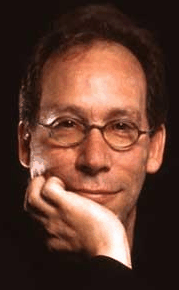
Recently, as a result of my most recent book, A Universe from Nothing, I participated in a wide-ranging and in-depth interview for The Atlantic on questions ranging from the nature of nothing to the best way to encourage people to learn about the fascinating new results in cosmology. The interview was based on the transcript of a recorded conversation and was hard hitting (and, from my point of view, the interviewer was impressive in his depth), but my friend Dan Dennett recently wrote to me to say that it has been interpreted (probably because it included some verbal off-the-cuff remarks, rather than carefully crafted written responses) by a number of his colleagues and readers as implying a blanket condemnation of philosophy as a discipline, something I had not intended.
Out of respect for Dan and those whom I may have unjustly offended, and because the relationship between physics and philosophy seems to be an area which has drawn some attention of late, I thought I would take the opportunity to write down, as coherently as possible, my own views on several of these issues, as a physicist and cosmologist. As I should also make clear (and as numerous individuals have not hesitated to comment upon already), I am not a philosopher, nor do I claim to be an expert on philosophy. Because of a lifetime of activity in the field of theoretical physics, ranging from particle physics to general relativity to astrophysics, I do claim however to have some expertise in the impact of philosophy on my own field. In any case, the level of my knowledge, and ignorance, will undoubtedly become clearer in what follows.
More here.
Posted by S. Abbas Raza at 12:29 PM | Permalink


Comments
I know we're dragging this on longer than necessary, and I've tried to be a voice of conciliation. But Krauss just genuinely doesn't seem to understand what a metaphysical claim consists of. This:
"If all possibilities—all universes with all laws—can arise dynamically, and if anything that is not forbidden must arise, then this implies that both nothing and something must both exist, and we will of necessity find ourselves amidst something. A universe like ours is, in this context, guaranteed to arise dynamically, and we are here because we could not ask the question if our universe weren’t here."
is a metaphysical conjecture, if there ever was one. It begins with "if all possibilities", an "if" that can never be satisfied entirely by empirical data. It has a "must" and a "necessity" and a "guaranteed", again none of which could ever be proved by any quantity of empirical data. "Necessity" implies a priori truths about the structure of the universe, this is anathema to the project of empirical science. He also tags on some "anthropic principle" at the end, which is a pretty commonly argued metaphysical concept.
Some might say that this is all just him overstating, or using strong language (let's put aside the fact that he explicitly warned against overstating in that Atlantic interview). Well, I hate to tell you but philosophy is the critiquing of claims. And I'm sorry, but if someone like Krauss, who is obviously extremely intelligent, doesn't realize when he's making a metaphysical claim or when to use softer or firmer language in order to not raise the eyebrows of those whose profession consists of interrogating claims as they appear, then the responsibility lies with him, not them.
Posted by: Ben Schwartz | May 4, 2012 2:27:50 PM
I was wondering how long this was going to take for Krauss to answer philosophers, directly.
Posted by: Norman Costa | May 4, 2012 3:14:38 PM
Great stuff, Ben!
Posted by: Elatia Harris | May 4, 2012 3:19:05 PM
Ben,
I think he means that if there is an infinite number of universes then everything that can happen, no matter how unlikely, must happen somewhere. This is not philosophy, but profitability. The anthropic principle simply means that one of these possible universes will necessarily be conducive to the rise of humans. Perfectly logical to me.
I just finished Krauss's book "Atom". It is the best science book I have ever read, touching on cosmology, quantum mechanics, biology, evolution, chemistry - really everything. He ties it all together by imagining the creation of a single atom in the big bang and then following it step by step as it moves from stars to Earth to living beings and ultimately to disintegration in the depths of space trillions of years from now. I have learned more about nature and the universe from Krauss than from any other writer.
Posted by: reader | May 4, 2012 3:22:27 PM
Sorry, I meant "this is not philosophy but probability".
Posted by: reader | May 4, 2012 3:23:55 PM
I see nothing "metaphysical" in Krauss and would be very disappointed if I did. Isn't "metaphysical" just another word for superstition?
Posted by: reader | May 4, 2012 3:28:53 PM
Not long ago, I was listening to Steven Weinberg (in a video) say something to the effect that philosophy adds nothing to the pursuit of physics. Philosophy does not inform him, or the science of physics, as to how to design an experiment, nor how to determine the direction of the next scientific line of inquiry.
At another point in the same video, he talks about his hopes, in his early career, that science will find the answers to the most fundamental questions in physics - even in his own lifetime. Then he spoke of the emerging realization in his unfolding career, that he will never know, nor would any other person come to know, the ultimate answers to the questions we find in nature.
For Weinberg, it was as if it were a personal 'crisis of faith' in science. He reconciled himself to it by accepting it as a property of the human condition - that, in the end, we will never know the ultimate answers.
It was in another video that Weinberg spoke about coming to terms with Heisenberg's Uncertainty Principle. It changed him, forever. He spoke about it, not with the excitement of a scientist pushing back the frontiers of knowledge, but as a human being who was moved and humbled by the experience.
Leon Lederer talks about applying the lesson of the Uncertainty Principle to how we conduct our own lives and relationships with the rest of the world. Knowledge and belief are never certain and final. Like Weinberg, he calls for a humility on our part to internalize this notion.
No, metaphysics is not superstition, and it never was. It was, and still is, the next volume on the bookshelf after Physics. The Renaissance, the industrial revolution, the rights of humankind, and modern political systems came from philosophers and others who thought about the nature of existence and the pursuit of knowledge. If you believe that science is a proper pursuit of humankind and a way for some of us to live our lives, then there are at least two millenniums of philosophers and other thinkers to whom we owe an enormity of gratitude.
Posted by: Norman Costa | May 4, 2012 4:23:33 PM
Norman,
Here's a quick and dirty definition of metaphysics from wikipedia:
"The metaphysician attempts to clarify the fundamental notions by which people understand the world, e.g., existence, objects and their properties, space and time, cause and effect, and possibility"
The properties of space and time, cause and effect, possibility - all have been transformed not by philosophy but by science in the past hundred years. Of course we owe a great deal to the philosophers of the past, but I think there is no denying that philosophy, as a way of searching for new knowledge, has been superseded by science. This is what Hawkings and Krauss mean by saying philosophy is dead.
Posted by: reader | May 4, 2012 4:43:26 PM
Reader,
In my opinion, a better reading of the Wikipedia entry is required. The emphasis in on clarifying the "NOTIONS [emphasis mine] by which people understand the world."
Beginning with the early Greek and Ionian experimentalists (observation and the recording of data,) Pythagorus' development of mathematical argument, Islamic scientists of the ninth and tenth centuries, the philosophical foundations of Abelard in the 12th century, and the heroes and martyrs of the Renaissance, the notions came to be clarified.
Notion 1: Concepts and ideas are the creation of the human mind, and do not have a separate existence in an hypothetical "World of Forms."
Notion 2: Knowledge of the world comes from experiencing it, observing it, and recording our descriptions of it.
Notion 3: The experiment is an exceptionally good tool for observing things under different conditions.
Notion 4: Science is AN approach to understanding nature (including ourselves) based upon observation and the recording of data. It has been very successful at doing what it does.
Notion 5: There are other approaches to understanding nature (including ourselves.) Some of these are art, literature, history, intuition, poetry, spirituality, philosophy, experiential learning, and transcendent experiences. Unfortunately, narrow minded scientists complain that these are not science. They are giving the correct answer, but to the wrong question.
Leon Lederer's lesson of uncertainty, in my comment above, is a spiritual notion, in the broadest sense of the term. It acknowledges a connection between ourselves with the rest of the universe and with other people.
Steven Weinberg's reflections on his own intellectual development over a lifetime is nothing short of a profound realization of the nature of existence and the acquisition of knowledge.
Weinberg was right in that philosophy can no longer contribute to the design of a physics experiment. When Neils Bohr was asked about the 'deep meaning' of discoveries in Quantum Mechanics, he replied that there was none. There were equations, he said, and they seemed to work.
If there is 'deep meaning' in science, it will not come from science. It will come from philosophers, philosophical thinkers, other thinkers, and those who express themselves in the many arts. There is no scientific 'deep meaning' in the Hubble Ultra-Deep field image. Yet, Christopher Hitchens can respond with a transcendent awe, others are moved to an inexpressible understanding and humility, and some find a connection to all that exists in the stardust that composes us all.
Posted by: Norman Costa | May 4, 2012 5:49:22 PM
Reader: I don't think you entirely understood that wikipedia quote. It is dealing with something more akin to"what must the universe be like in order for knowledge claims to be possible"
Posted by: chris | May 4, 2012 5:54:55 PM
Elatia,
Thanks :)
reader,
I wholeheartedly appreciate Krauss' expertise in Physics and Cosmology. I'm sure that his writing is incredibly engaging and enlightening for many people, as it is for myself.
However, the premises and assumptions that you ascribe to Krauss are philosophical, by any understanding of what philosophical means. For example:
"if there is an infinite number of universes then everything that can happen, no matter how unlikely, must happen somewhere."
In one sense this claim can be taken as a hypothesis, since it follows the traditional if/then form. However when we inquire as to its content, we realize that it is not a confirmable claim in the sense in which we typically take empirically verifiable claims to be confirmable. That is, the very notion of an "infinite number of universes" can only exist as an idea, a conjecture. It can't be said to have a separate existence in the manner in which we take most "objects" to exist. There is no method of measurement that would reveal the objective existence of "infinite universes" in the same way that the existence of, say, DNA would be revealed. Not because we are currently limited in our technology or theoretical framework, but simply because an infinite quantity of universes is an intractable object for measurement. It's very properties make it unmeasureable. So if you take science's project to be the measure and description of natural phenomena then there is no way in which an "infinite number of universes" can be measured and confirmed. Thus, as a concept it is more within the purview of philosophy than science.
Please note, that the logical coherence of the concept of an infinite multiverse is not what is in question here. It is perfectly possible for a concept to adhere to all logical requirements and nonetheless be outside the range of scientific measurement.
Posted by: Ben Schwartz | May 4, 2012 5:55:06 PM
It will be quite interesting when scientists develop entirely convincing virtually reality machines.
At some point as a joke, maybe on some April 1st, one of the scientists who is unfortunate enough to fall asleep at his optical table will be placed in the machine by his colleagues.
What will he tell himself when 66.6% of the photons he aims at a pair of slits goes through the one on the left?
Posted by: DAS | May 4, 2012 6:22:21 PM
Ben's comment on the quote from Krauss that it "...is a metaphysical conjecture, if there ever was one," is spot on.
Krauss is a terrific scientist, thinker, writer, and science educator. However, he wouldn't know a philosophical statement or idea if it bit him on the ass. In fact, one did. He likes to reference the work of Hoyle who showed that the heavier elements and complex molecules that make our existence possible were created in giant super novas. Stars, not Jesus, he says, had to die so that we may live.
I love his work, but Krauss should consider himself bitten on the ass.
This philosophical notion was translated into the 2006 movie, "The Fountain." It was directed by Darren Aronofsky, written by Aronofsky and Ari Handel, and starred Hugh Jackman, Rachel Weisz, and Ellen Burstyn. Science, the work of Hoyle in particular, was a foundation for this story. However, science and scientific thinking cannot produce an interpretation of the great cosmic cycle, such as that found in this screenplay. It took an artist, a writer, a film maker, and someone with a spiritual sense to give meaning to Hoyle's scientific discoveries.
Posted by: Norman Costa | May 4, 2012 9:30:54 PM
"Stars, not Jesus, he says, had to die so that we may live"
I like that.
I'm sure Krauss is not condemning all philosophy. Moral and political philosophy has much to offer. Rising income inequality obviously raises philosophical questions about the fair distribution of society's resources. He, along with other scientists like Hawking, is just saying that philosophy has nothing to offer us in discovering how the universe actually works. "Natural" philosophy has obviously been superseded by science. And I agree with you completely that science is not the only worthwhile human intellectual endeavor. Science is not in the business of creating meaning or constructing culture. We have art, music, stories and film for that. I'll take science for truth and art for beauty.
Posted by: reader | May 5, 2012 12:02:55 PM
Science does not give us truth. It gives us scientific truth. All scientific truth is provisional, never absolute, and never final.
There are scientists that see beauty, even a moment of transcendence, in elegance, symmetry, and simplicity.
If you want to find truth and beauty in poetry, read the poems of our own Jim Culleny. The mind of a poet delivers a truth in the beauty of the poet's words, rhythms, imagery, and subtext. These truths, too, are provisional, never absolute, and never final. Another poet might find something more, or something different, or something deeper.
Posted by: Norman Costa | May 5, 2012 4:14:16 PM
@reader, thank you! Atom is a great book.
Intuition, while useful in certain circumstances, cannot stand on its own without reason. The reverse doesn't apply to understanding the fundamentals of life, the universe (and everything).
Posted by: Sam | May 6, 2012 1:33:21 AM
There may or may not be infinite universes. But if there are, they will all be the same. For, if they are different, only one of them can be infinite. Hence there is only one universe, the infinite one. And in that universe people are saying silly things. So what else is new?
Posted by: Stefan | May 6, 2012 9:52:25 AM
@ Sam:
What does Richard Feynman have to say about reason and understanding quantum mechanics?
Posted by: Norman Costa | May 6, 2012 11:19:24 AM
Colbert asks Krauss for a hair sample.
Posted by: M73 | Jun 26, 2012 12:03:26 AM
'There more things in heaven and earth, [Mr. Krauss}, than dreamt of in your philosophy'.
Posted by: goof | Jul 3, 2012 2:03:12 PM
If scientific truth "is provisional, never absolute, and never final" then philosophical (or metaphysical or whatever) truth is eons more so.
In my opinion all this controversy is about is canine territory marking, and ego-ache. It is only natural that one growls and barks when its territory is being threatened.
There is only one way to human knowlege. It should be a synchronized endeavour.
My solution: all philosophers should be allocated to modern scientific branches - each according to his/her own affinity, inclination, etc.
Posted by: robiv01 | Feb 12, 2013 10:08:12 AM
Post a comment