| ABOUT US | ARCHIVES | LINKS | RSS FEED | MONDAYS | |

3quarksdaily

An Eclectic Digest of Science, Art and Literature

« Can you identify? | Main | Mathematicians Come Closer to Solving Goldbach's Weak Conjecture »

May 20, 2012

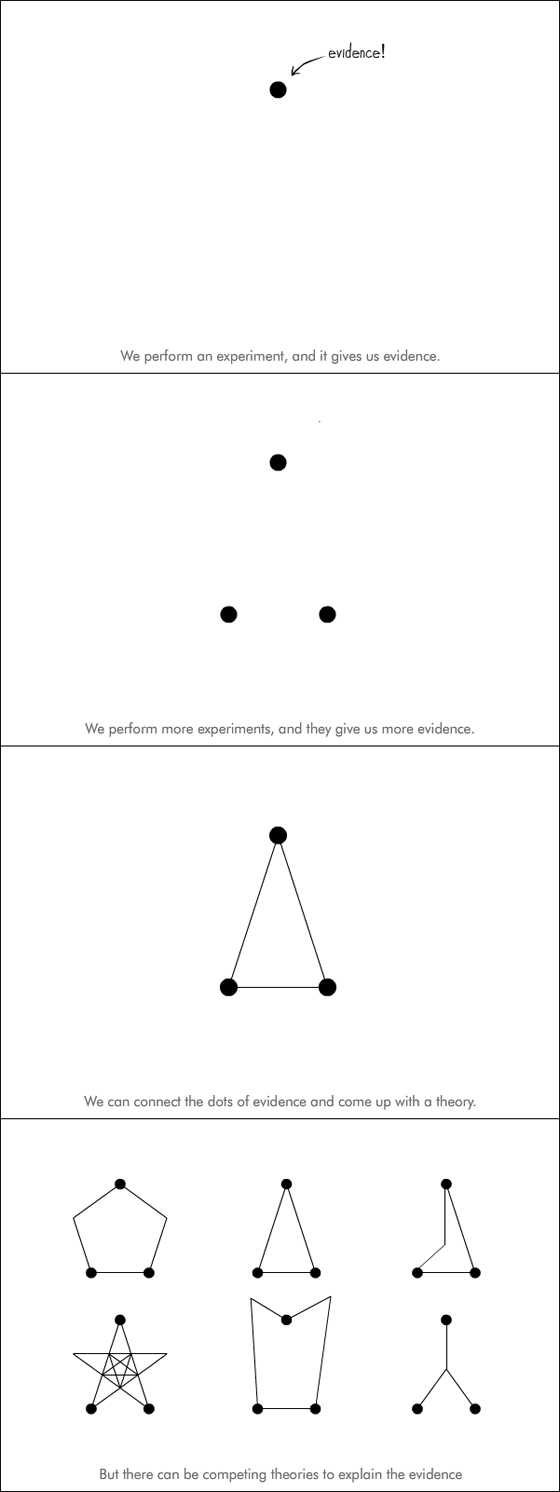
Experiment, Evidence, and Theory

BktwQ


Continue reading here.

Posted by S. Abbas Raza at 08:11 AM | Permalink

Comments

Broken link? The "continue reading here" link points to the illustration image instead of the rest of the article. Hope this will be fixed.

Posted by: Margaret S. | May 20, 2012 9:58:52 AM

Please fix the link.

Posted by: Nusrat B | May 20, 2012 10:12:41 AM

Um...I'm pretty sure the illustration is the rest.

Posted by: Ken Pidcock | May 20, 2012 10:34:41 AM

I think the pictures on the click- through tell a good story, with minimal explanation.

Posted by: Greg Armstrong | May 20, 2012 10:35:00 AM

Is it saying that Evidence and Truth are the same thing since both are shown as dark circles? If so why have theories?

Posted by: Raza | May 20, 2012 1:52:56 PM

As Ken says, the illustration just is the rest. I thought it was a lighthearted and fun thing, not to be taken as some sort of graphic representation of a particular view in the philosophy of science!

Posted by: Abbas Raza | May 20, 2012 2:04:43 PM


I agree with Greg. The message is that scientific truth is an illusion. All truth is an illusion. In my view, that is exactly was is intended. However, I don't know if the one who posted the original was just yanking our chains, or felt they were making a serious statement about reality and knowledge.

I have a hunch that the poster doesn't really know science or the philosophy of science. They thought they were being clever by throwing us a zinger. It's a gotcha upon smartie scientists.

This is only an hypothesis. I have no evidence, only my speculation. I could go on with theory after theory. My God! They're right!

Posted by: Norman Costa | May 21, 2012 12:56:59 AM

My first thought is to question the representation of the concept of "different theories" by a bunch of different geometric figures. A crude metaphor at best.

Posted by: Kai Matthews | May 21, 2012 5:38:58 AM

Abbas, unfortunately this kind of graphic serves only to spread ignorance about how science works. As someone who has taught both biology and philosophy of science I can say that I wouldn't let it anywhere near my students. The three major issues are:

1) There is no such thing as experimentation outside of theory, all experimentation is informed by some prior theory about how the world works.

2) Experimental results are therefore not pure "dots" which can be connected in some obvious shape, they must be interpreted in accordance with prior theory.

3) Slide 6: there are an infinite number of shapes that might be drawn through the 5 dots. This is, in essence, the problem of induction, but the slide makes it look as though there are two obvious ways to make a shape out of 5 dots.

This last point might seem hair-splitting, but think of the many competing interpretations of quantum mechanics: all are technically consistent with the data, but all have different "shapes".

Posted by: Joe | May 21, 2012 10:25:02 AM

Okay, guys, I'm sorry! I'll stick to more serious stuff...

Posted by: Abbas Raza | May 21, 2012 10:27:20 AM

Reminds me of the saying, "All models are false - some are useful". George E.P. Box

Posted by: Joe | May 21, 2012 12:55:13 PM


Now on the serious side....

Thanks, Joe, for your thoughts, I disagree on your first point, that there is no such thing as experimentation outside of theory. Like you, I taught, and my area was research methods in social science, particularly, psychological research.

I begin with the definition of science as an approach to understanding nature (which includes ourselves) through observation and the recording of data. The basic function of science is to describe the properties of things.

The experiment is but one means of observation, albeit, a very powerful means of observation. Simply put, the experiment is a means of observing something under different conditions. Good science can be done at the descriptive level, with the experiment as one of many tools of observation.

Theory and hypotheses will come and go as ideas are validated or not in an eternal iterative process. However, theory does not, in the absolute, require experimentation. Nor does experimentation derive, exclusively, from theory.

Whether we experiment or not depends on the nature of the field of inquiry, and what is necessary to answer a question. When I ask students, at the beginning of the semester to define science in their own words, many seem to view the experiment as part of the definition of science. It's not.

I pose this problem: The Large Hadron Collider is described as the world's biggest and most expensive scientific experiment. I wonder if it is 'really' an experiment in accordance with the definition of observing something under different conditions. Not being a physicist nor engineer, I hesitate in calling it an experiment. To me it sounds more like, "OK, let's crank this sucker up to MAX and see what comes out the other end." This is science, but I wonder if it really is an experiment.

Posted by: Norman Costa | May 21, 2012 4:59:17 PM

Post a comment


Subscribe to this blog's feed  

PayAnywhere with iphone credit card swiper

Android Tablet

Bluetooth Headset

2013 New Style Dresses

Compare Car Rental Prices

DHgate.com Wholesale

3QD on Facebook

3QD on Kindle

3QD by Daily Email

Receive all blogposts at the same time every day.

Enter your Email:


Preview 3QD Email

3QD on Twitter

Miscellany

Lijit Search

AddThis Social Bookmark Button

Add to Google

Recent Comments

seth edenbaum on Habermas, Adorno, Politics

Raza Husain on If Only We Had A Leader Like Chavez, Who Solved Real Problems -- Instead Of Debating Fake Ones Like The Deficit

Raza Husain on Think About Nature

Raza Husain on Getting Smarter

johnnyred on Getting Smarter

Lou on Throwing away ancient wisdom, painting with sound and staying awake: a conversation with radio dramatist and ZBS Foundation president Thomas Lopez

Sundar on If Only We Had A Leader Like Chavez, Who Solved Real Problems -- Instead Of Debating Fake Ones Like The Deficit

flowers rainbows on Lift up your voices: The century-long battle for women's freedom

mr.ed on wagner in new york?

mirel on Here’s how to change the world

mirel on If Only We Had A Leader Like Chavez, Who Solved Real Problems -- Instead Of Debating Fake Ones Like The Deficit

X on Getting Smarter

Ross Williams on Getting Smarter

oroboe on Lennon's "Imagine" and McCartney/Wings' "Band on the Run" overlaid: One way of reuniting (some of) the Beatles

Richard H. Randall on Obama must Make Fighting Climate Change National Project, or Die the death of a thousand Scandals

seth edenbaum on The First New Atheist? Kierkegaard

waqnis on Mortify Our Wolves

nogodrod on KFC smugglers bring buckets of chicken through Gaza tunnels

waqnis on Here’s how to change the world

Fernando on Mortify Our Wolves

seth edenbaum on The case against empathy

Dredd on Mortify Our Wolves

Max on Here’s how to change the world

Rohana on Mortify Our Wolves

Raza Husain on If Only We Had A Leader Like Chavez, Who Solved Real Problems -- Instead Of Debating Fake Ones Like The Deficit

Acclaim For 3QD


"I couldn't tear myself away from 3 Quarks Daily, to the point of neglecting my work. Congratulations on this superb site."—Steven Pinker, Johnstone Professor of Psychology, Harvard University.

"I have placed 3 Quarks Daily at the head of my list of web bookmarks."—Richard Dawkins, Charles Simonyi Professor of the Public Understanding of Science at Oxford University.

"Just wanted you to know I’m one of many who reads and enjoys 3 Quarks....almost daily."—David Byrne, musician, former lead-singer of the Talking Heads, artist, intellectual.

Read more here.

The 3QD Prizes

Subscribe to this blog's feed