
by Evan Selinger, Thomas Seager, and Jathan Sadowski
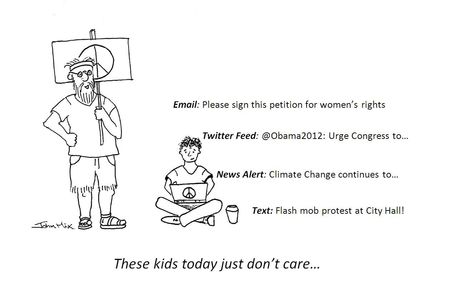
A highly publicized Journal of Personality and Social Psychology study depicts Millennials as more egoistic than Baby Boomers and Generation Xers. The research is flawed. The psychologists fail to see that kids today face new problems that previously weren’t imaginable and are responding to them in ways that older generations misunderstand.
The psychological study seems persuasive largely because the conclusions are supported by massive data. Investigators examined two nationally representative databases (Monitoring the Future and American Freshman surveys) containing information provided by 9.2 million high school and college students between 1966 and 2009. Such far-reaching longitudinal analysis seems to offer a perfect snapshot of generational attitudes on core civic issues.
Comparison makes Millennials look bad. According to the study, they aren’t just primed to consume more electricity and pass on community leadership. Overall, they’re ethically deficient: concerned less with the environment and keeping up with political affairs, while driven more by extrinsic values (money, fame, image) than intrinsic ones (self-acceptance, community, and group affiliation). The media couldn’t wait to spin these characterizations into headlines, running pieces like “Millenial Generation’s Non-Negotiables: Money, Fame, and Image” and “Young People Not So ‘Green’ After All”.
Jean Twenge, the study’s lead author, seems entitled to sit back with a told you so look on her face. For some time, she’s contested portrayals of Millennials as “Generation We.” The new study updates her anti-entitlement manifesto, Generation Me: Why Today's Young Americans are More Confident, Assertive, Entitled–And More Miserable than Ever Before, and she presents more damning information in a recent Chronicle of Higher Education article accusing Millennials of declining empathy.
Unfortunately, when Twenge and her colleagues consider limitations that could constrain their study, they miss a big one. They acknowledge potential complications from students dropping out of school before surveys are administered, demographic shifts in college samples, self-reporting bias, attitudes changing as people age, and the recession having an indeterminate impact. They don’t consider the limits of longitudinal analysis.
If moral problems remained constant, psychologists could treat age as the decisive independent variable. Take the problem of environmentalism. Millennials, Boomers, and Xers all had to decide whether to save energy during the winter, or say sweaters be damned and crank up thermostats to maximize personal comfort. All things being equal, it makes sense to judge the conservationists more environmentally committed, and do the same with charitable donation, voting, and writing to public officials.
All things aren’t equal, though. Longitudinal studies designed decades ago are out of sync with the unique challenges Millennials face. They live in a world plagued by new problems that require a new global mindset to solve. To pick but one of many relevant dilemmas, if Millennials appear less concerned about personal energy consumption, it is because they are increasingly worried about climate change. This extraordinary problem wasn’t part of Boomers and Xers’ high school and college vocabularies, and it profoundly shifts the moral landscape. Climate change renders older, methodologically individualist, approaches to responsible behavior obsolete.
Fundamentally, climate change must be solved at a global level because the earth’s atmosphere has a limited capacity to store green house gas emissions. If the United States tries to do the right thing by cutting back on its CO2 emissions, and powerful regulation doesn’t bind nations together, it simply incentivizes China and India to emit more. The net effects would impact everyone and overall could make the planet worse off. National sacrifice would have the perverse consequence of making us suckers on the global stage.
This basic game theory problem holds for individuals, too. Without effective regulation, my choice to cool off with open windows over the summer quickly becomes your incentive to crank up and air conditioners. My Prius purchase encourages you to buy a gas guzzling SUV. My SKYPE conducted business meetings inspire you to fly to more overseas conferences. The road to hell would get paved by good, but naïve intentions.
Of course, Millennials could behave like good Boomers. To prevent free riding, they could write to elected officials and ask them to make new laws mandating restrictive caps limiting the energy available to every residence in a county, city, state—or, even the entire country. But given the unpopular legacy of President Carter’s “Crisis of Confidence” speech, why should they assume this gesture would be anything but token participation?
While Millennials might be cynical about traditional political participation, they are open to other forms of civic engagement. As members of the socially networked, digital generation they view posting, linking, blogging, and tweeting as moral acts that provide opportunities for participating in collective governance. Critics don't give them credit for this, viewing the mindset as the triumph of slacktivism over activism. But, the issue is hotly debated, and its import, including the possibility that in at least some instances the Millennials are right, falls off the psychologists’ radar.
Now, it would be sensible to ask Millennials about their views on institutional responsibility, especially in cases where a positive outcome can be identified. For example, would they be willing to pay increased tuition to convert campus buildings into LEED-certified structures, particularly if doing so would advance a trend and make it advantageous for other colleges to follow suit? Since LEED certification came on the scene in 1998, it post-dates the longitudinal framing. Consequently, this issue also falls outside the data that Twenge and collaborators scrutinize.
Given the growing importance of large-scale geoengineering projects, it also makes sense to ask Millennials how they feel about them. But, as debate only recently started over whether geoengineering is technocratic solution to a political problem, the surveys certainly don’t address them or their implication for attitudes towards globalized political participation. To continue with the game theoretic concepts, some have argued that geoengineering projects will benefit developed nations at the expense of developing ones, with inequity engendering conflict.
In short, the psychologists didn’t prove that Millennials care less about the environment than their predecessors. By using longitiundal studies that are tone deaf to change, they obscure the special issues at stake in being an environmentalist today—issues that are incommensurate with past problems where singular actions and good intentions could make people feel good about themselves for discharing their environmental responsibilities.
Critics might reply that our analysis casts the Millennial vision in terms that are too sophisticated. The might ask: How many Millenials actually understand game theory? There is some truth to this rebuttal, but less than meets the eye.
In many cases, Millennials likely don’t understand game-theoretic reasoning in a rational, analytic way. However, their behavior demonstrates they grasp it heuristically. They will lower their thermostats when they are part of a social network that is doing it with them.
Prior generations exhibited similar behaviors that are consistent with our reasoning. According to what has been termed the “cul-de-sac effect,” homeowners will not install roof-mounted PV panels until they see one or more neighbors do it. Likewise, studies show people are less motivated to reduce heating/cooling use by financial incentives than they are to respond to information about what their neighbors are doing. In short, people often wait for social cues before acting because they heuristically understand that without reassurance that they are acting in concert with others, attempts at moral action may be counter-productive. Milllennials exhibit this type of interdependency to a greater extent than any prior generation because they are the most inter-connected of all generations.
—–
Evan Selinger is an associate professor of Philosophy at Rochester Institute of Technology.
Thomas Seager is an associate professor at the School of Sustainable Engineering and the Built Environment and a Lincoln fellow of ethics and sustainability at Arizona State University.
Jathan Sadowski is a research technician in the Lincoln Center for Applied Ethics at Arizona State University.
The authors were supported by National Science Foundation funded project, “An Experiential Pedagogy for Sustainability Ethics” (#1134943). Any opinions, findings, and conclusions or recommendations expressed in this material are those of the authors and do not necessarily reflect the views of the National Science Foundation.