
Jeremy Waldron in Eurozine:
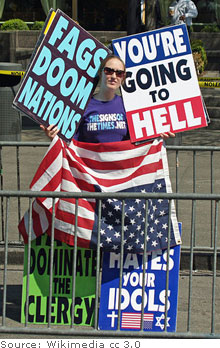
The message conveyed by a hateful pamphlet or poster, attacking someone on grounds of race, religion, sexuality, or ethnicity, is something like this:
“Don't be fooled into thinking you are welcome here. The society around you may seem hospitable and non-discriminatory, but the truth is that you are not wanted, and you and your families will be shunned, excluded, beaten, and driven out, whenever we can get away with it. We may have to keep a low profile right now. But don't get too comfortable. Remember what has happened to you and your kind in the past. Be afraid.”
That message is conveyed viciously and publicly. To the extent that they can, the purveyors of this hate will try to make it a visible and permanent feature of our social fabric. And members of the vulnerable groups targeted are expected to live their lives, conduct their business, raise their children, and allay their nightmares in a social atmosphere poisoned by this sort of speech.
And, for the opposing view, Ivan Hare:
[I]t is clear from Timothy Garton Ash's commentary andJeremy Waldron's response to it that we are taking about much more than a guide to behaviour. Some would advocate giving effect to this norm not just through legislation but also through criminal prohibition in the form of laws against hate speech. To do so would be an error, as the hate speech laws in existence in large parts of Europe and Canada are contrary to the free speech principle at a fundamental level.
The most convincing justification for free speech is that it is essential to our ability to engage in democratic self-governance. That is, our right to participate in the debates on issues of public importance that affect us all. Debates about race (such as immigration, accommodation, assimilation and so on) are central to public discourse in most modern democracies. To prohibit the expression of strongly worded and provocative views on the subject of race through hate speech laws deprives those speakers and their audience of their right to participate fully in that public discourse.
It is no answer to say that the speaker can re-phrase their contribution in more “civil” terms and avoid liability. The topics covered typically by hate speech laws (race, religion, homosexuality) engender strong emotions and speakers should be entitled (as in other areas of public debate) to express themselves forcefully. In any event, how can those misguided enough to assert the superiority of one race over another or the wickedness of homosexuality do so without inciting hatred against the criticised group?