| ABOUT US | ARCHIVES | LINKS | RSS FEED | MONDAYS | |

3quarksdaily

An Eclectic Digest of Science, Art and Literature

« Brian Greene: Is our universe the only universe? | Main | Woman, Fighter, Philosopher »

April 27, 2012

Review of Jonathan Haidt's new book, The Righteous Mind

Srivas Prasad in Accidental Blogger:
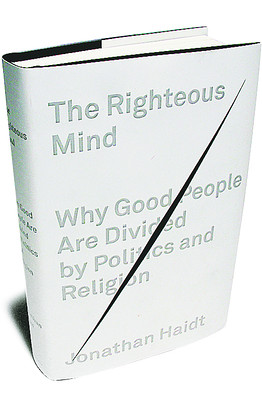
Ob-sf834_bkrvha_dv_20120315153035Jonathan Haidt is a moral psychologist best known for his work on the moral foundations, identifying the dimensions along which peoples' moral responses vary. The most fundamental moral concerns of human beings include, he says, care or harm, fairness or cheating, liberty or oppression, loyalty or betrayal, authority or subversion, and sanctity or degradation. The neat fact uncovered by his research is that not all people weigh these dimensions of morality seriously, that whilst conservatives bring all these dimensions to bear upon moral deliberation, liberals and libertarians use only the first three. The ''money'' plot is here, showing how much people of different political orientations care about a given moral concern. A significant portion of Haidt's new book, ''The Righteous Mind'' is devoted to explaining these dimensions and findings.

An important concern for Haidt is that liberals and conservatives in contemporary America are increasingly divided (his book is subtitled ''Why Good People Are Divided by Politics and Religion''), and he thinks his moral dimensions help explain why. We simply respond to different moral criteria. We have different ''moral taste-buds'', he says, in an image used repeatedly in the book. It is not just moral disagreement he is interested in however, but moral incomprehension, the fact that we can literally fail to understand what someone on the opposite side might be thinking, or why he isn't a moral monster just because we disagree with him. Here he thinks a significant portion of the blame rests with the liberal side of the divide.

More here.

Posted by S. Abbas Raza at 08:59 AM | Permalink

Comments

A great review -- I am still reading it, after days, and trying to square it with what I know of Jonathan Haidt. Anytime Srivas, whom we know around here as the commenter Prasad, wanted to leave physics, he would have other options...

Posted by: Elatia Harris | Apr 27, 2012 10:04:10 AM

Thanks for linking to this, Abbas. I hope your readers will leave their thoughts at our blog too.

Posted by: Ruchira | Apr 27, 2012 10:30:40 AM

Very thorough criticism of the Haidt book that seems to be wowing nearly everybody. (Especially masochistic lefties.) Another author, like Douthat, who is receiving loads of undeserved kudos from lefty intellectuals who are currently undergoing another attack of the painful self-abnegation they love so much. ("Spank me again -- it feels so good!")

Posted by: JonJ | Apr 27, 2012 4:31:20 PM

The projectionism of Social Darwinists, and the like, becomes suspected when the revolution in genetics seems to be ignored.

Posted by: Dredd | Apr 27, 2012 4:32:53 PM

Care fairness and liberty are all things that the individula wants to GetCare fairness and liberty are all things that the individula wants to Get from society (=right). The other values are all about what an individual Owes to society (-Duties). Therein lies the kernel of the Right - Left divide.

Posted by: aguy109 | Apr 27, 2012 8:25:29 PM

Sorry that should have read :
Care fairness and liberty are all things that the individula wants to Get from society (=right). The other values are all about what an individual Owes to society (-Duties). therein lies the kernel of the Right - Left divide.

Posted by: aguy109 | Apr 27, 2012 8:27:06 PM

Excellent piece Prasad, I'm a big fan of his moral foundations theory, but your review expands on some quibbles I've been having.

Posted by: Sagredo | Apr 28, 2012 4:21:39 AM

Supposing someone at a maternity ward swaps two newborns, who end up going home with the wrong families. No-one is the wiser.

That's wrong, isn't it? But from which moral foundation?

Two years later, the hospital discovers the swap. Should they tell the families? If they do, it will cause a great deal of pain, which is bad on the harm/care foundation. If they don't, which moral foundation has been violated?

I borrow your car without your permission while you're away, and return it without you ever knowing. Sure, I caused some wear on the car, but I left extra fuel in the tank, which is worth more. Did I do wrong?

What if I have sex with you pretending I'm your husband? You consent under the false pretence, enjoy the experience and never find out. In many jurisdictions I've committed the crime of rape. I did wrong, but on which moral foundation?

Posted by: Sagredo | Apr 28, 2012 4:10:51 PM

I do wish folks would hold off coming up with evolutionary explanations for social phenomena. I mean, I don't doubt the fundamental assumption of evolutionary psychology, that who we are is very much determined and constrained by millennia of selection, but there's no reason why explanations for things that we commonly understand as complex, such as religion, art, liberty etc. should have simple explanations. The scientist's instinct to look for the simplest possible explanation that fits the data doesn't work well here, especially when the data is knowledge that isn't very amenable to scientific analysis.

It looks like Haidt is doing this in his book, and if I understand Prasad correctly, he could have dropped the whole evolutionary thing without loss.

On the other hand, I am a little bit more concerned with the proliferation of foundations. Shouldn't this be more settled? Or are we seeing more and more examples that only kinda-sorta fit a foundation?

Posted by: Sagredo | Apr 28, 2012 7:16:01 PM

Sagredo,
Can you please comment on our blog (you can combine the two comments) where readers there too can see it?
Thanks.

Posted by: Ruchira | Apr 28, 2012 10:13:46 PM

Ruchira and others, I'll post this on Accidental Blogger too. It occurs to me the kinds of actions Sagredo describes above cause a common harm -- harm to the self, and the idea of the self, as a fair dealer who is truthful. Maybe doing a thing you can get away with harms no one but you -- don't you count? Doesn't your idea of yourself as a person who can be relied on for doing the right thing count? You are the one you have to live with, after all, and that's not a foundation to whack away at or let erode.

Posted by: Elatia Harris | Apr 28, 2012 10:53:10 PM


@ prasad:

Excellent piece of writing. This is why I like reading reviews of books. My shortcoming in being able to devour large numbers of books is helped by the fact that at least I know, generally, what all those books are about. The more important thing, for me, is learning a great deal more from a critical assessment by the reviewer than I could bring to, or take away from, a first reading on my own.

I'd like to comment about several parts of your review, but I'll do it in manageable chunks. Your criticism in "Things You Might DO with Foundations," uncovers an unforgivable sin in social science research. Going to press with the most high level and abstract 'findings,' without doing an in depth examination of more informative questions in inexcusable and suspect. A decent scientist might present findings and 'progress to date,' with a mention of the general direction of follow-on research, or where we go from here.

I will quote one piece of your writing here, to save the reader scrolling up and back.

"When you get a hundred thousand people to fill out detailed questionnaires cataloguing their attitudes, together with detailed demographic information, there’s a lot you can probe with this information, to see if particular attitudes to specific political questions covary with scores along various moral foundations....What would be valuable is this sort of information, but broken up along particular political and moral questions. Some possible examples:

"Natural food, or environmental pollution: purity plays a role in addition to care, but how much? As you ramp up interest in recycling, what happens to overall scores along the harm, fairness, or purity dimensions? Or in-group, for that matter - maybe recycling is about belonging to a good group and hating people in the bad one! Conservative wags often say ''Recycling'' is a liberal religion built around defilement of the land. Well, to what extent are they right?"

Haidt could keep his research assistants busy for a couple of years with IMPORTANT AND INFORMATIVE questions like these. Whether his RAs are really smart undergraduates, or run-of-the-mill cadres of graduate student slaves, he should be producing this research for journals and graduate student dissertations.

A good researcher knows that this kind of probing, the absence of which you brought to our attention, is part of an iterative process of refining and extending - even debunking - earlier ideas and research methods. He showed a modicum of refinement by increasing the number of foundational factors, as well as changing labels. This is fine, but the term 'modicum' is still operative.

Posted by: Norman Costa | Apr 30, 2012 10:03:58 PM


FULL DISCLOSURE: I have not read Jonathan Haidt's book. However, I have read Prasad's earlier, and more lengthy, draft, and a number of reviews. I watched a number of videos, including TED, of Haidt talking about "The Righteous Mind," a video interview with Robert Wright, and a Public Radio interview with Leonard Lopate. Also, I took one of his surveys and will take a few more. So here goes.

All social science research will have some flaws - some serious and some not. It is very easy for any experienced researcher, like myself, to spot almost all of them, eventually. The temptation is great to turn a critique of another person's research into an opportunity to tell the world how smart the critic is - especially compared to the author of the 'flawed' research. However, there are serious, fundamental flaws in his research and interpretations.

1. Correlation versus Causation

Interpreting Correlation as Causation is a fundamental problem, if not a deadly one, for any interpretation of Haidt's data. Haidt's interesting moral dimensions (also called personal styles in other contexts,) that are used to differentiate Liberals and Conservatives, are only - and exclusively - correlates of self-identification with a label. That label has no definition other than an operational one - the person says I own this label. There is nothing in the data to suggest that these personal styles, Haidt's moral dimensions, have any bearing on the political behavior of the respondents. By political behavior I mean voting behavior, contributing to a candidate or cause, or working against an opposing candidate or cause. It is the simplest and the worst mistake any social scientist can make. Correlation is interpreted as causation.

There is a way to examine causation, and to determine if these personal styles actually influence political behavior. You set up a study in which you change something in the personal style of the individual, and then look for a change in behavior. The reason why you don't see Haidt (nor many other social scientists) doing this is because it is too frakkin' hard, and takes too damn long. Striking while the iron is hot may be advantageous in publishing a NY Times best seller. I've been in the survey research field for more than 40 years. It takes a great deal of discipline, and 'moral' integrity to attenuate the impulse to run to publication with data that are, in the end, more apparent than real.

Here is an example of misinterpreting correlation as causation. It comes from another area of research of several decades ago. It was known as the Locus of Control (LOC) studies. Briefly, LOC describes the source of the reinforcements (this was in the day when Skinner and behaviorism were the IN THING) that determine the outcomes of our lives. The 'good' source of LOC was from within the person, an Internal LOC. If the source of life's reinforcements came from the outside, External LOC, that was 'bad.' With Internal LOC, a person felt that they had control over the sources of reinforcement in their lives. With External LOC control of your life was in the hands of other people and events in the world. Mentally healthy people had an Internal LOC, and mentally ill people had an External LOC. White people had an Internal LOC, and Black people felt that forces that controlled the reinforcements in their lives were outside themselves - External LOC. The same held for more educated people versus less educated people; People with more money, etc. etc. etc.

Everyone but everyone believed that LOC was a determiner (A CAUSE) of behavior (success versus failure) in the real world. Black people would do so much better, it was believed, if they understood that they should find their LOC inside themselves. This reinforced a belief that failure of Blacks in society was a direct result of a character flaw. Research in later years showed that a belief in an External LOC was not a character flaw. Rather, it was an intelligent and accurate assessment of their lives and the world in which they were living. Internal versus External LOC were correlates of race/ethic classification, not a determiner of behavior of peoples in different groups.

More managable chunks will be revealed, below.

Posted by: Norman Costa | Apr 30, 2012 10:06:46 PM


More on methodology:

2. Throw away your horoscopes. Personality tells all.

The potential explanatory power of the concept of personality, since the earliest days of Sigmund Freud, captivated the imaginations of people in medicine, psychology, literature, advertising, human potential, education, law, child rearing, and politics. The study of Haidt's moral dimensions is a study of personality, albeit a circumscribed view of personality, or personal styles. The more accurately you can describe personality, the more successful you will be in predicting behavioral, emotional, and mental outcomes in many aspects of life. At least, that was the hope and expectation.

Haidt's approach is akin to Adorno's study of "The Authoritarian Personality," from the 1940s through the 1960s. It was an attempt to explain the origins, rise, and behaviors of the Fascist State. Actually, it was even more specific than that. Adorno wanted to explain the Nazi State under Hitler, and the atrocities of the holocaust. Discovering a specific personality type that would explain everything was a reasonable hypothesis with which to start.

In the end, foundational personality traits, or personal styles, were found to have little utility in predicting specific outcomes in real life, or in generalizing to a wide array of situations and environments. Yet, Haidt's expectation is that he is going to do just that, and expose the inner workings of moral dimensions for Liberals, Libertarians, and Conservatives. Better still, he is going to do so without ever defining these three concepts. Factor analysis of self-reports is not a definition. It's a circular reasoning cop out.

Adorno failed because there was no underlying personality type that made Fascism, Hitler, Nazi Germany, and the Holocaust possible. Everybody and every personality type participated.

Haidt fails because his explanations are akin to roll-your-own Freudian interpretations of everyday life. A signature with loops and extensions that go, mostly, below the line, indicate a dominant Id. If they are, mostly, above the body of the signature, then you have a dominant superego. When you have no non-circular definitions, and no research showing a link to actual behavior, then you are stuck in trying to generalize. Otherwise, your explantions and interpretations are classed with the likes of deceptive illusions that can appear as either a hag or as an attractive young woman. His interpretations are no better than parlor tricks.

Posted by: Norman Costa | Apr 30, 2012 10:10:37 PM


In Adorno's research on "The Authoritarian Personality," there was no single compelling explanation for Fascism, Nazism, Hitler, and the Holocaust. That's because these were not a unified, seamless phenomenon, cut from whole cloth. Many things came together to produce them, and any explanation will be at least as complex. It seemed obvious that we should find a Germanic personality that explained it all. He didn't find it.

Now, Haidt wants us to believe that six moral dimensions separate separate the left from the right, and the right leads by a score of 6 to 3; and the left will never be able to make up the difference.

Anyone else want to propose a single explanation that describes the political spectrum for most of the industrialized world? And yes, it's that ridiculous.

Posted by: Norman Costa | Apr 30, 2012 10:12:15 PM

Such a good analysis, Norman. I'm wondering if you'd like to take a shot at a similar analysis for the DSM. Jeffrey Poland has already given a good head start, but I'm sure you could expand on methodology, scientific basis of the classifications of mental disorders (now over 300), empirical evidence of the disorders . . . the use of labels, the use of checklists of symptoms to define disorders--indications of a broken brain.

http://metapsychology.mentalhelp.net/poc/view_doc.php?type=book&id=557

After people are given a label from the DSM, they are often given Pharma drugs to ameliorate their suffering. Sometimes, this increases their suffering by making them sick through the drugs' pernicious side effects, especially when people are given neuroleptic drug cocktails--even children.

I'd certainly be interested to hear what you have to say about the scientific foundations of the DSM. Even if Adorno was wrong, it seems the committees assigning labels to people with life problems and emotional suffering might indeed be suffering from authoritarian personalities.

Posted by: Louise Gordon | May 1, 2012 1:54:32 PM


@ Louise:

Thank you. You don't believe in giving a guy an easy assignment. As a result of exchanges on the subject over the past two years, I am less accepting and more critical of plans for the new DSM. My knowledge is limited, though, at this point.

Not to be discouraged, I am working on a review of the latest book by Louis Breger PhD, "Psychotherapy: Lives Intersecting." The format will be an interview with the author. It's a professional memoir of a 50 year career. He includes self-revealing content, and feedback from his own clients.

Posted by: Norman Costa | May 1, 2012 10:18:04 PM

Thank you, Norman. It is interesting that the criticism Allen Frances has been leveling at DSM-5 also pertains to the volumes he edited. Not much science, a whole lot of opinion and bias.

I look forward to reading your review.

Some Doug Bremner graphics to liven up the discussion:

http://www.beforeyoutakethatpill.com/index.php/2009/05/01/bogus-letter-from-psychiatrists-asking-for-removal-of-dissociative-disorders-from-dsm/

Posted by: Louise Gordon | May 1, 2012 11:27:26 PM


Jonathan Haidt conquers the White House: http://reason.com/blog/2012/05/01/barack-obama-hereby-declares-may-1-loyal

"Who says House Republicans and President Obama never work together? From Whitehouse.gov:

"In order to recognize the American spirit of loyalty and the sacrifices that so many have made for our Nation, the Congress, by Public Law 85-529 as amended, has designated May 1 of each year as "Loyalty Day." On this day, let us reaffirm our allegiance to the United States of America, our Constitution, and our founding values.

"NOW, THEREFORE, I, BARACK OBAMA, President of the United States of America, do hereby proclaim May 1, 2012, as Loyalty Day. This Loyalty Day, I call upon all the people of the United States to join in support of this national observance, whether by displaying the flag of the United States or pledging allegiance to the Republic for which it stands.

"IN WITNESS WHEREOF, I have hereunto set my hand this first day of May, in the year of our Lord two thousand twelve, and of the Independence of the United States of America the two hundred and thirty-sixth."

Posted by: Norman Costa | May 2, 2012 10:35:08 AM


May Day! May Day! May Day! President Barack Obama is being body-snatched by Jonathan (The Righteous Mind) Haidt. May Day! May Day! May Day!

Rumors abound that Jonathan Haidt is the 'dark horse' candidate for the 2012 Democratic Party Presidential nomination. President Barack Obama is running scared.

Posted by: Norman Costa | May 2, 2012 10:47:04 AM

Well, he was reading Fareed Zakaria in 2008, and no one panicked. I actually don't think the president is feeling frightened. He holds the office at great risk to himself, many times the risk of any white man who has ever held the office. People may disagree with him and wish him ill -- oh, only politically, of course! -- but he is a brave man, personally braver than most of us will ever be called upon to be.

Posted by: Elatia Harris | May 2, 2012 11:55:28 AM

Everyone should read Adam Ash's The Real Obama for a more nuanced appreciation of the president's personal qualities, such as courage.

Posted by: Louise Gordon | May 2, 2012 12:51:46 PM

We can read anyone we like on whether the president is politically enough of a risk taker to do what we consider the right thing. I hope my remarks will engage no one who is interested in negatively evaluating him in that way alone. I have a few things to tell him, too, on that subject. But my observations here are about his personal bravery -- the risk to his life he as taken on, not the political risks we might like him to take.

Posted by: Elatia Harris | May 2, 2012 1:14:50 PM

Apparently you believe that being black is putting his life at risk. The Secret Service are on duty--or should be.

If the president refuses to take political risks and uphold the Constitution, how brave is that?

If you don't want to read Adam Ash, try reading Glenn Greenwald on the undermining of the Constitution, the lack of transparency in his administration . . . the list goes on.

Posted by: Louise Gordon | May 2, 2012 2:24:33 PM

http://www.3quarksdaily.com/3quarksdaily/2012/05/unexceptionalism-a-primer.html#comments

How many of these policies has the president actively opposed?

Posted by: Louise Gordon | May 2, 2012 2:32:31 PM

Louise, there have been many more threats to Obama than to W or earlier presidents -- yes, his not being white has something to do with that. I have said I didn't want to engage, on this thread, in dialogue about the risks inherent the president's calculations for political success, as I consider those apart from personal risk, so my thoughts about that topic are are not for here and now. Also, I feel like it's not productive to speculate whether people are incurious or poorly informed on the grounds of their not agreeing with you, or their not engaging with you on a topic they believe will fail to bring insight or consensus. Thanks!

Posted by: Elatia Harris | May 2, 2012 2:53:43 PM


I hope no one took my May Day post literally. In my view, "Loyalty Day" was a direct response to the play that Jonathan Haidt has been receiving for his characterization (or should I say caricature) of Liberals vis a vis Conservatives. I predict "Authority Day" on July 1, and "Sanctity Day" on November 1.

I believed, from the moment Barack Obama was elected, that too many anti-Obama pundits and political wannabees wanted to see him assassinated. They fanned the flames just enough to stir up the crazies among us, and then carefully backed away from the brink with their rhetoric. No, they didn't call for his assassination. They just wanted to see someone else do it, but sound like they didn't.

The Mitch McConnell's of the world knew exactly what they were doing when they insinuated their support into the hate-filled elements on their political camp. Loud and clear he, and they, shouted that their first order of business in the new Presidency was to make sure he never got to a second term.

Oh, and I believe the situation will get worse as the election nears. God forbid Obama should be reelected, then I'll be even more afraid for his safety and that of his family. God protect us all!

Posted by: Norman Costa | May 2, 2012 3:29:09 PM

Norman, do you remember that famous 2008 interview in a beauty shop that catered to African-Americans? Ladies having their hair done said they hoped not to see an Obama presidency, because they believed he would be assassinated if he became president. This was before Sarah Palin's hate mongering rallies, too. So that point of view was based on fear and common sense, not on the particular behavior of the most odious whites with a platform. These are very frightening times. Years ago, you said you could not support an Obama presidency as long as Nader was running, but I feel I don't have the luxury of voting for Nader or Kucinich or anyone I agree point for point with in presidential politics, which I see as always about voting to prevent the worst that could happen. If the harsh reality was: Obama or Romney?, and you knew yours was the single vote that would deliver New York to one or the other, then what?

Posted by: Elatia Harris | May 2, 2012 4:27:45 PM

This is interesting. A review of Haidt's book turns into a paean on Obama's bravery.

Posted by: Louise Gordon | May 2, 2012 5:19:51 PM

@ Elatia,

Yes, the prospect of assassination was based on fear and common sense. The odious whites with a platform could smell the source a mile away and stroked it for their own advantage.

On Obama v Romney, I could demur and say I don't like an hypothetical question. If I did, then I would have squandered an audience of one who wanted to hear what I had to say.

Before this election cycle, there were only two major issues I cared about:

1. Abolishing Corporate Personhood; and

2. A real progressive income tax. If I could only have one, it would be doing away with Corporate Personhood. Do that and everything will follow.

I've added three more major issues that I care about.

3. Defeating the war on women. It is really a war on women, children, and families. Jonathan Haidt can put that in his fucking Loyalty, Authority, and Sanctity pipe and go fuck himself.

4. Pulling out of all trade agreements that send jobs and money to China with little benefit to us beyond lower prices for decent clothes. Kucinich had this one nailed.

5. Reducing, greatly, the burden of student debt or even abolishing it altogether.

I would do anything to defeat as many Republicans as I could. And they and Jonathan Haidt can take their Care, Fairness, and Liberty and shove it up their asses. They are destroying your country and mine.

Posted by: Norman Costa | May 2, 2012 6:12:08 PM

Either way, you're voting for the Corporate Party of the United States.

http://metanoia-films.org/lifting-the-veil/

Posted by: Louise Gordon | May 2, 2012 7:57:20 PM

I really wanted to attend the George Clooney fundraising dinner. Just don't have $35,000 to spare.

Posted by: Louise Gordon | May 2, 2012 8:00:24 PM

Thanks, Norman -- those are among my issues too. Interesting how as times get more threatening, women and children are more warred against. A way for the most feckless men, in or out of power, to feel magnified, perhaps. But I am also a climate hawk. Meaning that of the two candidates who could win, one of whom will win, I will vote for the least bad environmentalist, while putting personal energy and the $$$ I can into building the Green Party we need.

Posted by: Elatia Harris | May 3, 2012 12:04:38 PM


@ Elatia:

"A way for the most feckless men, in or out of power, to feel magnified, perhaps."

I think about Rick Santorum, and other Catholics in public life, including Antonin Scalia, and I wonder where their souls reside. For once I'd be happy to concede a 'ghost in the machine' but there isn't even a heart or even warm blood circulating. I don't know if you caught Scalia's comment about NOT giving medical treatment to poor who use the emergency room as their only medical resource.

But back to Santorum and Paul Ryan, I don't see Cardinal Dolan or the USCCB trying to inspire their campaigns with the Love of Christ. Santorum was never really running for President. He was running for Robert Ailes and a spot on his network, and more income from political consulting and lobbying. There is a fundamental dishonesty, and an even more deep seated nastiness. A family man who despises families (women and children) in need? An man who has received a higher education and achieved professional competence in law, yet misquotes Obama on higher education for our children and calls him elitist and a snob.

He does not like people. In fact, I would go further and say there is a level of hatred for people.

Posted by: Norman Costa | May 4, 2012 1:57:28 AM

Good comprehensive analysis. I was surprised to find on page 9, by Haidt's self-admission, a whiff of something which tends to keep my critical sense on high alert and might also explain much of the overreaching noted by prasad.

"People who devote their lives to something often come to believe that the object of their fascination is the key to understanding everything. Books have been published in recent years on the transformative role in human history played by cooking, mothering, war...even salt. This is one of those
books." Theres a lot of good plausible and thought-provoking food for thought in Haidt's model but he seems to have drank a bit too much of his own home brew or possibly stared so long at something so as to burn it into his retinae thereby seeing it everywhere he looks. The quest for overarching model and silver bullet only leads him to leaving many well-studied dynamics untapped in his framework.

Posted by: Pat Pattillo | Nov 23, 2012 10:22:41 AM

Post a comment


Subscribe to this blog's feed  

PayAnywhere with iphone credit card swiper

Android Tablet

Bluetooth Headset

2013 New Style Dresses

Compare Car Rental Prices

DHgate.com Wholesale

3QD on Facebook

3QD on Kindle

3QD by Daily Email

Receive all blogposts at the same time every day.

Enter your Email:


Preview 3QD Email

3QD on Twitter

Miscellany

Lijit Search

AddThis Social Bookmark Button

Add to Google

Recent Comments

Erich on REFLECTIONS ON WOOLWICH

omar on Race Is Not Biology

Raza Husain on Race Is Not Biology

Raza Husain on Race Is Not Biology

Josef Stern on REFLECTIONS ON WOOLWICH

Colette on POETRY IN TRANSLATION: CORDOBA

Dana on A young Houston couple is planning to give away $4 billion—but only to projects that prove they are worth it. Can they redefine the world of philanthropy?

omar on REFLECTIONS ON WOOLWICH

Dredd on REFLECTIONS ON WOOLWICH

omar on Race Is Not Biology

prasad on Race Is Not Biology

JF on REFLECTIONS ON WOOLWICH

Sundar on REFLECTIONS ON WOOLWICH

omar on REFLECTIONS ON WOOLWICH

musafir on Loneliness, isolation and desperate yearning

carlos on The Gut-Wrenching Science Behind the World’s Hottest Peppers

Dredd on A young Houston couple is planning to give away $4 billion—but only to projects that prove they are worth it. Can they redefine the world of philanthropy?

Dredd on Why Rational People Buy Into Conspiracy Theories

JonJ on Daniel Dennett's seven tools for thinking

JonJ on Race Is Not Biology

omar on Race Is Not Biology

omar on Race Is Not Biology

Dredd on Race Is Not Biology

Dredd on Race Is Not Biology

allsmiles on A Mother, a Son and a Wife

Acclaim For 3QD


"I couldn't tear myself away from 3 Quarks Daily, to the point of neglecting my work. Congratulations on this superb site."—Steven Pinker, Johnstone Professor of Psychology, Harvard University.

"I have placed 3 Quarks Daily at the head of my list of web bookmarks."—Richard Dawkins, Charles Simonyi Professor of the Public Understanding of Science at Oxford University.

"Just wanted you to know I’m one of many who reads and enjoys 3 Quarks....almost daily."—David Byrne, musician, former lead-singer of the Talking Heads, artist, intellectual.

Read more here.

The 3QD Prizes

Subscribe to this blog's feed