
by Joy Icayan
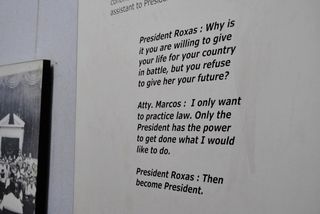
Stepping inside the Marcos Museum in Batac, Ilocos feels like stepping into a different time capsule. The museum, which also houses the remains of the late dictator, resembles more a shrine for a person deemed half human, half god. The walls are decorated with framed notes, fragments of letters and Marcos’ personal history, intricately tied to the history of the country. Personal virtues and achievements are extolled, such as Marcos’ topping the bar exam. Everywhere one turns, there are pictures of Marcos the hero, sought after by ordinary folk—Marcos with peasants, Marcos with the arms of those outstretched, reaching out to him.
For every tear you shed, there will be victory, a plaque read.
On September 21, 1972, citing threats of communist insurgency and civil disobedience, then President Marcos declared Martial law, effectively suspending civil rights and what activists would then call ‘plunging the country into its darkest times’. What followed could not quite be described by the available statistics: 30,000 cases of human rights violations according to Commission of Human Rights, 21,000 documented cases by the nongovernmental organization Task Force Detainees of the Philippines. A country paralyzed by debt while its neighboring countries in Southeast Asia boomed economically. A country with its citizenship in constant mistrust of the government. The images and stories that haunt, haunt in their universality—a replica of a famous dissident’s cell in a museum in Quezon City—bunk beds and toilet cramped together, countless pictures of men and women in the streets being sprayed on by water cannons and tear gases, skeletons that still turn up in the most remote of regions, stories of friends, comrades dead, missing, families broken, the individual voices that speak of torture, loss.
The traces are everywhere, visiting a high school friend in my hometown, we went to go to McDonald’s and just outside, was a frail man pacing back and forth, cursing an incoherent stream of stories out loud. The locals were quick to orient us about his story—that he had been tortured and had lost his mind, and in a country where mental health services are basically non-existent, he had been trawling the streets for years surviving on McDonald’s leftovers and the intermittent kindness of strangers.
In 1986, fuelled by the death of one of the primary dissidents of Martial Law, Benigno Aquino, massive cheating in the snap elections which declared Marcos president for the third time, the people trooped to EDSA for a nonviolent revolution, effectively ending Marcos rule. Aquino’s widow was declared President.
There is a different version of history in Ilocos, where the Marcoses are still celebrated and where the former President’s wife still walks around fully made up, dressed in her signature Filipiniana. The museum’s version of history does not acknowledge the EDSA revolution, but looks at it as illegal seizing of power. Marcos descendants refuse to acknowledge the violations, pressing forth an alternative version of history where the arts flourished and the First Lady’s beauty captivated the world leaders. Marcos’ kin who have found their places back in Philippine government, offer a story which run along the themes of victimhood and ultimate sacrifices, that of someday redeeming themselves to the world.
And yet to discuss these in terms of narcissism, in terms of delusions of grandeur would be to ignore the truth that different people subscribe to different truths, to different histories. It opens the issue of what history ultimately serves its people, of various meanings of then and now, and of how much memory has to be carried for a country to move forward. Different countries have carried on differently. German President Wulff recently declared that it is their people’s responsibility to carry on the memory of the Holocaust, so that it never happens again. Japan found it necessary to whitewash its involvement in World War II, to somehow ease the future generations of guilt.
It would be easy too to blame the indifference on the youth’s penchant for easy answers, the Powerpoint generation who have vague notions of history. But that would be missing the issue of what remembering should serve, and that in a nation where one can reinvent oneself over and over—one only need go to a strip in Recto, Manila where one can avail of fake diplomas, fake marriage/death certificates, where forgetting and re-crafting seems to be another art itself, the adherence to remembering becomes the most valued form of dissent. As Milan Kundera famously quoted… the struggle of man against power is the struggle of memory against forgetting, that forgetting is natural, and when it carries shame becomes in itself a source of relief, the role of arts, of literature, of storytelling and museums is a continuous struggle against it.
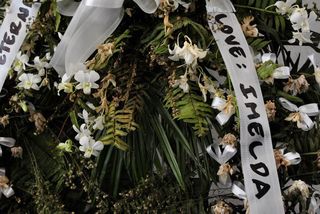
The late dictator’s remains are in a separate part of the museum. Flowers still line the entrance, despite the fact that Marcos died decades ago. There are no cameras allowed, visitors walk in one direction around the late leader, whose body is carefully preserved under a glass case, pardoned off by velvety ropes. The ambience carries with it the weight of a place of worship—reminiscent of that heavy feeling that one gets walking around a statue of a crucified Jesus in a giant cathedral, the smell of wilting flowers mixing with the stale air. We can only talk in whispers, but carry on a conversation of whether it is still the real body—there have been rumors that the body has long been replaced with a wax figure. It’s understandable—one could make a case for instance for preserving Einstein’s brain, but preserving the body of a late dictator does defy a kind of rationality, or at least a Filipino belief that the dead deserve its peace. We leave the room quite unsure, the whorls of the ears feel too intricate to be made of wax, but then again that too can be faked, and for a family who carry with them too many secrets, nothing is quite too unimaginable. If we must at least preserve this—this body in a glass case, still serenaded by army music, then at least, let the people know what they are preserving, let them decide what to keep and worship, what truths we can all live with.
– Photo credits: George-Edward Putong