
April 29, 2012
A Universe from Nothing?
Sean Carroll in Cosmic Variance:
Some of you may have been following a tiny brouhaha (“kerfuffle” is so overused, don’t you think?) that has sprung up around the question of why the universe exists. You can’t say we think small around here.
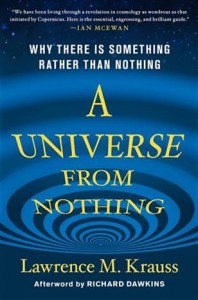
First Lawrence Krauss came out with a new book, A Universe From Nothing: Why There Is Something Rather Than Nothing (based in part on a popular YouTube lecture), which addresses this question from the point of view of a modern cosmologist. Then David Albert, speaking as a modern philosopher of science, came out with quite a negative review of the book in the New York Times. And discussion has gone back and forth since then: here’s Jerry Coyne (mostly siding with Albert), the Rutgers Philosophy of Cosmology blog(with interesting voices in the comments), a long interview with Krauss in the Atlantic, comments by Massimo Pigliucci, andanother response by Krauss on the Scientific American site.
I’ve been meaning to chime in, for personal as well as scientific reasons. I do work on the origin of the universe, after all, and both Lawrence and David are friends of the blog (and of me): Lawrence was our first guest-blogger, and David and I did Bloggingheads dialogues here and here.
Executive summary
This is going to be kind of long, so here’s the upshot. Very roughly, there are two different kinds of questions lurking around the issue of “Why is there something rather than nothing?” One question is, within some framework of physical laws that is flexible enough to allow for the possible existence of either “stuff” or “no stuff” (where “stuff” might include space and time itself), why does the actual manifestation of reality seem to feature all this stuff? The other is, why do we have this particular framework of physical law, or even something called “physical law” at all? Lawrence (again, roughly) addresses the first question, and David cares about the second, and both sides expend a lot of energy insisting that their question is the “right” one rather than just admitting they are different questions. Nothing about modern physics explains why we have these laws rather than some totally different laws, although physicists sometimes talk that way — a mistake they might be able to avoid if they took philosophers more seriously. Then the discussion quickly degrades into name-calling and point-missing, which is unfortunate because these are smart people who agree about 95% of the interesting issues, and the chance for productive engagement diminishes considerably with each installment.
Posted by Robin Varghese at 11:06 AM | Permalink


Comments
In this context, I prefer folderol.
Posted by: Carlos | Apr 29, 2012 1:38:45 PM
It appears that the professional philosophers are up at arms because, like the theologians, their belief systems and traditions have been called to question by a professional scientist. Their response is to move the goalposts and/or kick the can further down the road. If there could be multiverses with different set of physical laws in each, then they ask why; without any meaningful way to put up a testable hypothesis. As Jinasena pointed out over a millennium ago in the context of a creator, absurd logic which leads to infinite regressions. Any wonder that Krauss exhibits little patience with Albert and his ilk?
Posted by: Sam | Apr 29, 2012 4:03:11 PM
Sean writes: "Well, a bit of contemplation should reveal that this kind of reasoning might, if we grant you a certain definition of “nothing,” explain how the universe could arise from nothing."
Well, I contemplated the hell out of this, and I don't see that Krauss has established this, or even claimed to, unless the definition of nothing you are willing to grant us is not the one we have been inquiring about all along. His hypothesis allows for the creation of empty space in the presence of strong fields (pulling at it?)which can then (be pulled on to) produce particles, but those required strong fields presuppose a prior something.
The folderol, kerfuffle, or whatever really hinges on the title of the book, which would be fine as a provocation but for the fact that so many turtlearian and infinitizers seem to feel he has *finally* driven the last nail in the coffins of those philosophers still going on about the Primordial Existential Question. That Krauss explicitly denies this, and then claims to have done this, is perhaps partly to blame. That he over-promises in the title, and then tells a reviewer how critical it is that science popularizers not over-promise, only adds to the muddle.
Small wonder he's now bogged down discussing just how irrelevant he really feels philosophy is rather than the meat of the book. It's more than a little ironic that so many are jumping on to that particular train wreck, just as (I'd wager) he is coming around to the idea that a better editor might have suggested he leave that bit out of what is otherwise a delightful book.
Posted by: Carlos | Apr 29, 2012 5:22:12 PM
Since time came into existence with the universe, it follows that the universe has *always* existed (there cannot be a "before" there was time). So the difference between a universe from nothing and one that has always existed is semantical. But to say it is from nothing requires further explaining that Krauss miserably fails to do.
It is physicists who are kicking the can down the road from solar system to galaxies to universe to multiverse. The multiverse is a matter of belief and cannot be experimentally confirmed since no information can be exchanged between universes. Krauss is the one who is being theological.
Philosophy is the foundation of all knowledge including Science (which used to be called Natural Philosophy). Mathematics on which all science is based is like philosophy based on logic and reasoning. Krauss is just a narrow minded geek limited to his speciality and is the one who is the moron. Ditto Dawkins!
Posted by: Raza | Apr 29, 2012 6:20:20 PM
This whole "kerfuffle" simply highlights that philosophy consists in large part in asking the right questions, determining what are the *wrong* questions, and last but not least, identifying which ones aren't even wrong but simply incoherent. Thus we must interrogate our use of language. This is something central (or at least it should be) to the sciences but not confined to them. It's not that the linguistic turn is all that's left for philosophy to do, but it has always been a good place to start, as a certain engineer by training - Wittgenstein - knew.
Posted by: Kai Matthews | Apr 29, 2012 6:51:51 PM
"Since time came into existence with the universe, it follows that the universe has *always* existed (there cannot be a "before" there was time)"
Well, maybe, to the first part, but this has not been demonstrated. To the second part: even if point one is true, if the age of everything can be tracked back to the zero moment, that may be defined as "for all time'" but not as eternally (without limits). At least if you want to be clear, and not merely clever. But the entire notion of "came into existence" is a point of interest, isn't it?
Posted by: Carlos | Apr 29, 2012 7:18:55 PM
As far as your second paragraph, while I am sympathetic to it, I did read something compelling about it, I wish I could remember where... Basically, though, the gist was that if the mathematics behind M-theory could make predictions about this universe that could be experimentally verified, that would lend credence to the assertion that there were nearly infinite universes, even if we could not directly verify other universes. I believe I recall Krauss himself suggest that if some of our collider experiments seemed to indicate that energy was leaving our universe, this would do something similar, but this wasn't particularly convincing.
However, that still doesn't allow us to escape. The question then becomes, why are there multi-verses rather than nothing? and what is the origin of the Multiverse? This isn't a philosophical question, though it may reveal the limits of *science* to the degree that it is constrained by materialist thinking.
Note that it is scientists (once again) moving the goalposts. Not that there's anything wrong with that.
Posted by: Carlos | Apr 29, 2012 7:55:51 PM
Wow. I think Krauss is now willfully misconstruing the criticism of his thought and throwing dust in the air to aid in his escape.
He thinks philosophers do not cast useful light on the question, but I suggest he start learning something about the topic and go read Parmenides, who would be especially skeptical of this sentence in Krauss's Scientific American apology: "If “something” is a physical quantity, to be determined by experiment, then so is ‘nothing’." Do tell.
Just as it is interesting to try to grasp how mind arises from matter, so it is intriguing to speculate how something arises from nothing. But Krauss's current solution for the origins of ontology makes philosophers unsure whether to laugh or weep.
Posted by: Stefan | Apr 29, 2012 8:23:22 PM
The subtitle for Sean Carroll's piece could be "The arrogance and ignorance of physicists", i.e., theologinas and philosophers (at least the good ones) know alot about the field of physics, whereas physicists, at least some it would seem, know very little about theirs. Do physicists have the monopoly on thought? Everyone is ultimately at the mercy of experiment. If we stick around long enough we all end up at the same place anyways. Our job is not to prove each other wrong but to try to understand nature, n'est ce pas? Recall the creator of the big bang theory, Lemaitre, was a Catholic priest, and the father of genetics, Gregor Mendel, was an Augustinian friar. Both believed in God, and yet both got the understanding right, and were the first to do so.
Posted by: Pedronius | Apr 30, 2012 1:37:33 PM
Sean Carroll is giving his physicist buddies too much credit.
He claims "both sides expend a lot of energy insisting that their question is the 'right' one rather than just admitting they are different questions."
It is only the physicists that are confused about what question is being asked and prematurely 'answered'.
It is a plain fact that some physicists see no use for philosophy. They lump philosophy in with religion and they wish to chuck both projects out with the garbage.
They have had some success with religion. However, in order to chuck out philosophy they have to use philosophically valid arguments to do so. Even if they were good philosophers (as some past scientists were) they would still be using philosophy. Being horrible philosophers they only make a mess of it, and end up providing more ammo to their philosophical nemeses.
They haven't yet figured out how to get something from nothing, and they are nowhere near coming up with a non-philosophical way to demonize philosophy.
Maybe they should start praying for answers.
Posted by: DAS | Apr 30, 2012 4:46:11 PM
let's understand two things
Every thing out of something
Something out of nothing
the universe we know today was created out of something that we know of as big bang and bigbang emerged out of singularity, and how was singularity created . if theoretical physicsts are to be believed the singularity was created out of nothing. now let's try and understand what nothing stands for-
1. nothing as in emptyness
2. nothing as in nothing,nothing,nothing at all
In the first case nothing is defined with boundaries ie space/time as in the case of vacuum
In the second case it means nothing on a imperceptible scale of nothing
and how can something arise out of nothing in the absence of space time and to answer that question again we have theories of universe within universe, branes, particles creating out of nothing etc
so what actually triggered the singularity and bigbang?
one aspect has been overlooked by all, within the space/time of universe created there exists,Consciousness, A consciousness capable of grasping the birth of the universe. now what is consciousness? well it can simply be defined as the feeling of being alive/percieving. this was created within the created universe and hence is part of creation. do consciousness spring out of nothing........ I believe yes....... your thoughts are also product of your consciousness and they spring out of nothing and they effect matter around........guys I'm not preaching god. I'm theorizing the way I understand....... u may call this as deepak phenomenon etc .....lol
and if consciousness is part of creation of universe and in this created universe consciousness springs out of nothing , is there not a possibility that consciousness was part of setup before bigbang also......and if possible was existing before bigbang also may be in the form of branes, we are led to believe that sub atomic particles can create out of nothing if that is true there is no reason we cannot believe that the particles are created in conscious medium
defying all laws of physics.......well particles of matter in singularity behave differently isn,t it.
Posted by: deepak | Aug 24, 2012 1:30:10 PM
But can there be consciousness without a brain? I doubt it.
Posted by: reader | Aug 24, 2012 2:33:50 PM
well, brain is also part of creation.....isn,t it
and if we are finding planets with conditions similiar to ours on a large scale within the universe, there is no reason for us not to believe that may be housing consciousness and consciousness spreadout evenly with in the creation.........this can get vindicated if we find any form of life on other planetss....or they simply find us.
Posted by: deepak | Aug 25, 2012 8:08:19 AM
Post a comment