
March 12, 2012
Poetry in Double Translation
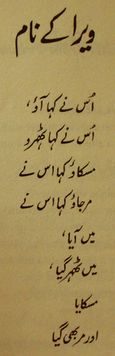
This is my English version of Pakistani poet Faiz Ahmed Faiz's Urdu rendition of a Turkish poem written by Nâzım Hikmet for his Russian wife Vera.
To Vera
She said come
She said stay
Smile, said she
Die, said she
I came
I stayed
Smiled
And died also.
Posted by S. Abbas Raza at 12:10 AM | Permalink


Comments
Hmm interesting, the original is "laugh" instead of "smile" it seems and there is some flow added here.
If I do a direct translation from the oft-quoted Turkish below I get this:
Come, she said.
Stay, she said.
Laugh, she said.
Die, she said.
I came.
I stayed.
I laughed.
I died.
Gelsene dedi bana
Kalsana dedi bana
Gülsene dedi bana
Ölsene dedi bana
Geldim
Kaldım
Güldüm
Öldüm
This would be a more literal version probably:
Come, she said to me.
Stay, she said to me.
Laugh, she said to me.
Die, she said to me.
I came.
I stayed.
I laughed.
I died.
But the above english version would probably remain unchanged if the original words were changed to:
Gel dedi bana
Kal dedi bana
Gül dedi bana
Öl dedi bana
Geldim
Kaldım
Güldüm
Öldüm
The 'Gel' means come, 'Gelsene' is a more insistent version that is difficult to differentiate in english.
Posted by: litmus | Mar 12, 2012 1:11:49 PM
Thanks, Litmus. Interesting to know more about the original.
Posted by: Abbas Raza | Mar 12, 2012 2:05:55 PM
Litmus, gelsene could be translated as, c'mon, get over here already. Thank you too for the Turkish - you've made it into a triple translation!
Posted by: Deniz | Mar 12, 2012 3:55:54 PM
hmm yeah, you're right in the sense that if you say gel to someone and they don't respond you would most likely follow with gelsene instead of repeating gel, the same way you would say c'mon after the person didn't respond to come here.
But gelsene is often said as a first utterance as well, no? in which case c'mon, get over here already seems a bit strong. Maybe c'mon by itself gets us closer to the literal meaning, since it too is said when one anticipates the other is stalling, although its a little more awkward:
C'mon come, she said to me.
C'mon stay, she said to me.
C'mon laugh, she said to me.
C'mon die, she said to me.
I came.
I stayed.
I laughed.
I died.
To me the meaning here seems to fit gülsense and ölsene more than it does kalsana, but that might be cause kalsana is often used in casual speech where it doesn't necessarily have the same insistence as the english version (why don't you stay vs c'mon stay ).
Somebody should find a Russian version...
Posted by: litmus | Mar 12, 2012 5:53:37 PM
Come
Stay
Laugh
Die
She said
I did
Posted by: Rafiq Kathwari | Mar 13, 2012 2:16:57 AM
Litmus, I love your suggestion of c'mon come - and am amused at the idea of c'mon stay - but - it fits!
Posted by: Deniz | Mar 13, 2012 8:20:29 AM
Thanks everyone. What a beautiful poem, and how interesting the nuance of language. Of course no translation could hope to match the formalism of the original - the phonic patterns and so on, but seeing both and having the commentaries makes the whole thing come alive. Any chance of a transliteration of the Urdu?
Posted by: Mike Cope | Mar 13, 2012 2:34:07 PM
Here you go, Mike:
Vera kay naam
Uss nay kaha aao
Uss nay kaha tehro
Muskao kaha uss nay
Marjao kaha uss nay
Main aaya
Main teher gaya
Muskaya
Aur mar bhee gaya
Posted by: Abbas Raza | Mar 14, 2012 3:39:35 AM
Post a comment