
March 03, 2012
People Aren't Smart Enough for Democracy to Flourish, Scientists Say
Natalie Wolchover in Yahoo! News:
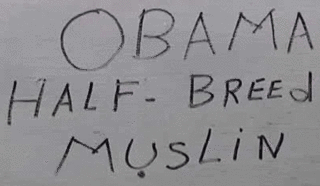
The democratic process relies on the assumption that citizens (the majority of them, at least) can recognize the best political candidate, or best policy idea, when they see it. But a growing body of research has revealed an unfortunate aspect of the human psyche that would seem to disprove this notion, and imply instead that democratic elections produce mediocre leadership and policies.
The research, led by David Dunning, a psychologist at Cornell University, shows that incompetent people are inherently unable to judge the competence of other people, or the quality of those people's ideas. For example, if people lack expertise on tax reform, it is very difficult for them to identify the candidates who are actual experts. They simply lack the mental tools needed to make meaningful judgments.
As a result, no amount of information or facts about political candidates can override the inherent inability of many voters to accurately evaluate them. On top of that, "very smart ideas are going to be hard for people to adopt, because most people don’t have the sophistication to recognize how good an idea is," Dunning told Life's Little Mysteries.
He and colleague Justin Kruger, formerly of Cornell and now of New York University, have demonstrated again and again that people are self-delusional when it comes to their own intellectual skills.
More here.
Posted by S. Abbas Raza at 07:10 AM | Permalink


Comments
The actual focus for the article is a computer model created by a medical doctor who appears to be doing some amateur sociology. If you read the original article "A mathematical model of democratic elections"(it's open access)then it's considerably less provocative as it makes a large number of assumptions about the purpose of democracies. It's point is that democratic leadership is not optimum for the society as a whole; however many people would argue that this is precisely the point democracy is set-up to avoid.
This is on top of the more basic problem of assigning a score for "leadership talent" devoid of any consideration of ideology. Stalin may be a great leader from the global perspective of the USSR but from the perspective of a conservative Ukrainian peasant he's absolutely terrible.
Posted by: Michael | Mar 3, 2012 9:10:49 AM
Akbi Khan,
You might like the work of Bernays:
"The conscious and intelligent manipulation of the organized habits and opinions of the masses is an important element in democratic society. Those who manipulate this unseen mechanism of society constitute an invisible government which is the true ruling power of our country."
The Ways of Bernays
Posted by: Dredd | Mar 3, 2012 9:32:52 AM
The reality is that a plutocracy furnishes the politicians it wants the people to vote for.
The selection process has been subverted so that the political menu is narrowly drawn to serve the plutonomy.
This result is inescapable upon even a cursory examination of the social data.
Choosing the least poisonous is still being poisoned.
Posted by: Dredd | Mar 3, 2012 9:38:39 AM
"The democratic process relies on the assumption that citizens (the majority of them, at least) can recognize the best political candidate, or best policy idea, when they see it....."
So who is to pre-judge what the "best political idea" or "best policy idea" is? In a democracy it is the "will of the people" that matters not fascist intellectual elitists (from left or right) who think that their ideas are the best and the rest of the population must conform to them.
Posted by: Raza | Mar 3, 2012 9:44:48 AM
Raza's right.
The I'm-smarter-than-they-are argument is as old as the oldest monarchy and as prone to be blown by the next revolution.
http://roshibobsays.wordpress.com/2011/08/05/the-human-nature-of-politics/
Posted by: Jim | Mar 3, 2012 10:23:07 AM
... which is not to say that a too-large part of the American electorate (at least) is not ignorant.
However, the remedy is not to default to greedy, well-educated, super-pac-funded but stupid elites.
Posted by: Jim | Mar 3, 2012 10:32:29 AM
Jim and Raza,
I agree.
In the U.S.eh? we can't test the theory, because Alice's Restaurant (the 1%) prints their own menu, serving only what they want served.
Which does not necessarily equate to what you want to eat.
For any politician to be able to get on that menu, so as to seek some government office, requires subservient behavior to the 1% first and foremost.
The people, the 99%, do not have the money to produce those candidates, but furthermore, the system does not even want those candidates of "the popular", the populous.
In theory, the people should be able to decide who is the good candidate and who is not.
But that theory is not what is being practiced, not what is real, at this time in U.S. history.
Posted by: Dredd | Mar 3, 2012 10:42:52 AM
This argument might explain why Santorum is so opposed to having as many people as possible go to college. Although, personally, I don't think Santorum is smart enough to adopt such a devious strategy on purpose.
Posted by: Jabez Vancleef | Mar 3, 2012 12:27:14 PM
Wow, talk about completely missing the point. "Democracy" is not about having the people select the candidate who best meets some high IQ bullshitter's private notion of "best candidate" and it certainly doesnt have much to do with understanding every issue until one reaches agreement with Professor X.
The Western democratic system is empirically more successful in permitting multiple elite factions to negotiate with each other, in preventing mass disorder, in delivering basic services, in permitting talented individuals to contribute to our sum of knowledge, in permitting gradual change of status of social groups with limited violence, than any other actually existing system. One day, we will probably improve it further, but not because Dunning has suddenly realized that all people (including Dunning and me and every other commentator) have a very limited idea of what is going on...
About plutocracy, one would again have to compare whether this plutocracy permits more mobility than other forms of organizing power relations. That is not to say this is perfect, a fact generally recognized, and not just by comfortable middle class critics, but by the ruling elite and by those at the bottom of the pile. Much more substantive criticisms are made every day, some will even lead to improvements, this one is a dead end.
Posted by: omar | Mar 3, 2012 2:03:37 PM
Back to the days when a small, elite group of (white) male citizens had the vote; that's the ticket! Southern Democrats and the Republicans already jumped the gun with their literacy tests and voter identification requirements.
Democracy is flawed, but it still is the best thing out there. There is no alternative.
Posted by: Sam | Mar 3, 2012 2:19:09 PM
"The democratic process relies on the assumption that citizens (the majority of them, at least) can recognize the best political candidate, or best policy idea, when they see it....."
That is actually not the assumption behind the democratic process. Democracy is not a system for getting 'optimal results'. It is a system for preventing results that are too harmful, and the promotion of liberty. (although you could say that is an optimal result compared to other systems).
The idea that there is some objective way to judge political outcomes is rubbish.
Posted by: Jazz | Mar 3, 2012 3:06:31 PM
Proof is squatting in the White House.
Posted by: Scott | Mar 3, 2012 3:28:32 PM
"squatting in the white house"?
i guess the article is closer to the truth than
i first thought
Posted by: b | Mar 3, 2012 4:13:23 PM
If we could but devolve back into a democracy -- the kind Forster meant when he wrote that essay, "Two Cheers for Democracy," then I would say that Omar calls it. Instead, we have a corporatocracy that is giving way to a kleptocracy. To compete for a power share in this system, you do need to be very cagey -- people who are not smart enough to work it are indeed left behind. In participatory democracies, even the imperfect ones that are as far as we have ever gotten with the idea, people of average intelligence should be able to form an opinion about important issues and the election of those they believe would handle trust and power responsibly. People who turn the system into a labyrinth, then game it successfully because their kind alone hold the thread that will pull them through it, are more than a little morally compromised in suggesting only smart people can play. They don't want intelligent people, some of whom are decent -- they want more criminals like themselves to share power with, because that simplifies their every approach. If highly intelligent kleptocrats would stop conflating brains and criminality by assigning the highest intellects to the most successful thieves they know, and forcing this down the throats of everyone else, then we could have a good enough democracy -- again.
Posted by: Elatia Harris | Mar 3, 2012 6:32:43 PM
India is the best example of the most successful democracy on the planet. It has a billion population, 22 official languages and more than 5 national and 50 state political parties. The democracy is working fine without any interruptions since founding of modern India 65 years ago and without any military, industrial, security, feudal or foreign backings. The literacy rate is 75% (started at 12%) and high school graduates less than 10%.
Besides, the study is an attempt to blame the 99% for problems caused by the 1%.
Posted by: Raza | Mar 3, 2012 7:27:03 PM
Many forms of Government have been tried and will be tried in this world of sin and woe. No one pretends that democracy is perfect or all-wise. Indeed, it has been said that democracy is the worst form of government except all those other forms that have been tried from time to time.
Winston Churchill, Speech in the House of Commons
Posted by: Ian Kaplan | Mar 3, 2012 8:22:21 PM
Representative democracy simply asks voters to identify the candidates with values closest to their own. Party cues are general sufficient I think.
Posted by: Eli | Mar 3, 2012 8:25:13 PM
One point the writer of the original article and every other responder seems to be misinformed on is that the US is not a democracy. Saying it over and over just proves either your ignorant of the fact that the US is a republic or you have a twisted political agenda. We in the US atleast are a republic governed by laws. Democracy is a failed mob rule structure. When you hear leaders talk about our great democracy cringe in fear that the fools may get their wish.
Remember the term Checks and Balances? The 3 branches of government were put there to oppose each other and thereby keep them out of our lives for the most part. The worst times for the freedom of the common man usually happen when they all work together.
One if the worst things you may ever hear is: "Hi, I'm from the government and I'm here to help you."
Posted by: Jayson | Mar 3, 2012 9:50:48 PM
Does anybody study history any more? Constitutional and parliamentary forms are formulated to ameliorate mass ignorance by representatives designated by various constituencies. Whether at the local, regional or state level, representatives are elected for the purpose of doing the heavy lifting on behalf of their constituents.
In our colonial past illiteracy was the norm, women didn't vote until 1920 and the secret ballot was not in widespread use until after the Civil War.
It's easy to lose track of these little details in an era when everybody seems to be an expert about everything. Our progenitors were smart enough to know what they didn't know, so they treated Democracy with a measure of humility and good citizenship we now find quaint.
Posted by: John Ballard | Mar 3, 2012 10:50:20 PM
The current crop of Republican primary candidates appear to be a precise reflection of the intelligence of those who vote for them.
If you look at them for very long it's possible to begin speculating that Charles Darwin was a wee bit overly optimistic regarding that survival of the fittest thing.
Posted by: Angeleo Mysterioso | Mar 3, 2012 10:54:52 PM
Elatia, the notion that the US has become less democratic in some generally agreed upon way, than it used to be in the "good old days", is not supported by the evidence.
Some people are old enough to remember the good old days. Others read history and have at least a vague idea.
Posted by: omar | Mar 3, 2012 11:11:19 PM
Omar, I wasn't ranting about the good old days -- which I am not old enough to remember unless nostalgia for youth is a memory of the good old days that is not supported by the facts of the era.
Here's an example of the kind of thing I mean. The hugely powerful independently owned media that played such a role in forcing the revelations of Watergate, and in ending the Vietnam war, is gone from us. We get our news from many sources now -- favored mavens who blog, etc. But the mainstream media is far less diverse than it was, owing to corporate ownership of many slightly differently branded outlets. No Kay Graham, no Woodward and Bernstein. So the news is more managed than it has ever been, and there are arguments to be made that this helps keep the public from the kind of outrage that worked to end an immoral and illegal war more than three decades ago, but which did not help the public to significantly rise up against the wars in Iraq and Afghanistan. That the mainstream media is dominated by many fewer corporations than 40 years ago is documented -- though it is of course an opinion, shared by many, that managed news has a bad effect on democracy.
Oh, and the hanging chads. And the revolving door between Monsanto and the government. There was a time when these would not have been features of our democracy. They are not evidence that it has been subverted, but what would you call them? If by evidence you mean something as solid as the germ theory of disease, I am not so sure we can look for -- and find -- causation like that in politics or the social sciences.
Posted by: Elatia Harris | Mar 4, 2012 12:07:04 AM
No doubt democracy is the best system at hand. And yes, there is no sense in trying to find the "best" political outcome in a democracy since it is the result of an open negotiation between the major actors of society, with limits to protect minorities.
But I also hold true that better information results in better decisions collectively taken. This is a classic argument on the importance of newspapers and media.
Alongside this, better "cognitive tools" to deal with that information MUST be important, too.
And although no government can impose erudition or even concern about current affairs on anyone, it is for me an ethical/civic imperative. I try to make my best, and although I know I can't deal with all issues, there are always many experts on a given field that can act as watchdog, so colletively we can, if not reach the optimal, ideal outcome, at least avoid the overtly stupid (which is not happening that much these days, btw).
And although I can't deal with all issues, one thing I can surely do is analice the results of a given policy. Let's say: "I'm not an economics expert, I don't know whether reaganomics is going to work, people have decided to give it a try, let's see what happens". And if, given fair conditions, enough time, it work, I will give the president credit. Same thing with Prohibition, NAFTA, etc.
And of course I will avoid the most obvious biasses, like that of partisanship.
As I said, I make my best and I consider it an ethical imperative in a democracy, where the destiny of the nation is on people's hands. As Spiderman puts it: "With great power comes great responsibility". In a Republic that responsability means information plus prudent, rational decision making. I try.
And I have to admit that I respect more my fellow citizens that try to do so.
Posted by: Homelandz | Mar 4, 2012 12:48:48 AM
Jonathan Chait's assessment of the GOP Suicide Watch offers an intelligent analysis of our current politics. Very insightful.
...Grim though the long-term demography may be, it became apparent to Republicans almost immediately after Obama took office that political fate had handed them an impossibly lucky opportunity. Democrats had come to power almost concurrently with the deepest economic crisis in 80 years, and Republicans quickly seized the tactical advantage, in an effort to leverage the crisis to rewrite their own political fortunes. The Lesser Depression could be an economic Watergate, the Republicans understood, an exogenous political shock that would, at least temporarily, overwhelm any deeper trend, and possibly afford the party a chance to permanently associate the Democrats with the painful aftermath of the crisis.
During the last midterm elections, the strategy succeeded brilliantly. Republicans moved further right and won a gigantic victory. In the 2010 electorate, the proportion of voters under 30 fell by roughly a third, while the proportion of voters over 65 years old rose by a similar amount—the white share, too. In the long run, though, the GOP has done nothing at all to rehabilitate its deep unpopularity with the public as a whole, and has only further poisoned its standing with Hispanics. But by forswearing compromise, it opened the door to a single shot. The Republicans have gained the House and stand poised to win control of the Senate. If they can claw out a presidential win and hold on to Congress, they will have a glorious two-year window to restore the America they knew and loved, to lock in transformational change, or at least to wrench the status quo so far rightward that it will take Democrats a generation to wrench it back. The cost of any foregone legislative compromises on health care or the deficit would be trivial compared to the enormous gains available to a party in control of all three federal branches.
On the other hand, if they lose their bid to unseat Obama, they will have mortgaged their future for nothing at all. And over the last several months, it has appeared increasingly likely that the party’s great all-or-nothing bet may land, ultimately, on nothing. In which case, the Republicans will have turned an unfavorable outlook into a truly bleak one in a fit of panic. The deepest effect of Obama’s election upon the Republicans’ psyche has been to make them truly fear, for the first time since before Ronald Reagan, that the future is against them.
http://nymag.com/print/?/news/features/gop-primary-chait-2012-3/
Vox populi may be ignorant, but it remains the voice that counts. Ask last year's pageant of falling tyrants in North Africa. They'll tell you.
Posted by: John Ballard | Mar 4, 2012 6:14:38 AM
If you believe that the purpose of government is to maximise happiness in society (ala Bentham), then it may be that despite the inefficiencies due to lack of knowledge on the part of the voters, democracy may well achieve that objective best purely because the voter believes they have an influence in the outcome.
Posted by: Brian Mulligan | Mar 4, 2012 7:58:12 AM
There is a saying that any candidate who runs on a platform of robbing Peter to pay Paul will always be assured of Paul's vote.
Oddly enough, though, the number of people who actually participate in the process compared with the number who are eligible is relatively small. In the case of revolutionary upheavals the number of true believers (Lenin's vanguard of the proletariat, Egyptian youth, Tea Party types - both original and contemporary) is invariably a minority.
I would say minimizing discontent trumps maximizing happiness. Sadly that means those in control sometimes annihilate those attempting to seize control. And in the end power trumps intelligence. Which is the thinking behind Mao's famous "Power grows out of the end of a gun," and "Our strategy is to pit one against ten, and our tactics is to pit ten against one."
It's hard to advance the notion that widespread intelligence is an important part of the formula for successful governance.
Posted by: John Ballard | Mar 4, 2012 9:01:05 AM
I think the problem with this article can be summed up by the first and last sentences.
In the first sentence she writes: "The democratic process relies on the assumption that citizens (the majority of them, at least) can recognize the best political candidate, or best policy idea, when they see it." But this isn't true. The democratic process relies on the assumption that democracy will be more likely to pick the best candidates and policies than any other system. If we don't define it this way, we're setting ourselves up to fall into the Nirvana Fallacy (to assume that we should reject an idea because it's not perfect). Democracy only has to be better than the alternatives. Also left out of the article is any discussion of who is evaluating what counts as "best" in this sentence. Is "best" what the author of the study thinks is best, or what the people think is best. Surely democracy won't tend to think what elite intellectuals think is "best," but is that because the people are wrong. It seems like an advantage that democracy depends on diverse opinions of what counts as "best."
I should add that, though I think that the population will frequently pick candidates and policies that are counter-productive towards fulfilling their own interests, I think it is more likely than any other alternative to pick something that is closer to what people want.
If we then skip to the last sentence, we see a major and under-acknowledged advantage of democracy: 'Their advantage over dictatorships or other forms of government is merely that they "effectively prevent lower-than-average candidates from becoming leaders.'" This is important since really bad leaders and bad policies can do far more bad than good leaders can do good, it's really important to weed out the bad ones, which democracy does well.
It would be nice if we had a system that was better at picking out the best leaders and policies, but until we discover it, we're stuck with the system we have.
Posted by: Joseph K | Mar 4, 2012 2:49:12 PM
Of course we argue what those we believe in argue, because our belief in them is what we call "knowledge" (epistemology).
In effect we are saying "my expert and my professor can kick your expert and your professor's ass."
It happens everyday in courts across the land.
But if we stick to the facts, rather than fabricating our own facts, a better scenario will derive.
It is clear why, in the U.S.eh? at least, some powerful people do not want IQ improving education to proliferate.
It will result in fewer voters who support them.
Posted by: Dredd | Mar 4, 2012 5:10:33 PM
There is really no good reason that a test not be given to see if a voter had minimum qualifications to cast a vote. Like who is the vice president, or how many states are there? Or make every voter pass the same tests immigrants take before they are allowed to become citizens.
Posted by: joe | Mar 4, 2012 5:42:43 PM
Joe, there is a right to vote. You don't have to be anything but a citizen of legal age to exercise that right. Alas, there is no legal obligation to vote. And there is no responsibility to vote intelligently and with preparation. If there was a ballot allowing us to vote for "None of the Above" I am sure more than half the citizenry would go to the polls.
Posted by: Elatia Harris | Mar 5, 2012 12:19:12 AM
The most important function of the democratic process is not to elect a good government, but to throw out a bad one. Individuals and parties can get elected through gile or duplicity ("You can fool all the people some of the time..") but when an electorate realizes that it has been poorly served and throws a government out - that is the real triumph.
Posted by: aguy109 | Mar 5, 2012 10:40:25 AM
Don't get Saussy, Bernays!
Posted by: ray Butlers | Mar 6, 2012 10:45:27 AM
I agree with Raza above. If anyone wants to see how and why democracy is a better system for peaceful governing, go to India and see how it works. Some of the elelcted officilas cannot read and write ! The system is still somewhat feudal and chaotic ! Convicts get elected because they lead a group of ethnic people in a community. Crime, bribary, money laundering -- everythin goes. But, the military has strictly followed Brithish system and stays out of politics, and it is the only system that will work. Othrwise, there will be a civil war.
Posted by: Mandar | Mar 10, 2012 1:22:35 PM
Post a comment