
| ABOUT US | ARCHIVES | LINKS | RSS FEED | MONDAYS | |

3quarksdaily

An Eclectic Digest of Science, Art and Literature

« collecting America’s other language | Main | Women: The Libyan Rebellion's Secret Weapon »

March 28, 2012

How to Write Like a Scientist

From Science:

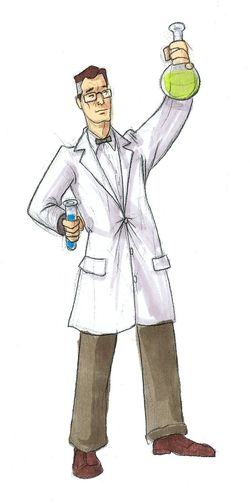
ScientistScetch081005_originalI didn’t know whether to take my Ph.D. adviser’s remark as a compliment. “You don’t write like a scientist,” he said, handing me back the progress report for a grant that I had written for him. In my dream world, tears would have come to his eyes, and he would have squealed, “You write like a poet!” In reality, though, he just frowned. He had meant it as a criticism. I don’t write like a scientist, and apparently that’s bad. I asked for an example, and he pointed to a sentence on the first page. “See that word?” he said. “Right there. That is not science.”

The word was “lone,” as in “PvPlm is the lone plasmepsin in the food vacuole of Plasmodium vivax.” It was a filthy word. A non-scientific word. A flowery word, a lyrical word, a word worthy of -- ugh -- an MFA student. I hadn’t meant the word to be poetic. I had just used the word “only” five or six times, and I didn’t want to use it again. But in his mind, “lone” must have conjured images of PvPlm perched on a cliff’s edge, staring into the empty chasm, weeping gently for its aspartic protease companions. Oh, the good times they shared. Afternoons spent cleaving scissile bonds. Lazy mornings decomposing foreign proteins into their constituent amino acids at a nice, acidic pH. Alas, lone plasmepsin, those days are gone. So I changed the word to “only.” And it hurt. Not because “lone” was some beautiful turn of phrase but because of the lesson I had learned: Any word beyond the expected set -- even a word as tame and innocuous as “lone” -- apparently doesn’t belong in science. I’m still fairly new at this science thing. I’m less than 4 years beyond the dark days of grad school and the adviser who wouldn’t tolerate “lone.” So forgive my naïveté when I ask: Why the hell not? Why can’t we write like other people write? Why can’t we tell our science in interesting, dynamic stories? Why must we write dryly? (Or, to rephrase that last sentence in the passive voice, as seems to be the scientific fashion, why must dryness be written by us?)

More here.

Posted by Azra Raza at 06:02 AM | Permalink

Comments

One of my happier larks as a grad student was to introduce into an internal ATLAS note something like "We eschew the complacent triumphalism of Monte-Carlo-based expectations, giving a voice to previously excluded data-driven methods." Regrettably, in a note written by twenty people, it lasted a mere twelve hours before being changed to something more scientific.

More seriously, a lot of the time, writing "scientifically" involves play-acting more than anything else; you leave out what you actually did or really think, omit speculations and suspicions, and try to sound as robotic as you can. This is meant to cultivate objectivity, but it's really a whitewash, a pantomimic hollywoodized faux-objectivity imposed upon actual scientific work and thinking. No-one actually becomes more scientific because he eliminates the first person from his writing, for example.

Posted by: prasad | Mar 28, 2012 7:04:04 AM

How about:
"..So Crick and I went to the pub for a couple of beers, and there we came up with a structure that is just fucking amazing!"

Posted by: aguy109 | Mar 28, 2012 9:57:27 AM

The notion of dry writing is a vestigial appendage from the 18th century notion of "reason."

Artful writing is more natural to the modern understanding of reason we now have.

Posted by: Dredd | Mar 28, 2012 11:04:35 AM

It is incumbent upon me to note that the dryness of scientific discourse is the least of our problems: if we could only eschew the pretentious in the art of letters communication would doubtless be considerably enhanced.

Posted by: reader | Mar 28, 2012 12:13:33 PM

I feel like it is hyper-correction. My postdoc advisor actually did go through my papers and remove every single use of the passive voice. It was an abomination not to be borne.

I can trace several trends in this. One is that boring prose is safe and won't get you into trouble. Getting out of trouble in your papers is usually the point, because you want to get past the cranky referees.

Secondly, more and more people are writing in a language that isn't their own, so the field develops its own dialect, only really understandable to other scientists. It's a form of gatekeeping and signaling now that faculty jobs are so hard to get.

Posted by: Hektor Bim | Mar 29, 2012 9:57:46 AM

Post a comment


Subscribe to this blog's feed  

PayAnywhere with iphone credit card swiper

Android Tablet

Bluetooth Headset

2013 New Style Dresses

Compare Car Rental Prices

DHgate.com Wholesale

3QD on Facebook

3QD on Kindle

3QD by Daily Email

Receive all blogposts at the same time every day.

Enter your Email:


Preview 3QD Email

3QD on Twitter

Miscellany

Lijit Search

AddThis Social Bookmark Button

Add to Google

Recent Comments

Elatia Harris on I am dust and ashes and full of sin

PeteChapman on I am dust and ashes and full of sin

Raza Husain on the culture animal

Chris on Positive Failure - a review of "The Power" by Rhonda Byrne

DAS on Why is Europe so Messed Up? An Illuminating History

DAS on Is the Brain No Different From a Light Switch? The Uncomfortable Ideas of the Philosopher Daniel Dennett

DAS on the culture animal

Raza Husain on Unknown Mathematician Proves Elusive Property of Prime Numbers

Dredd on NORTH KOREA’S NERVE WAR

Dredd on Unknown Mathematician Proves Elusive Property of Prime Numbers

Raza Husain on Is the Brain No Different From a Light Switch? The Uncomfortable Ideas of the Philosopher Daniel Dennett

Dana on germ houses

musafir on Tuesday Poem

soubriquet on Tuesday Poem

Eli on Unknown Mathematician Proves Elusive Property of Prime Numbers

Jim on Tuesday Poem

Josef Stern on Unknown Mathematician Proves Elusive Property of Prime Numbers

Shelley on Is the Brain No Different From a Light Switch? The Uncomfortable Ideas of the Philosopher Daniel Dennett

Bill on The Beautiful German Language

Eleutheria on The Bystander Effect in Medical Care. Why Do I Have So Many Doctors Not Taking Care of Me?

Eleutheria on Tuesday Poem

Raza Husain on the culture animal

musafir on The Bystander Effect in Medical Care. Why Do I Have So Many Doctors Not Taking Care of Me?

KRS on Tuesday Poem

Félix E. F. Larocca, MD on Tuesday Poem

Acclaim For 3QD


"I couldn't tear myself away from 3 Quarks Daily, to the point of neglecting my work. Congratulations on this superb site."—Steven Pinker, Johnstone Professor of Psychology, Harvard University.

"I have placed 3 Quarks Daily at the head of my list of web bookmarks."—Richard Dawkins, Charles Simonyi Professor of the Public Understanding of Science at Oxford University.

"Just wanted you to know I’m one of many who reads and enjoys 3 Quarks....almost daily."—David Byrne, musician, former lead-singer of the Talking Heads, artist, intellectual.

Read more here.

The 3QD Prizes

Subscribe to this blog's feed