
March 31, 2012
Gene behind van Gogh’s sunflowers pinpointed
From Nature:
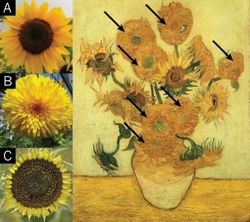
A team of plant biologists has identified the gene responsible for the ‘double-flower’ mutation immortalized by Vincent van Gogh in his iconic Sunflowers series. Van Gogh’s 1888 series includes one painting, now at the National Gallery in London, in which many of the flowers depicted lack the broad dark centre characteristic of sunflowers and instead comprise mainly golden petals. This was not simply artistic licence on van Gogh’s part but a faithful reproduction of a mutant variety of sunflower. In a paper published this week in PLoS Genetics1, researchers at the University of Georgia in Athens report that they have pinned down the gene responsible for the mutation, which they say could shed light on the evolution of floral diversity.
A wild sunflower (Helianthus annuus) is not so much a single flower as a composite of tiny florets. The golden ray florets, located at the sunflower’s rim, resemble long petals, are bilaterally symmetrical and do not produce pollen. That job belongs to the disc florets, tiny radially symmetrical blossoms that occupy the sunflower's darker centre. In combination, the two types of florets create the impression of a single large flower, and presumably an attractive target for insect pollinators. “The success of the family is determined by floral strategy,” says plant biologist John Burke, who led the study. Because changes in floral symmetry can affect how a plant interacts with pollinators — and therefore its reproductive fitness — the unusual sunflowers depicted by van Gogh piqued Burke’s curiosity.
More here.
Posted by Azra Raza at 08:43 AM | Permalink


Comments
Damn, there goes my hypothesis that it was caused by an absinthe T-ball of the Slamin Rushie variety, a la:
1) crush up a Xanax pill;
2) crush up a Viagra pill;
3) mix then sprinkle into a
vaseglass of absinthe;4) git 'r dun ...
Now you know why Nancy Grace has a bulge in her belfry.
Posted by: Dredd | Mar 31, 2012 4:16:21 PM
Post a comment