
| ABOUT US | ARCHIVES | LINKS | RSS FEED | MONDAYS | |

3quarksdaily

An Eclectic Digest of Science, Art and Literature

« Arguing Science as Faith | Main | Sunday Poem »

March 31, 2012

Debate the Usefulness of Election Models

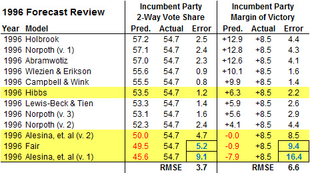
Fivethirtyeight-0326-models1996-blog480There a debate on the issuse over at the NYT's FiveThirtyEight. First, Nate Silver:

...Lynn Vavreck’s excellent 2009 book, “The Message Matters,” for instance, made the following claim:

The economy is so powerful in determining the results of U.S. presidential elections that political scientists can predict winners and losers with amazing accuracy long before the campaigns start.

To be clear, that is the publisher’s copy and not Ms. Vavreck’s. However, statements like these have become fairly common, especially among a savvy group of bloggers and writers who sit at the intersection of political science and the mainstream media (a space that this blog, of course, occupies).

But is it true? Can political scientists “predict winners and losers with amazing accuracy long before the campaigns start”?

The answer to this question, at least since 1992, has been emphatically not. Some of their forecasts have been better than others, but their track record as a whole is very poor.

And the models that claim to be able to predict elections based solely on the fundamentals — that is, without looking to horse-race factors like polls or approval ratings — have done especially badly. Many of these models claim to explain as much as 90 percent of the variance in election outcomes without looking at a single poll. In practice, they have had almost literally no predictive power, whether looked at individually or averaged together.

John Sides responds:

I am less critical of the accuracy of these models than is Nate. For one, forecasters have different motives in constructing these models. Some are interested in the perfect forecast, a goal that may create incentives to make ad hoc adjustments to the model. Others are more interested in theory testing — that is, seeing how well election results conform to political science theories about the effects of the economy and other “fundamentals.” Models grounded in theory won’t be (or at least shouldn’t be) adjusted ad hoc. If so, then their out-of-sample predictions could prove less accurate, on average, but perfect prediction wasn’t the goal to begin with. I haven’t talked with each forecaster individually, so I do not know what each one’s goals are. I am just suggesting that, for scholars, the agenda is sometimes broader than simple forecasting.

Second, as Nate acknowledges but doesn’t fully explore (at least not in this post), the models vary in their accuracy. The average error in predicting the two-party vote is 4.6 points for Ray Fair’s model, but only 1.72 points for Alan Abramowitz’s model. In other words, some appear better than others — and we should be careful not to condemn the entire enterprise because some models are more inaccurate.

Third, if we look at the models in a different way, they arguably do a good enough job.

Posted by Robin Varghese at 04:50 PM | Permalink

Comments

It makes way to project the election on a weekly basis right up to the end. and then use final Registered and Likely voter state polls, allocate undecided voters and run a Monte Carlo Simulation. LV polls typically understate Democratic turnout. RV polls have been more accurate in predicting the True Vote. LV polls are better at predicting the bogus recorded vote. http://richardcharnin.wordpress.com/2011/09/01/monte-carlo-simulation-election-forecasting-and-exit-poll-modeling/

Posted by: Richard Charnin | Apr 15, 2012 2:44:15 PM

It is more realistic to project BOTH the True Vote and the fraudulent Recorded vote using Registered and Likely voter state polls, respectively. The model should be run on a weekly basis right up to the election. The first step is to allocate undecided voters and then to run a Monte Carlo Simulation. LV polls typically understate Democratic turnout and are good at predicting the bogus recorded vote. RV polls have been more accurate in predicting the True Vote. http://richardcharnin.wordpress.com/2011/09/01/monte-carlo-simulation-election-forecasting-and-exit-poll-modeling/

Posted by: Richard Charnin | Apr 15, 2012 2:54:18 PM

Post a comment


Subscribe to this blog's feed  

PayAnywhere with iphone credit card swiper

Android Tablet

Bluetooth Headset

2013 New Style Dresses

Compare Car Rental Prices

DHgate.com Wholesale

3QD on Facebook

3QD on Kindle

3QD by Daily Email

Receive all blogposts at the same time every day.

Enter your Email:


Preview 3QD Email

3QD on Twitter

Miscellany

Lijit Search

AddThis Social Bookmark Button

Add to Google

Recent Comments

prasad on the culture animal

Mitt Romney's Dog on Why race as a biological construct matters

Elatia Harris on The Moral Status of Rocks

prasad on The Moral Status of Rocks

Raza Husain on The Moral Status of Rocks

Fred on Unknown Mathematician Proves Elusive Property of Prime Numbers

Joel Grant on Why Rational People Buy Into Conspiracy Theories

Tomboktu on Why is Europe so Messed Up? An Illuminating History

Joe on Why Rational People Buy Into Conspiracy Theories

Jalees Rehman on The Science Mystique

Dredd on The Moral Status of Rocks

sjg on Why Rational People Buy Into Conspiracy Theories

Dredd on Why Rational People Buy Into Conspiracy Theories

Ken Pidcock on The need for critical science journalism

Louise Gordon on Why race as a biological construct matters

Louise Gordon on The stories of two Palestinian villages: From Al-Araqib to Susiya

musafir on a pretty funny book

freddie on The stories of two Palestinian villages: From Al-Araqib to Susiya

freddie on The stories of two Palestinian villages: From Al-Araqib to Susiya

Junaida on Tuesday Poem

rafiq on Tuesday Poem

Raza Husain on the culture animal

Nebor on Tuesday Poem

Eleutheria on I am dust and ashes and full of sin

carlos on I am dust and ashes and full of sin

Acclaim For 3QD


"I couldn't tear myself away from 3 Quarks Daily, to the point of neglecting my work. Congratulations on this superb site."—Steven Pinker, Johnstone Professor of Psychology, Harvard University.

"I have placed 3 Quarks Daily at the head of my list of web bookmarks."—Richard Dawkins, Charles Simonyi Professor of the Public Understanding of Science at Oxford University.

"Just wanted you to know I’m one of many who reads and enjoys 3 Quarks....almost daily."—David Byrne, musician, former lead-singer of the Talking Heads, artist, intellectual.

Read more here.

The 3QD Prizes

Subscribe to this blog's feed