
by Misha Lepetic
“If you design with a view to optimize anything, it is bound to end up suboptimal, because it can’t cope with change. This applies as much to political constitutions, universities and buildings”
~ Jeff Mulgan
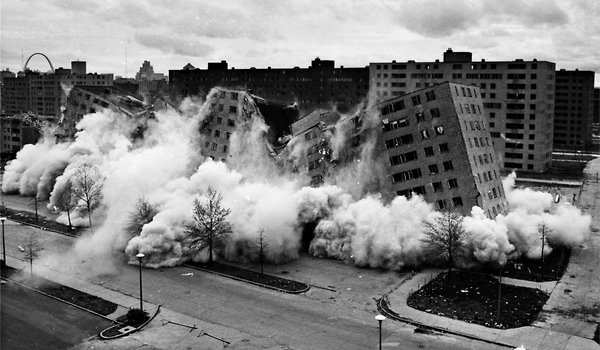
Recently I had the good fortune to catch “The Pruitt-Igoe Myth” at the IFC Center here in New York. The docuementary is a fascinating corrective to the perception that when we talk about failed public housing, we are talking about failed architectural design. The documentary makes liberal use of the above 1972 picture and footage, which has become visual shorthand for, as Alexander von Hoffmann writes:
…an icon of failure. Liberals perceive it as exemplifying the government’s appalling treatment of the poor. Architectural critics cite it as proof of the failure of high-rise public housing for families with children. One critic even asserted that its destruction signaled the end of the modern style of architecture.
There is much to be said about the story of Pruitt-Igoe. Its history, and the narratives and ideologies that are woven around that history, constitute a microcosm of how we choose to perceive many aspects of architecture, urban planning and public policy during the 20th century. Unsurprisingly, such a grand flameout was bound to attract grand pronouncements, since there was something for everyone to cherry-pick for his or her own agenda.
The genesis of a housing development as large as Pruitt-Igoe was made possible by the United States Housing Act of 1949, but flight to the St Louis suburbs was already in motion. Postwar migration from the South, in the form of the Second Great Migration, re-filled that urban core with poor families that could not afford much better than the tenant buildings run by slumlords. However, even this migration was not sufficient to re-inflate the population of the City of St Louis, which would peak at 857,000 in the 1950 census. Currently standing at 319,000, the 63% loss in population has left the city at roughly the same size as during the 1870 census. Even more remarkably, the St Louis Metropolitan area – the destination of urban flight – saw its population grow from 400,000 to well over a million in the same 60-year span.
It is against this backdrop that we must examine the design decisions made by planners. In a 1991 article that partly inspired the documentary, Katherine Bristol writes:
In 1950 the St. Louis Housing Authority commissioned the firm of Leinweber, Yamasaki & Hellmuth to design Pruitt-Igoe. The architects’ task was constrained by the size and location of the site, the number of units, and the project density, all of which had been predetermined by the St. Louis Housing Authority. Their first design proposals called for a mixture of high-rise, mid-rise, and walk-up structures. Though this arrangement was acceptable to the local authority, it exceeded the federal government's maximum allowable cost per unit. At this point a field officer of the federal Public Housing Administration (P.H.A.) intervened and insisted on a scheme using 33 identical eleven-story elevator buildings.
The planners had placed a huge bet that the 57-acre site would accommodate even greater densities than the slums they were replacing. At the same time, funds for the maintenance, repairs and cleaning of the development were intended to come from income generated from rents. Pruitt-Igoe’s occupancy, however, topped out at 91% only three years after its 1954 opening, and by 1973 only 800 people were living in a complex that had originally been designed for 15,000. Additionally, as Michael Kimmelman writes in the New York Times:
[Among] the factors conspiring against the project [were]…unfathomable welfare rules stipulating that no able-bodied man could live in a home where the woman received government aid. A night staff from the Welfare Department patrolled apartments searching for fathers to evict.
Further budgetary constraints saw the axing of children’s playgrounds and the use of substandard construction materials. Finally, Pruitt-Igoe was originally “zoned” for one-third occupancy by whites and two-thirds occupancy by blacks, but during the project’s construction the Supreme Court passed down its desegregation ruling. This had the ultimate effect of turning all of Pruitt-Igoe into housing for poor African-Americans.
All of these factors converged to obviate the project’s chances of success, and Pruitt-Igoe became the byword for public housing failure. The result “was a housing project that represented to its tenants a system of powerful control because it encoded racist messages by isolating and containing a population that was 98% African-American.” These decisions have little to do with the actual design of the buildings themselves, and yet the revisionist history that has since accrued to Pruitt-Igoe has focused on this almost exclusively. Bristol’s article is particularly interested in dismantling the myth that:
For most architects the entire story can be reduced to a one-line explanation: the design was to blame… With all the attention being paid to the project's design in the early 1970s, a strong associative link was forged between architectural flaws and Pruitt-Igoe's deterioration. In 1965 James Bailey had taken care to point out that two of the major causes of the deterioration of Pruitt-Igoe were chronically inadequate maintenance and the increasing poverty of tenants. By 1972 these crucial elements of the story had been all but forgotten in the rush to condemn the architecture. It is the privileging of these design problems over the much more deeply embedded economic and social ones that constitutes the core of the Pruitt-Igoe myth.
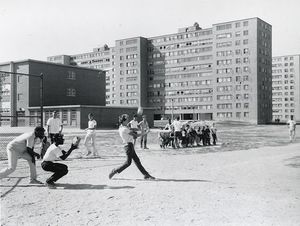
The apotheosis of this attitude was Charles Jenks’ epitaph, hinted at above, that “Modern Architecture died in St. Louis, Missouri on July 15, 1972 at 3.32 pm (or thereabouts) when the infamous Pruitt Igoe scheme, or rather several of its slab blocks, were given the final coup de grâce by dynamite.” It’s natural to want to remove failures from our sight – we don’t like to be reminded about how badly things can turn out. (Nor had Yamasaki seen the last of the revolt against Modernism, since Al-Qaeda proved to be far harsher architectural critics than the likes of Jencks.) Of course, the real, socio-economic factors responsible for this and other “design failures” otherwise imputed to Modernism cannot be dynamited away quite so easily.
*
However, what interests me about this narrative is the opportunity to think about resilience. As is clear from Pruitt-Igoe's genesis, wagering on what a built environment is meant to accomplish is a fairly permanent proposition. Even a design optimized for a particular moment in time may become obsolete as old needs recede and are supplanted by new ones. The unpredictability of the city is such that one can never anticipate what those needs might be. As Keynes’ (unfortunately apocryphal) aphorism goes, “When the facts change, I change my mind. What do you do, sir?” So, how might we introduce this kind of thinking into design and architecture? That is, how do you build something in a way that allows you to change your mind later on?
This may seem difficult to envision from the point of view of the built environment, so let me introduce a metaphor from another field. There are several serious contributions that software development has introduced to the field of innovation: use case modeling; object-oriented development (inspired, in part, by the architect Christopher Alexander’s writings on pattern languages); and lean startup methodologies. The latter, developed by Eric Riess, attempts to develop a more empirical approach to innovating in a startup. For example, he asks how we can aggressively shorten the time that it takes to identify and develop a product, as well as the customers that might be interested in that product. Of Riess’s palette of tools, I am especially thinking of what he calls the MVP, or Minimum Viable Product.
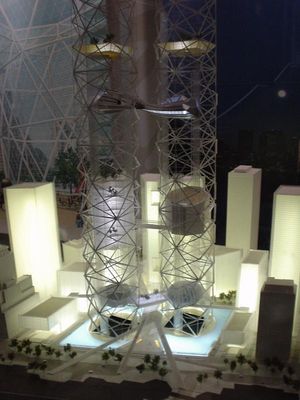
In the case of the built environment, it may be difficult to imagine how this might be possible. After all, bytes are easier to move around or delete than bricks; also, there are fewer regulations and institutions to navigate. However, a minimum viable product for a city has already been taking shape in the form of pop-up structures, whether they are cafés or commercial spaces. Cheap structures can be erected quickly for a variety of functions. If they are efficacious, these structures can become permanent, or they can melt away on a seasonal or some other basis. Pop-up parks can also occupy spaces that are awaiting development (although these spaces, like Duarte Square, may in turn find themselves the subject of occupation).
The larger point is to determine what works in an urban space. It is not just guerilla artists and fly-by-night entrepreneurs whose interest is served here: New York City’s Department of Transportation has been encouraging restaurants to sponsor pop-up cafés as a way for sidewalks to function as gathering places. Interestingly, the DOT requires the sponsoring restaurants to allow people to gather, regardless of whether they buy anything from the establishment. In the same way, the DOT has been putting up small parks around traffic intersections in Manhattan, and judging whether the attention they receive ought to qualify them for more permanent placement. It is much easier to paint a few extra lines, throw out a few tables and chairs and, based on what happens, determine if this is in fact the space where a park’s utility would trump the constriction of traffic lanes. In essence, this is urban design’s minimum viable product.
*
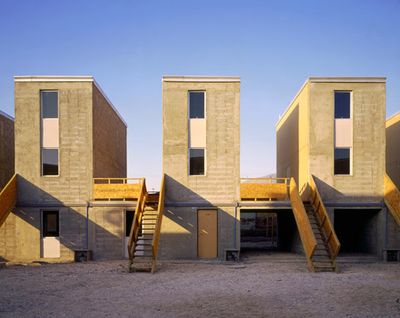
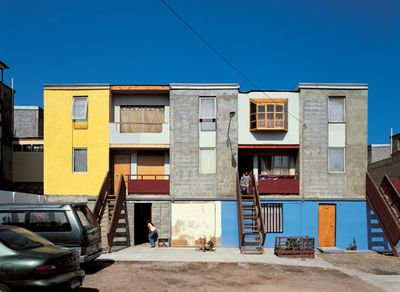
The problem is this: the informal settlement has a finite size, and too many families living upon it. Within the constraints of the budget, they could build:
- A few medium size houses – and then most people would have to leave, as there would not be enough houses for them.
- Many tiny houses – but still not enough, too small, and these houses would be difficult to “expand” as families' needs grew.
- Highrise buildings – which the inhabitants refused to contemplate, and which could also not be “expanded.”
The Elemental project’s solution was this: the project would plan for the “medium” size houses, but build only half the house. They would plan (and build) in such a way that more units could fit in, and that the families could easily expand into the “missing” half when they were able to do so. Elemental built a system of row houses in which half of every unit is missing. But because they have built the part that requires the most expertise and investment – the load bearing structure, the roof and so on – the inhabitants could expand into the missing voids at a later stage – in any way they liked. This also dealt with the pervading problem of social housing – the uniformity and lack of individuality.
Thus, Aravena’s group understood and worked with the limitations – budgetary and otherwise – that were being imposed on their design. In fact, they turned these limitations into points of strength: few architects have the courage or insight to allow their tenants to become co-designers, despite the fact that the benefits of this are gradually being proven worldwide. At the same time, please note that the consultations with the future residents of the Iquique settlement revealed much the same misgivings about living in a highrise as Pruitt-Igoe’s architect expressed almost 40 years earlier. If nothing else, this is illustrative of both the constancy of the human condition, as well as the persistence of design problems. However, the real progress in this case is that neither the architect nor the residents were passive players before more dominant institutional forces, such as the role played by St Louis Housing Authority in the 1950s.
As for Pruitt-Igoe itself, all that remains is a brownfield that has mostly reverted to urban forest. But it is curious that few of its interlocutors spend time imagining the site's future. Even the documentary ends by dwelling on its wild and overgrown state as a cautionary tale, although perhaps threatened by “future development.” Indeed, Pruitt-Igoe has, since the early 1970s, been the burial ground of many proposed re-development schemes. Nevertheless, brave souls have launched a new design competition on the 40th anniversary of the initial demolition. The organizers of the competition feel it is their responsibility to finally lay these ghosts to rest:
No design intervention has ever been staged that would reconcile the remains of Pruitt-Igoe with our contemporary consciousness. If the site registers, it registers as an emptiness whose meaning is ripe but unarticulated to those who live or pass near it. Shall the site ever be liberated? Or is its current condition already an important monument to the memory of the site?
Each city deals with its wounds in a way that is fundamentally reflective of the temperament of its citizens and the institutions they create. I wonder whether this temperament has shifted sufficiently to allow the creation of outcomes that may make a real difference in the way we collectively weave our urban fabric. As a final note, I was tormented throughout the writing of this essay about where I had seen the footage of Pruitt-Igoe being dynamited. And then I remembered: Reggio and Glass's morality play, condeming our hubris on a civilizational scale, has not lost any of its poignancy, or timeliness.