
| ABOUT US | ARCHIVES | LINKS | RSS FEED | MONDAYS | |

3quarksdaily

An Eclectic Digest of Science, Art and Literature

« The search for a two-thousand-year-old city | Main | Perceptions »

February 06, 2012

David Shrigley: Brain Activity

by Sue Hubbard

Until 13th May 2012, Hayward Gallery, London

The term black humour was first coined by the Surrealist André Breton in his 1940 anthology of texts, which traces the literary history of the satire of death. In 1896 Alfred Jarry’s Absurdist play Ubu Roi ushered in Surrealism which created a platform for political and psychological disruption against the events of the early 20thcentury, particularly the atrocities of the First World War. Satire provided a way of facing death as well as subverting authoritarian thinking.
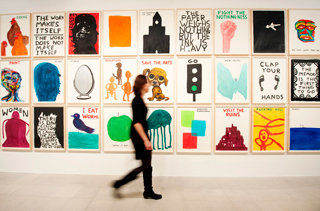
Ds5aAbsurdist humour forms the basis of David Shrigley’s art practice. His drawings with their dead-pan one line jokes, his videos and taxidermy have created a whole new category that sits somewhere between popular culture and fine art. It’s as if the jottings of a nerdy comic loving teenager had been plastered round the Hayward Gallery. Some of his drawings are very funny indeed: the pair of feet that says ‘clap your hands’, the wall painting of a man where his ankle has been labelled ‘tooth’, and his penis ‘chimney’. Or the sign high on the gallery wall that simply reads: Hanging Sign. Yet as I write this down something is stripped away. It just doesn’t sound so funny – but it is. Often it is simply the tension between the object, the context and the text, the stating of the obvious in a way that’s never quite obvious until Shrigley does it, that creates the humour. There is also something very English about it. His are the sort of jokes you might find in those old school boy comics the Dandy and the Beano or in Monty Python.

A course in Environmental Art at the Glasgow School of Art in the late 1980s and early 1990s seems an unlikely springboard for such zany work. Yet it appears to have provided a sense of context for his absurdist interventions. Leisure Centre (1992) depicts a white flimsy cardboard box with a cut-out door on which he has written LEISURE CENTRE. Placed in the middle of a muddy building plot it implicitly comments on the paucity of local authority services. Another placard stuck in dry ground announces RIVER FOR SALE, whilst a sheet of paper pinned to a tree simply reads: LOST. GREY+WHITE PIDGEON WITH BLACK BITS. NORMAL SIZE. A BIT MANGY-LOOKING. DOES NOT HAVE A NAME. CALL 2571964. The bathos and pathos of this little narrative are almost worthy of Sam Beckett.
Ds27aAll Shrigley’s drawings – however intuitive and seemingly slap-dash - are made in a disciplined manner in his organised studio. Their casual appearance belies the fact that he does many dozen in one stretch and, like any good writer, will then leave them for a period to be subjected to the editing process of his‘artistic distance box’, before destroying the majority. As a student he’d spend time looking for new words in his much used thesaurus, learn them and then set them to work. Although drawing is central to his practice his sculptures, with their exaggerated scale and sense of the uncanny, form a large part of this exhibition. The squashed aluminium ladder at the entrance recalls the soft sculptures of Claes Oldenburg, whilst the row of big black ceramic boots suggests not only the paintings of Philip Guston but also, rather uncomfortably, marching jackboots and a faceless army. Then there is Ceramic Ear (2010) that lies on its low plinth like a piece of pink ceramic bacon or something out of Blue Velvet, and his ridiculously big white ceramic eggs each painted with the word EGG and his Very Large Cup of Tea (2012) complete with cold brew that made me think of Meret Oppenheim’s teacup without the fur or the sexual innuendo. Shrigley is not afraid of art history. Duchamp is an obvious precursor as is the whimsy of René Magritte.

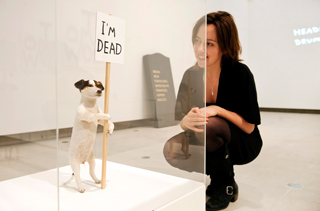
Yet for all its off-the-wall humour he is not afraid to take on the subject of death treating it with a shoulder-shrugging indifference. The obsession is there in his The dead and the dying (2010),a vitrine of 40 miniature clay figures in various states of demise, and the granite gravestone inscribed with a shopping list that includes baked beans and Aspirin. It is there, too, in his taxidermy; in the headless ostrich that greats you at the entrance to the gallery (a headless ostrich, head in the sand, get it??) and the squirrel, entitled Nutless (2002) that sits on a log disconcertingly holding its own head in its paws, and the small stuffed terrier that has become the poster pin-up for the show, which stands on his hind legs holding a placard that says “I’m dead”. Shrigley’s friend the artist Jonathan Monk, with whom he once shared a house, compares the piece to On Kawara’s early telegraphed work: I am still alive. It is an interesting point, but this is a stuffed dog announcing that it’s dead and not a disappeared Japanese artist claiming to be alive, so I’m not sure he’s right. Still there’s something both sad and funny about this little Jack Russell. He reminded me of the man who used to walk up and down Oxford Street carrying a placard proclaiming that the end of the world was nigh and insisting that we should all renounce protein because it enflamed lust. Perhaps, on second thoughts, this might actually be his dog. You never know.

Headlessness is something of a favoured theme in Shrigley’s work explored in his new animation the Headless Drummer (2012).The frenzied sound track can be heard throughout the gallery as you walk round making everything seem just that bit more mad. This is shown alongside other films including Light Switch (2007), his take on Turner Prize winner Martin Creed’s conceptual The Lights Going on and Off, and Sleep (2008), a series of drawings of a little man breathing whilst tucked up in bed. What is clear is that for Shrigley life is absurd, simply a prequel to endless oblivion. All we can do is wile away the time and we might as well distract ourselves while we do. As Vladimir says in Beckett’s Waiting for Godot “Well that helped to pass the time.” “It would have passed anyway,” replies his companion Estragon.

I first came across Shrigley’s work in his self-published books from his own The Armpit Press. These were cheaply printed and to be found in alternative shops under titles such as Merry Eczema (1992) and Blanket of Filth (1994). Their reputation was largely spread by word of mouth and lead to his first gallery exhibition at Glasgow’s Transmission Gallery in 1995. Now he has published 30 books and created drawings for The Independent, The New Statesman and The Guardian. “I started to draw,” he says, “in the way that I do as an attempt to reduce my ideas to their barest form; to communicate as simply and directly as possible.” In so doing he has defined his own aesthetic that bridges fine art, graffiti and popular culture. The seductive, childlike appearance reveals the absurdities and mini psychodramas of daily life. Like Shakespeare’s clowns and fools Shrigley holds up a mirror to the uncanny, to violence and death with dead-pan humour and a straight face.

And the show at the Hayward? Well it seems a misjudged. Clowns and fools are, by definition, outsiders. Shrigley’s natural habitat is the alternative bookshop and the small gallery where he can observe, pock fun and be as wacky as he likes. This show turns him into an establishment artist; and that’s a pity.  

www.suehubbard.com

Photo: Linda Nylind. Installation view of David Shrigley: Brain Activity at the Hayward Gallery

Posted by Sue Hubbard at 12:10 AM | Permalink

Comments

Post a comment


Subscribe to this blog's feed  

PayAnywhere with iphone credit card swiper

Android Tablet

Bluetooth Headset

2013 New Style Dresses

Compare Car Rental Prices

DHgate.com Wholesale

3QD on Facebook

3QD on Kindle

3QD by Daily Email

Receive all blogposts at the same time every day.

Enter your Email:


Preview 3QD Email

3QD on Twitter

Miscellany

Lijit Search

AddThis Social Bookmark Button

Add to Google

Recent Comments

Rohana on Mortify Our Wolves

Raza Husain on If Only We Had A Leader Like Chavez, Who Solved Real Problems -- Instead Of Debating Fake Ones Like The Deficit

mirel on If Only We Had A Leader Like Chavez, Who Solved Real Problems -- Instead Of Debating Fake Ones Like The Deficit

araldo on Here’s how to change the world

Elatia Harris on Here’s how to change the world

Sundar on Here’s how to change the world

araldo on Here’s how to change the world

prasad on Here’s how to change the world

araldo on Thursday Poem

Raza Husain on Here’s how to change the world

prasad on Here’s how to change the world

Raza Husain on Here’s how to change the world

prasad on Here’s how to change the world

Jim Sanders on the hudson review

Ian Kaplan on Stephen Wolfram: Dropping In on Gottfried Leibniz

Sundar on Here’s how to change the world

sjg on The First New Atheist? Kierkegaard

billy on Obama must Make Fighting Climate Change National Project, or Die the death of a thousand Scandals

Raza Husain on How do Finnish kids excel without rote learning and standardized testing?

Raza Husain on If Only We Had A Leader Like Chavez, Who Solved Real Problems -- Instead Of Debating Fake Ones Like The Deficit

DAS on Obama must Make Fighting Climate Change National Project, or Die the death of a thousand Scandals

czrpb on The case against empathy

Jesse M. on The case against empathy

Khader on Mourning (in)formation of Palestinian Collective Memory: A Mythopoetic Reclamation of Palestine, Part I

Dredd on Obama must Make Fighting Climate Change National Project, or Die the death of a thousand Scandals

Acclaim For 3QD


"I couldn't tear myself away from 3 Quarks Daily, to the point of neglecting my work. Congratulations on this superb site."—Steven Pinker, Johnstone Professor of Psychology, Harvard University.

"I have placed 3 Quarks Daily at the head of my list of web bookmarks."—Richard Dawkins, Charles Simonyi Professor of the Public Understanding of Science at Oxford University.

"Just wanted you to know I’m one of many who reads and enjoys 3 Quarks....almost daily."—David Byrne, musician, former lead-singer of the Talking Heads, artist, intellectual.

Read more here.

The 3QD Prizes

Subscribe to this blog's feed