
by Vivek Menezes
I’m trying to avoid all hyperbole here, honest. Also it’s not like I haven’t been around – my 3-decade concert resume includes Jobim in Rio, Springsteen in New Jersey, Aida in Luxor, and – some of you might recall – Lou Majaw in his hometown Shillong.
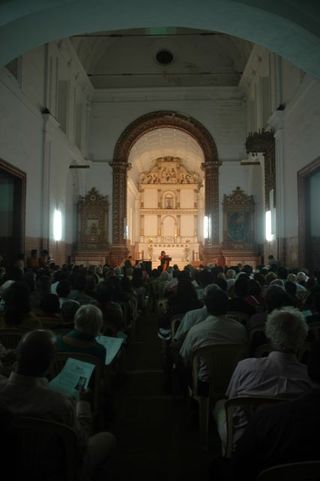
But this Saturday night on a rugged hillside overlooking the Mandovi River in Old Goa was the equal of all those experiences.
The marvelous soprano Patricia Rozario sang Bach, Mozart and Mendelssohn in the lovely 500-year-old Capela do Monte, packed in tight with a hushed, intent audience. The sari-clad singer dazzled throughout, but it is when she sang in Konkani – hymns from Goa’s centuries-old tradition – that a palpable atmosphere of catharsis arrived for Rozario and her now-emotional audience.
The formidably talented and experienced singer suddenly had tears visibly welling in her eyes. All around me audience members were crying, the silver-haired lady next to me buried her face in her grandson's shoulder and sobbed quietly. My own face was wet now, we each had suddenly realized it had taken all of us – setting, singer, repertoire and audience too – five full centuries to get to this electric moment of coming together. It was inexpressably moving to be there. But we all knew it never should have taken this long.
For at least two decades, I’ve fairly diligently (but informally) surveyed scholars, musicians and music fans about “western” music in India.
In all that time, I’ve encountered barely a handful of non-professional musicologists who realize that – for example – the violin’s presence in India far predates the sitar or tabla, or even what is now called “Hindustani classical music.” It is common for boneheads to tout the credentials of this music, that emerged from post-Mughal North India, as somehow more ‘Indian’ than, say, a cello concerto. But that is totally ahistorical, and like every single North-India-generated generalization about “Indianness”, willfully ignores the history and culture of India’s Western coastline.
Here’s the facts: for thousands of years, the Konkan and Malabar coasts of India have engaged in trade and rich cultural interactions across the Arabian Sea. Seafaring communities from the Mediterranean all the way down the coastline of Africa came and went from the ports of the ‘spice coast’. Judaism flourished in pockets for milleniae. Christianity actually established permanent roots in India before it did in Europe – there were already Christian communities along the Konkan and Malabar coastlines centuries before England, Spain or Portugal saw their first significant conversions to the new religion.
Thus ‘western’ music was undoubtedly already being played in this part of India long before the Portuguese naval officer Alfonso de Albuquerque seized Goa in 1510, (still many years before the first Mughal set foot in India).
While the Portuguese remained largely indifferent to most education in their colonies (and remain so at home today!) – coerced conversions created hundreds of thousands of Konkani Catholics during the 16th and 17th centuries, and scores then hundreds of churches and chapels were constructed alongside. All of them needed musicians to accompany services in the European tradition, and the various religious orders scattered around Goa set about producing them with great alacrity.
Just months after subduing Goa – the present Capela do Monte was site to a particularly bloody tussle – de Albuquerque was already beseeching the king of Portugal to furnish organs for new churches that were mushrooming all over the new Estado da India. Within a scant generation – still the first half of the 16th century – western instruments were already rooted in Konkan Catholic practice, and church services were accompanied by expert musicians using the exact same mix of instruments as prevailed in Europe: cornettos, violas and harpsichords.
A century later, the native Goan’s mastery of these “western” instruments had already become notable. In 1683, the Italian traveller Sebastiani attended a mass in the Basilica of Bom Jesus and marvelled: ‘It was celebrated by seven choirs with the sweetest instrumental interludes. I felt I was in Rome. I could not believe how proficient these Canarese are in this music, how well they perform it, and with what facility.’
An unexplored reason why music was so important to Konkani Catholic practice is that is is so important to Konkani Hindu practice. In fact, the Portuguese proselytziers found that they could only succeed if music was incorporated in local rituals to a far greater extent than allowed anywhere else. This was underlined by an historic 17th-century decree by the Vatican. Rome declared that – unlike the rest of the world – only the diocese of Goa would be allowed to use instruments (violin, clarinet and bass were specifically named) in religious ceremonies that commemorated the three days of great mourning that culminate in Easter Sunday.
The close relationship between Goans and “western” musical instruments took another dramatic turn when the British occupied the territory during the Napoleonic Wars. During that period, the British were delighted to encounter native Christians who held no dietary or religious taboos. Thus began a major exodus of Goans to British India and beyond, as bakers, clerks, cooks, butlers, ayahs, and colonial administrators. Many thousands of church-trained musicians seized the opportunities available in regimental and club bands and orchestras – they learned to play ‘God Save the Queen’, and trooped out of Goa to become professional musicians in Bombay, Calcutta, Rangoon and Karachi, Aden and Singapore.
The indefatigable cultural historian and Bombay flaneur, Naresh Fernandes has described how some of these migrant musicians came together with a handful of other pioneers to create the addictive blend of musical styles that we now call “the Sound of India” or Bollywood music. His recent Taj Mahal Foxtrot is an epic survey of jazz music in Bombay – home to a sustained centre of excellence through the 30s and 40’s – which outlines how classically-trained musicians became seduced by the freer sounds emerging from black America, and then went all the way to become real jazzmen. See his superb blog for much more…
As Naresh recounts in his marvellously engaging book, by 1916 there was an almost entirely Goan orchestra playing at the Taj Mahal hotel in Bombay. Another arose in the 1920s, though admittedly the Bombay Chamber Orchestra was led by a German, Edward Behr.. Later, Dominic Pereira became the concertmaster of another promising fledgling orchestra full of Goans, the Bombay Philharmonic.
Without interference, these musical shoots would have certainly flowered into an indigenous classical orchestra, and given the early start, perhaps even a first-rate one. But narrow nationalistic politics stifled those possibilities, and generation after generation of piano and violin and trumpet players from Goa and the rest India were basically silenced silent or compelled to migrate, with their “alien” instruments subject to extraordinarily harsh penalties on import.
The last serious attempt to form an indigenous orchestra in India was actually the most promising, and so provides the most heartbreaking example of squandered opportunities for this kind of music in India.
It was the brainchild of Anthony Gonsalves, revered teacher of a generation of Bollywood composers (like Pyarelal, who named the famous ‘Amar Akbar Anthony’ character after his guru). A widely-acknowledged savant who died in near-isolation just a few weeks ago, Gonsalves developed an abiding love for raga-based music. He immersed himself in creating symphonies based on Indian classical traditions, and wrote several pioneering pieces of music in this vein, including ‘Sonatina Indiana’ and ‘Concerto in Raag Sarang’. In 1958, Gonsalves personally footed the bill to constitute 110 musicians into the Indian Symphony Orchestra, who made their debut in the quadrangle of St Xaviers College in South Bombay.
The photographs from that day are extremely impressive, but also quite painful to view in hindsight. A hundred and ten beautifully dressed Indian musicians playing symphonic music with tremendous gusto, with an impossibly young-looking Lata Mangeshkar and Manna Dey singing along with great intensity.
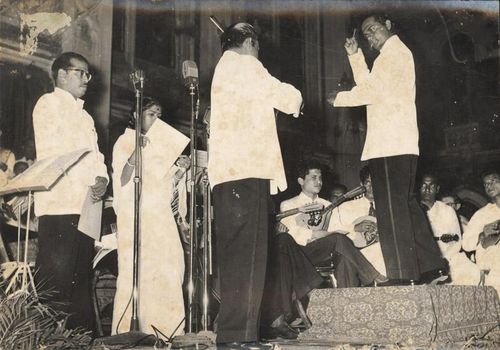
Standing majestically atop his lectern, baton in action, Gonsalves is poised and leonine. He looks very happy. But that is exactly when the smile got wiped off his face for good, and where his chapter in this story ends.
Nationalistic paranoia held that Goan musicians such as Gonsalves could not represent India because they had ‘foreign names’ and played ‘foreign music’. Walt Disney himself requested collaboration with the Goan, asking him to score a movie with Indian governmental involvement. But ministerial clearance never came: Gonsalves has often repeated the story of the day that information minister Keskar told him point-blank ‘Christian musicians cannot represent India.’
Gonsalves was crushed, bewildered, and never the same again. He disbanded the orchestra, went abroad to Syracuse University for a lost decade, then returned to total isolation in a village by the sea. His unique raga-based symphonies have never been performed again, and the musicians in his orchestra are now scattered into obscurity.
Today, there is a new, much-touted Symphony Orchestra of India that is being constituted as a symbol of new Indian pride at the NCPA in Mumbai, at considerable cost – butonly a few Indians are among the musicians (Goans over-represented, as you’d expect). Most are hired from Kazakhstan! Recently, we heard that the SoI will endeavour to develop an indigenous orchestral repertoire – macabre irony considering Anthony Gonsalves’s trunk full of scores is still lying there undisturbed so many decades later.
These were the thoughts, the collective history, that swirled alchemically in the breezes at the Capela do Monte in Old Goa on Saturday night, when our centuries-old musical traditions finally came together to deliver an hour of transcendent quality and meaning.
Patricia Rozario, in herself a kind of culmination of our musical aspirations, singing unsurpassably beautiful hymns in our own beloved native language, in an extraordinarily beautiful setting that recalls all of the strands in our complex, confluential history. I think that by the end, our tears were no longer for what has gone before but for the possibilities that now lie ahead.
Note: short sections of this Monday column are adapted from my own previous essay on classical music in India in Himal Magazine, here.