
January 31, 2012
Six Things That Are Dead, According to Harold Bloom
Austin Allen in Big Think:
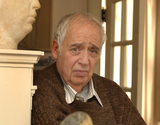
Celebrated literary critic Harold Bloom turns eighty-two this year and is still publishing and teaching. In his honor, I’ve compiled a list of six things he’s outlived.
1) The Western canon.
“Unfortunately, nothing will ever be the same because the art and passion of reading well and deeply, which was the foundation of our enterprise, depended on people who were fanatical readers when they were still small children.…The shadows lengthen in our evening land, and we approach the second millennium expecting further shadowing.” —“An Elegy for the Canon,” The Western Canon, 1994
“The battle is lost. These resentniks have destroyed the canon.” —New York Times interview, 1994
2) American education.
“American education—even in elite universities—has become a scandal, in my opinion. It has committed suicide.” —TheBrowser.com interview, 2011
3) Art.
[On slam poetry] “It is the death of art.” —Paris Review interview, 2000
More here.
Posted by Abbas Raza at 11:04 AM | Permalink


Comments
The difficulty of being so erudite is that you have to suffer how stupid most everything around you is.
Posted by: Stefan | Jan 31, 2012 11:50:37 AM
So everything is dead but the works of the dead genius authors and artists.
My next book will be called "The Anxiety of Influence and Zombies." I can already see the royalties bloom.
Posted by: David | Jan 31, 2012 12:19:19 PM
@David, +1.
I think this collection of phrases is most likely posted tongue-in-cheek. However, Mr. Bloom sadly appears quite serious. What I think he's witnessing is simply the death of his own scholarly era. Ironic then that one of the quotes blames the "resentniks". He seems to be in the thick of his own heavy resentment. And for that reason his pronouncements will simply be taken as the grumblings of an old codger.
All of this is quite a shame, given that a man so well read might instead have a greater appreciation for the cycles of art in it's various forms. I can't think of any great work of art, literary or otherwise, whose lesson is the grandeur of static culture and endless nostalgia. I would never presume to teach anything to a man like Bloom, but I think a more genuine embrace of the continued upheavals in art and culture might suit him better.
Posted by: Ben Schwartz | Jan 31, 2012 1:19:07 PM
Bloom does embrace the dionysiac and "the continued upheavals in art and culture"... someone just went mining for quotes of him at his most curmudgeonly. As much as I disagree with what he's saying here, he's still America's greatest critic.
Posted by: Justin | Jan 31, 2012 2:57:04 PM
Looking forward to Bloom's autobiography, Alas.
... Really, the "Western Canon" is an invention scarcely 100 years old. The "canon" before that was the classics; so far as any classicist is concerned, Bloom's infacility with Attic Greek makes him just one of the barbarians.
Posted by: Anderson | Jan 31, 2012 4:00:55 PM
I dunno, I'm inclined to say that a seventh thing that's dead is Bloom's relevance.
Posted by: Kai Matthews | Jan 31, 2012 4:25:38 PM
Hear, hear!, Ben. I relate to Bloom's problem, however. He is lamenting the loss of those standards by which he and his age-mates -- way back in the day -- were able to recognize one another as possessors of a superior education. Or, not. But, it's childish as well as snobbish. When I was in my teens and twenties, not to be current with certain film makers in France, Italy and Germany would have marked a person out as a nerd or a redneck. I know better now. But I'm still hung up on the opera singers and concert artists of my youth; can no one approach their profound artistry? Oh, maybe not -- but, as I would tell Bloom himself, it's up to me to keep looking. One of the music critics at the San Francisco Chronicle used to wonder aloud, and unexcitingly, whether he and every classical music lover were not "present at a death watch." If that's how you feel, someone who shall be nameless told him, you need to start the life watch, somewhere else.
Posted by: Elatia Harris | Jan 31, 2012 6:16:22 PM
Western civilisation is doubtless in stagnation or decline, and its artistic and cultural life is surely not in its prime. (References on my username link.)
As for the "article," it's parasitic and unserious: a lost of six quotes from a span of eighteen years, reinforcing a stereotypic view. If you go ask Bloom for a comment, his *overall* attitude to life or America could be shown to be very different from what you suppose.
Posted by: Levantine | Jan 31, 2012 7:35:14 PM
. If you go ask Bloom for a comment, his *overall* attitude to life or America could be shown to be very different from what you suppose.
Uh, no. I've read quite a bit of Bloom, back in the day. He's always like this.
You could even say it's implicit in his theory. We are latecomers, the great work has already been done.
The poet is the one who deludes himself that he's doing something new. The critic is the one who supplies the reality check.
Posted by: Anderson | Jan 31, 2012 8:21:13 PM
I think this is a fairly emblematic collection of the sanctimonious tripe he's been serving up for over twenty years now.
Posted by: Akim Reinhardt | Jan 31, 2012 11:51:51 PM
I agree to a certain extent with Akim. In his big book on Shakespeare and the making of the individual, his reading of Hamlet and Hamlet's precursors is completely fascinating but I simply cannot forgive him for saying Titus Andronicus is worthless and The Merchant of Venice should never have been written. Titus is the moment at which Shakespeare sends up and sends off Marlowe -- and in the process creates the templates for many of his great characters to follow. Aaron the Moor into Othello and Iago, hello?
The problem is that Bloom historicizes selectively. He can't see his own moment as but one in a continuum. Slam poetry may be lame in its most popular forms, but the sonnet we revere took centuries to transit from Italian into English. Compare the elegance of Petrarch to the vast majority of the clunky-yet-canonized early Tudor work, for example! It took 70 more years to go from that to Sidney.
I do agree with him regarding American higher education, in the main. But I've often thought of our own moment as comparative to England in the 1750s, when Oxbridge was archaic and in decline. We're about to see a complete restructuring of the way education is thought about and practiced -- really the first complete transformation of the university system since it was created a thousand years ago -- and Bloom (quite ironically considering his name) can only perceive the dying and not the rebirth. And that's a tragedy because death and rebirth is older than the Renaissance, older than Christianity.
Posted by: David | Feb 1, 2012 2:26:24 AM
What a sad old man, all bile and spittle. The dancers are all gone under the hill.
Posted by: G | Feb 1, 2012 5:21:46 AM
I can totally see this going viral. Or at least McSweeney's.
Things that make Harold Bloom angry and sad and curl his upper lip:
-People who have read less books than Harold Bloom
-That 'music' colored people listen to.
-Flowers
-Tricky sealing tape on colostomy bags
-People who have read more books or in more languages than Harold Bloom.
-New-fangled things beginning with 'e-' or 'i-'
-That dolphins cannot - or will not - read Musil.
-Harold Bloom, as reflected in the eyes of children.
Posted by: Al-Hallaj | Feb 1, 2012 5:59:57 AM
Footnotes all -
and none near the level of the throw-away lines of Bloom.
Posted by: HowBow | Feb 1, 2012 10:35:38 AM
Thank you, HowBow! The kind of shallow reading and celebrity-culutre-worshipping garbage that this posting seems to have elicited only proves Bloom's point. He's not the last word on everything, but he knows more than most of us ever will.
As for the issue of canon's, I have this anecdote. A post-colonial-oriented professor of great insight blah blah blah once shushed us for the arrogance of placing Charles Dickens above Danielle Steele. There's an argument to be made and won here, but I don't know why one would bother with those who denigrate the self-evidently great by lowering all standards to the most vulgar simply because it was widely enjoyed. People are idiots and it takes deep education to rise above this tendency. That is Bloom's message.
Posted by: ray Butlers | Feb 1, 2012 11:17:50 AM
Some commenters seem not to understand that "goofy curmudgeon" and "fascinating critic" are not mutually exclusive categories.
Posted by: Anderson | Feb 1, 2012 11:35:58 AM
I hear Shakespeare invented the human.
Posted by: Sister Y | Feb 1, 2012 11:40:39 AM
I hear some people don't know what a trope is. Reading Bloom will help this.
Posted by: ray Butlers | Feb 1, 2012 12:45:24 PM
You could even say it's implicit in his theory. We are latecomers, the great work has already been done.
Well, yes. If somebody has to do it it might as well be Harold Bloom. case in point:
A poet is not so much a man speaking to men as a man rebelling against being spoken to by a dead man more outrageously alive than himself.
--Harold Bloom
Posted by: litmus | Feb 2, 2012 6:22:35 AM
It's true. The poetry and music of the past was much better. But then, they didn't have Facebook.
Posted by: reader | Feb 2, 2012 10:36:30 AM
Well !
Everyone is entitled to an opinion and necessarily every opinion will differ from the ones preceding.
Do remember that Harold is entitled to say whatever he likes and I am sure that his comments will produce ire for some ,amusement for others .
Big deal !
Get a life .
Posted by: DrBinks | Feb 2, 2012 5:26:24 PM
Post a comment