
by Kevin Baldwin
About a year ago I began thinking about a host-parasite system that I could set up in a lab, that would be inexpensive to maintain and would provide opportunities for undergrads to get their fingernails dirty. I consider myself to be more of a field biologist, but with family obligations and the long winters and unpredictable weather in the midwest, I needed a lab system that would be available year round. After mucking about in the literature for a while, I decided to look at a group of parasites called gregarines that typically parasitize insects.
Gregarines belong to a group called the Apicomplexa that includes parasites of medical and veterinary importance like Plasmodium, the causative agent of malaria; coccidia, a cause of nasty diarrhea in vertebrates, and Toxoplasma, a mind-altering organism that can also have dire effects on fetal development. By virtue of relatedness, better understanding gregarines might give us insight into some of the greatest scourges of mankind.
Gregarines also infect worms, crustaceans (e.g., shrimp, crabs, barnacles, and krill) and molluscs. Their epidemiology could be important for aquaculture and mariculture of these organisms). Given the success of arthropods (which include insects and crustaceans) and mollusks as groups, it is probably worth understanding as much as possible about organisms that parasitize them. You could make a case for gregarines being the most successful group of organisms known. Of course this kind of success attracts attention and gregarines can in turn be hyper-parasitized by another group, the microsporidia (but that's another story,…).
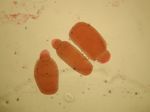
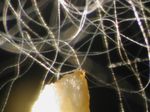
As single-celled animals go, insect gregarines can be huge and are frequently visible to the naked eye. The first time I opened the gut of a roach, the gregarines spilled out like bowling pins (Strike!,… A good omen to find them on the first try. Talk about reading the entrails,..). The parasite's life stage in the host's upper gut is called the trophozoite or “troph” for short. They feed and grow here. When they mature, the trophs mate and produce an (American) football-shaped gametocyst, which is shed in the insect's feces. Additional rounds of reproduction occur inside the gametocyst and the results is that hundreds of spore-like oocysts are extruded into the environment (like beads on a string), that can in turn infect new hosts. The strands are barely visible to the naked eye, resembling very fine lint.
As study organisms, invertebrates in general and insects in particular have many advantages: They are relatively inexpensive to obtain and maintain and can be cultured in relatively small spaces. Large lab populations mean that small sample size would not be a problem for any experiments. Ethically, insects tend to present less of a challenge than vertebrates. I don't really enjoy offing animals in order to study them, but for myself and most people, killing bugs is less traumatic than killing warm, furry things with backbones. Certainly there are elements of empathy and relatedness at work here. Insects are just different enough and tend to be demonized enough (competitors for food, vectors of disease, etc.) that for better or worse we find it easier to kill them. I know quite a few vegetarians and even vegans who don't have a second thought about squishing a bug.
Insects as competitors for food and vectors of disease can also be seen as something to be controlled. There is a long history of people using biocontrol and pesticides to limit crop damage and reduce diseases. Just how gregarines fit into this picture is not fully understood. Suffice it to say that an enemy of my enemy is my friend, so having a better handle on insect parasites is probably a good thing.
Another perspective can be provided by imagining insects as food. Though they are eaten in many parts of the world, insects are not something that ranks very high in most first world diets. Increasing human population, and decreasing fossil fuels may force us to reappraise our dietary preferences in the not-too-distant future. Because bugs don't turn 90% of what they consume into heat the way mammals and birds do, they are spectacularly efficient at making high quality protein. My only experience in entomophagy involved some thumb-sized palm beetle larvae that I found wriggling in an open-air market in Iquitos, Peru. Cooked, they tasted like a quality soft cheese with a slightly bacony aftertaste, and absolutely sold me on the concept of bugs as food. If we were to embrace bug-ranching, understanding their parasites better would likely be useful.
So much for the gregarines; what about a host? As insects go, Madagascar hissing cockroaches are pretty spectacular. They are big (typically 5-10 g, and 5-10 cm long) but easy to handle. For these reasons they are often used in education and frequently show up on reality TV shows: “We placed Meghan in a box with huge bugs and a hidden camera so we can sell commercial time for a show that costs practically nothing to produce!” The “hissing” name from their habit of forcefully expelling air through their spiracles (basically breathing holes). If you're not expecting it, the hiss can be alarming enough to make you drop the roach, thus showing how effective a defense strategy it can be! In fact, the roaches are harmless, subsisting on vegetable matter. On Madagascar, they seem to prefer living under and off of rotting logs. They are wingless, so they can't fly away like most roaches can. Males and females are easy to distinguish: males have what appear to be horns on their thoraxes and have bushier antennae than females. This sexual dimorphism typically means that interesting are happening between the genders (e.g., think deer antlers). Males fight for access to fertile females. The result of their coupling is an enormous egg case that the females sequester internally, until the larvae hatch. This gives the appearance of live birth as tiny roaches emerge from their mother.
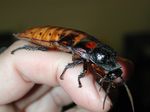
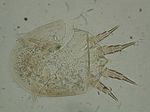
One of the roaches I had did not look well. He was missing the distal ends of some limbs and appeared kind of rough and dirty. On closer inspection the dirt turned out to be live mites! Were the mites making the roach sick, or was the poor condition of the roach attracting the mites? A quick search of the literature indicated that there is a commensal mite that is associated with giant hissing roaches. I grabbed one and mounted it on a slide. Could this be what I had? I would need to sit down and go through some papers and books on mite taxonomy to make a proper ID. It would have to wait. So many questions, so little time.
Now that I have gregarines living in roaches; so what? Because I have many students who are interested in the health professions, I thought it would be fun to see if we “cure” the roaches of their infections and see how that affects them. Students could think about pharmaceuticals, the pathways they disrupt, dosages, toxicity and so on and we could see what, if anything, gregarines do to roaches. We started with metronidazole (Flagyl) which has already been identified as an effective anti-gregarine agent. Preliminary results indicate that a short course of antibiotic can significantly reduce the number of trophs in the gut. Next, I'd like to see if higher and longer doses can reduce or eliminate gametocysts in their feces. Concentration, frequency, and duration of metronidazole doses (and other antibiotics) need to be more fully understood in insects. There are some chemotherapy drugs that also look promising for gregarine control.
So, this is my new lab system. I, and some other folks feel like this could be a model system for studying gregarines and testing drugs against them. It is looking promising so far. Model systems have played a huge role in increasing our understanding of many diseases and mechanisms. We owe much to vertebrate model systems like white mice, rats, and African clawed frogs. Classical genetics would not have been possible without fruit flies. Physiologists often refer to August Krogh's principle, which is that every question has a most appropriate/convenient organism with which to study it. I certainly won't be getting calls from Stockholm in the middle of the night, but I'm having a pretty good time. For me it is a privilege to be able to study these interesting organisms and see how they prosecute their lives on this planet. If I can advance the field ever so slightly, train some students to be good scientists and cliniclans, and continue to enjoy poking around in this somewhat alien world, then all is good.