
There are only two kinds of freedom:
your freedom to do what you like, and
our freedom to determine what kind of a society we want to live in.
~Gerald Frug
Thus it is a timely coincidence that 2011 marks the anniversary of the original “grid” plan, as conceived by the Commissioners’ Plan of 1811. Prior to its adoption by New York, street-grid planning had already had a long history – consider, among others, Francisco Pizarro’s original plan for Lima, Peru, conceived in the mid-16th century. The grid was seen by planners as an attractive alternative to the messy results of “organic” growth, that is, growth that lead to narrow alleys, winding streets and tortuous property claims. Such bottom-up density also made the broader provision of services difficult, and seemed to encourage the spread of disease and crime. Thus an authoritative master plan was the perfect means to sweep away the accumulated social and economic flotsam and jetsam that came with the decades of thousands of citizens scrapping and scraping for economic survival/prosperity over decades. (This tendency to overly treasure the act of tabula rasa continues to manifest itself today, most frequently as usually disastrous slum clearances in the cities of the developing world).
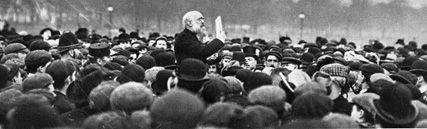
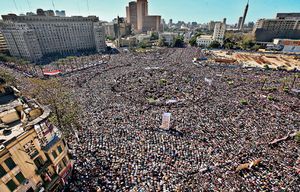
However, these same planners were confronted with a dilemma: by creating cleaner city layouts, the same designs that encourage mobility, commerce and interaction may, at the same time, encourage unwanted assembly, whereby citizens congregate in order to air grievances, hold strikes and generally foment the kind of unrest that might bring down a government. It is one thing to be all in favour of freedom of assembly or expression, but quite another to embody those rights within the built environment itself, no matter (or especially) what UNESCO might hold dear.
Initially, the city government of New York fared no better in its attempts to coax landowners into accepting any sort of a master plan. Perhaps not quite cognizant of the history lesson that not even the King of England could stand in the way of such a fractious lot, the municipality resorted to the authority of the State Legislature, which appointed a commission of the great and the good. As stated by the exhibition The Greatest Grid, currently on display at the Museum of the History of New York:
Commissioners Gouverneur Morris and John Rutherford were wealthy residents of the New York City area with long histories in land administration and business affairs. Albany resident Simeon DeWitt was among the most accomplished surveyors in the country. But we have no record of why these commissioners were chosen, who selected them, or how they worked together. We have only their published Remarks and their plan, submitted on March 22, 1811.
The commissioners’ most important decision was to make a rectangular city, rejecting the circles, ovals, and star-shaped plazas that were found in European cities and at home in the nation’s new capital of Washington, DC. They envisioned a city of “right-angled houses… cheap to build and… convenient to live in.” Acknowledging the high price of Manhattan real estate [already?! –Auth.], they wanted to maximize the development capacity of the city and reserved a limited area for public purposes. Reflecting the commissioners’ real estate orientation, these functions were mostly located on unlikely building sites: the reservoir and observatory on rugged, rocky terrain; the market on a salt marsh. Their plan was both visionary and practical.
Clearly, the plan’s “practicality” favours a commercial orientation for the city. Concern with public spaces was minimal – as an example, the design competition for Central Park would only be won by Frederick Law Olmsted and Calvert Vaux in 1858. In fact, public spaces had to be wrested from the grid, one by one. Surprisingly, it was the larger landowners, like Samuel B. Ruggles, who advocated for their value:
The Commissioners’ Plan of 1811 preserved three early roads – the Bowery, Broadway, and Bloomingdale Road – and called their elongated, irregularly shaped intersection Union Place (referring to the “union” of these roads). In 1830, the owners of the property around Union Place, including Samuel B. Ruggles, petitioned the Common Council to enlarge the area for public use. The lobbying effort was successful, and in 1831 Union Square, as it was renamed, became an official public space. (exhibition notes, The Greatest Grid)
It is interesting to note how many of New York’s public spaces are naturally carved out of the inverted triangles that are formed by Bowery and Broadway’s rude shanking of the grid. But it is even more important to realize that New York’s planners had little concern for what we would today consider a well-rounded approach to the city. Even the contemporaneous ideal of the Monumental City as espoused by Wren and later Haussmann, let alone L’Enfant’s radial complexification of DC’s own Cartesian grid, were shunted aside for the commercial benefit of a rapidly growing city. This gesture has been admiringly remarked upon by European commentators as varied as Le Corbusier and Rem Koolhaas as a particularly pure example of planning. But on the whole, New Yorkers were, it seemed, content to leave the physical manifestation of the new Republic’s constitutional ideals to its younger, swampier cousin down south.
*
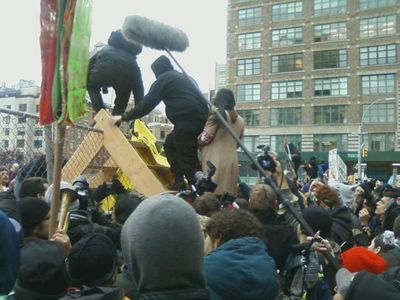
Lisa Keller, an urban historian and author of Triumph of Order: Democracy and Public Space in New York & London, continues our thread of how the original grid plan has left a lasting legacy, as she recounted a recent conversation with a “high-level New York official” concerning his “options” regarding the occupiers of Zuccotti Park (35 minutes ff., all transcriptions mine and edited for length and clarity):
You could go back to 1811, because it was that grid that started our problem. In their wisdom, our city fathers…decided that land was too valuable to leave as public open space. In fact, commercial development trumped everything else. When I was editing the Encyclopedia of New York City…I added an entry on “squares” and if you look at it you’ll see the first listing ever done of squares in New York – except they’re not really squares. We don’t really have squares in New York. We have something we call squares, but they’re actually parks. New York City squares are not like squares in Europe, or London, which is what my comparative study is about; they are very different.
When I was in City Hall, speaking to this high-level official – and I do think back on that conversation, because I knew from the conversation that [Zuccotti Park] would be cleared in a matter of days – I knew he was looking for some desperate straws to pick at. But one of the things that I said to this gentleman was, ‘Free speech and protest in New York City is America’s great NIMBY. It is the group home; it is the homeless shelter. We all think it’s a great idea – we all believe in it – but nobody wants it there in front of them. Nobody wants it on their street.’
Here are a few evergreens about public speech that most people don’t realize. The people in Zuccotti Park kept saying “It’s my right to have free speech.” In New York State in 1872, they passed a law that said, if you have 20 or more people [assembled], you have to get a permit. That followed the Draft Riots, [which] really was precipitated by the Orange Riots of 1871. Very few people know about this law. So, you can’t really have free assembly. Secondly, free speech was not a guaranteed First Amendment right until 1925, with the Gitlow decision… Everything we’re doing today, including Zuccotti Park, was more or less written in stone by 1900, [where] the principles were established where we can and cannot go, and public parks are one of the places where we cannot go. Almost since Day One they have been limited in terms of political access. The right of protest in New York City has historically been a relative one.
Whereupon Keller goes on to contrast the difference between tolerance for this kind of protest versus tolerance for commercial activities, such as street fairs, parades, movie shoots, etc etc. Particularly salient is her comparison that, in 2004, 750,000 people were allowed to demonstrate in London’s Hyde Park, whereas no such gathering was allowed to take place in Central Park. It bears mentioning, too, that Hyde Park is also home to the famous Speakers’ Corner, perhaps the only truly protected physical location for free speech in the entire world – and that in a country that, famously, has yet to codify its own constitution.
*
What of Zuccotti Park itself? Didn’t the organizers choose wisely, as the old movie saying goes? As landscape architect Lance Jay Brown noted during the same panel, its proximity to both City Hall, the Financial District, as well as easy access to many bus routes and subway stations made it exceptionally well-suited for “occupation.” Furthermore, the size of the park is so small that it creates tremendous intimacy very quickly, and even a small group can make it seem full. Indeed, when it was fully occupied with several hundred protesters and their jury-rigged infrastructure, it seemed ready to burst.
However, by far the most important aspect of Zuccotti was its status as a so-called “bonus park”, or publicly owned private space (POPS). As Nate Berg writes, “It’s a corporatization of the public square of yore that’s somewhat symbolic of the larger systems the demonstrators are protesting. It also raises some questions about what’s allowable in a public space that’s technically not owned by the public.” So while the phrase “publicly owned private space” sounds like a paradox of Epimenidean proportions, it nevertheless turned out to be a crafty insertion of protest into a built environment that, as we have seen above, seems to provide little, if any opportunity to physically do so.
Speaking at the panel, sociologist Gregory Smithsimon noted that their creation, in 1961 (another anniversary year!), established the precedent that:
Bonus plazas…are really spaces that are trades – the public gets a square foot of plaza and the developer gets up to ten square feet of additional usable office space [in the form of higher buildings]. Public space is [also] a space where social conflicts get negotiated. To give you an example, the occupiers did not want to negotiate with the Bloomberg Administration. They were driven by anarchist [principles], and anarchists don’t make demands. They just do stuff themselves, right? They don’t demand that you clean up Wall Street, they say, ‘we’ll occupy it, we’ll take it over ourselves.’ That’s why there were no demands. But the Bloomberg Administration said that they needed to clean up the park, or that the occupiers would be shut down – so [the occupiers] cleaned it up. Then the Administration said that the gas-powered generators were too dangerous, and so they got pedal-powered generators. The Administration said that they needed someplace to go to the bathroom, so they got port-a-potties. There’s this ongoing negotiation, and I think that what’s unfortunate is the use of police force terminates that democratic discussion. It would have been a very interesting discussion if the Administration had said, ‘We want you to leave, what would it take?’ Would that be a tax on the 1%? Affordable housing? A jobs program? Regulating the banks?
The thing that is particularly interesting about bonus plazas as a type of public space is that they are “leading indicators.” You can see the shape of the city to come first represented in these bonus plazas. In 2008 I wrote an article noting a sense of hubris in the new public spaces, that developers thought that there would no longer be conflict in these spaces, but conflict in these spaces is exactly what happened. If you understand public space as a conflict but the person building it does not, it’s very easy to come in and take that space over. (54 minutes ff.)
As a consequence of OWS, Smithsimon expects hearings that will subject bonus plazas to greater regulation – perhaps in the form of more restricted hours, which is a privilege that developers have been asking for since the law’s passage (ironically, the city has never trusted developers to maintain “reasonable” opening times, hence most POPS have remained open around the clock).
However, the dialogue that OWS has opened up may, even here, be of benefit. He noted that before William Whyte’s work in the 1970’s, developers could get away with building any kind of park and still receive their building bonus. Whyte realized that while no design restrictions at all would result in failed design, heuristics concerning linear feet of seating, minimum number of trees, etc, could give us better outcomes. Whyte also knew that too many restrictions would fail us as well. He intuitively understood the generative and incomplete nature of city life, and how good design creates the setting for these qualities. In this same regard, Smithsimon’s points out our responsibility to attend these hearings, in order to advocate for different kinds of activities that go beyond the “passive use” that has determined much of the fate of “public space” in New York. By advocating different kinds of active use, the hope is that New Yorkers will regain rights to the city that were withheld from them 200 years ago by the act of the Commissioners' Plan of 1811. Referring back to UNESCO’s Urban policies and the right to the city:
The right to the city is a vehicle for urban change, in which all urban dwellers are urban citizens; it creates space in which citizens can define their needs but, in order to appropriate substantive citizenship, citizens must claim rights of participation, and allow others the same rights.
I cannot think of more necessary rights than the ones to speech and assembly. If OWS helps designers and planners recapture this right for the urban public, it will have done much good indeed.
Thanks to Rachel Signer for OWS photo and general OWS inspiration.