January 30, 2012
Pakistan and the Ahmedis: Headed for disaster or just more of the same?
by Omar Ali
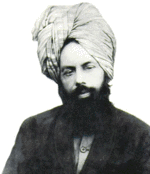
The Ahmediya movement was started in Punjab in 19th century British India, by Mirza Ghulam Ahmed of Qadiyan. He seems to have been a somewhat stereotypical prophet; a quiet, religious loner who brooded about the challenges faced by his faith and his people. The decisive military and economic superiority of Western civilization over the Islamicate world had produced a variety of efforts at reform and revitalization. They ranged from the Wahabi-influenced puritanical Jihadism of Syed Ahmed Barelvi (who led an extremely fanatical jihadist movement in what is now Khyber Pakhtunkhwah, until he was defeated by superior Sikh firepower and a reaction to his extreme views among the local Muslims) to the anglophile reformism of Sir Syed Ahmed Khan (founder of Aligarh Muslim University). Mirza Ghulam Ahmed’s response was to start a movement of religious revival that was built around his own charismatic claims. Though he contradicted some mainstream Islamist claims about the finality of prophet-hood and the absolute necessity of military Jihad (military jihad as a Muslim duty is now so widely downplayed that it is hard for Westerners and even Westernized Muslims to figure out why his claim was considered so controversial), his movement was socially conservative and even puritanical. He found some support among modestly educated middle class Punjabi Muslims (including Islamist icon Allama Mohammed Iqbal, who either flirted with joining the movement or actually joined for a few years, depending on what version you believe). As his movement (and his claims regarding his own status as prophet or messiah) grew, it drew more and more orthodox opposition, especially from the dominant Sufi-oriented Barelvi Sunni sect. Ironically this branch of local Islam enjoyed some American (and world media) attention as “moderate and tolerant Muslims” in contrast to their Deobandi/Wahhabi brethren in the aftermath of 9-11 (though this attempt to fight Wahabi/Deobandi fire with Sufi-Barelvi water seems to have run into some trouble recently).
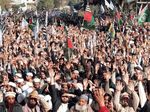
Soon after partition, the Islamist factions in Pakistan picked up the Ahmedi issue as a wedge issue with which they could acquire power and influence in a society that was otherwise not very interested in organized political Islam. Various elite factions (and, it is sometimes alleged, the American embassy) maneuvered against each other using this movement in creative ways, until their vicious squabbles derailed Pakistan’s rudimentary democracy. Still, even though they may have been useful to some elite factions, anti-Ahmedi troublemakers were still outside the elite mainstream and remained so until 1971. During the rule of Zulfiqar Ali Bhutto, this issue was again raked up and various Islamist parties found it useful to beat up on the Ahmedis on the way to power in Islamabad. Bowing to riots and rallies, Bhutto himself undertook to officially declare the Ahmedis as non-Muslims in 1974. Having tasted blood, the Islamist parties have never looked back, with steady increase in persecution and legal restrictions on the Ahmedi community and sustained propaganda that ensures that most Pakistanis find it difficult to publicly defend the threatened community.
It is very likely that the percentage of people in Pakistan who believe Ahmedis should be killed unless they repent is larger than the percentage of Germans who, in 1933, believed that all Jews should be killed (as opposed to, say, “put in their place” or just encouraged to leave). The blasphemy law and specific laws prohibiting Ahmedis from using any Islamic symbols are regularly used to put uppity Ahmedis in their place. Prominent businesses owned by Ahmedis can be targeted for boycotts or worse, and in some cases of mistaken identity, the business has gone out of its way to prove that Ahmedis are not the owners. Property can be grabbed from Ahmedi owners by cooking up blasphemy allegations or simply threatening to do so (in which case the sane owner may decide to play ball before any public effort is launched). Of course, such methods are not restricted to Ahmedis. Once human beings find a good thing, they tend to use it more and more. Still, Ahmedis remain uniquely vulnerable.
Currently, trouble is brewing in Rawalpindi, where the local branch of the Islamic militant network is preparing to bring down a local Ahmedi “house of worship” (the word mosque would be illegal). These Islamists/militants belong to what used to be the military-mullah alliance, though the army’s role in the current kerfuffle is unknown. It may be that the military component of the military-mullah alliance is not be as unified as it used to be, but thanks to decades of secret deals and conspiracies, such things are nearly impossible to figure out with certainty in Pakistan. Anyway, things may yet get settled if the Ahmedis concerned grovel enough (some money may change hands) or they may get worse, but other episodes will undoubtedly follow.

What then will be the longer term trend? Will Pakistan gradually become a more liberal and democratic country where anti-Ahmedi discrimination will gradually lessen? Or will it become a “neo-liberal authoritarian” regime that too will have less incentive to encourage free-lance attacks on life and property? Or will the Ahmedi’s role as designated national scapegoat be taken to its logical conclusion in a systematic fashion?
I generally like to think that saner elements in the elite will eventually tone down such persecutions because they tend to become self-destructive, but if the Germans can go to hell in 12 years, isn’t it possible that we too may end up in a less disciplined and less efficient version of the same? Or will the street agitators remain under elite control, to be used as needed in its internal and external squabbles, but not accelerating into anything resembling Nazi Germany or Rwanda? In my optimistic moments, I think it is the second, but this is really an appeal for information; I want your opinion, which way will this go?
Posted by omar at 12:15 AM | Permalink


Comments
Which way will this go?
The Shia are the target these days in Karachi. In his article 'The Politics of Living under Terrorism' published in Express Tribune yesterday, Khaled Ahmed writes, "Today, all parties will have to push some of the right buttons to qualify in the eyes of the terrorists. The condition is irreducible: you have to be anti-American and pro-Taliban." In 'Pakistan's rush for more bombs-why?' Parvez Hoodbhoy wrote "perhaps more important — reason for the accelerated nuclear development is left unstated: nukes act as insurance against things going too far wrong. Like North Korea, Pakistan knows that, no matter what, international financial donors will feel compelled to keep pumping in funds. Else a collapsing system may be unable to prevent some of its hundred-plus Hiroshima-sized nukes from disappearing into the darkness."
It is a wonderful read. I have an optimist outlook on life but Pakistan fails to spark hope. Reality sucks!
Posted by: Malik Rashid | Jan 30, 2012 8:47:33 AM
I am completely for the right of anyone who wishes to call him or herself a Muslim to be allowed to do so. But just as a question: If the most important tenet of Islam is the belief that Muhammad (PBUH) was the last prophet, than wouldn't calling Mirza Ghulam Ahmed a prophet mean that the person doing so is contradicting the central belief of Islam? I've heard that Mirza Ghulam Ahmed never called himself a prophet (rasul) but rather a reformer. If that is the case, than Ahmedi beliefs do not contradict the finality of prophethood.
Posted by: Kabir | Jan 30, 2012 10:09:02 AM
Mr. Ali, Thank you for this informative article on Ahmdaiyyas. It is indeed ironic that they themselves aggressively pursued "blasphemers" when they were in a position of (relative) strength.
Of course, that is not to say they deserve this wretched fate.
The condition of the 4 million Ahmadiyas causes you great distress (and rightly so) . What of the condition of the 2.8mm Christians of Pakistan? Or the 2.5mm Hindus of Pakistan?
Does not the persecution of these minorities have any bearing on Pakistan's future? I find it curious that an article that is concerned with Pakistan's future does not even mention these unfortunate communities. At least the fate of the Christians gets some exposure in the western press. Say a prayer for the unfortunate Hindus of Pakistan.
Posted by: Sundar | Jan 30, 2012 10:30:32 AM
Sundar ji, it is hard to say everything in one article. btw, as Malik Rashid has pointed out, we may soon add 20 million shias to that list too. So its X million Ahmedis, X million Hindus, X million Christians, X million Shias and X million others.
Its a long list and its growing. But so is the sense that this road leads (and not too far in the future) to ruin. My question was this: which tendency will win out? is the glass half full or half empty?
And before "friends of Tariq Ali" jump on me, there are other paths to ruin and if you wish to make the argument that ruin will come via Monsanto long before it comes via death camps for Shias, feel free to make that argument too. I want opinions..(in the interest of full disclosure, I personally no longer find the Tariq Ali version useful, but I am still happy to hear what the argument is from that side).
Last but not least, check out this really hilarious and scary exercise in scenario building:http://www.viewpointonline.net/lets-fly-sunni.html
Posted by: omar | Jan 30, 2012 10:59:52 AM
Kabir, you are assuming that whatever you were taught about Islam must be the only correct Islam. But in fact Islam, like all large and longstanding historical phenomenae, has taken many forms and continues to take new ones every day. There are claims about this or that set of "core beliefs" that are essential for being counted as Muslim, but in the details, the arguments are endless. As you seem to be aware, Ghulam Ahmed had his own arguments about why his claims were correct and in line with "true Islam". That many other Muslims do not find his claims credible is par for the course when it comes to religious claims (or Marxist or liberal or whatever claims).
Posted by: omar | Jan 30, 2012 11:05:01 AM
Omar,
The Kalima says that there is no God but Allah and Muhammad is his messenger. In addition, prophethood is supposed to have ended after Prophet Muhammad. This is the basic statement of faith that all Muslims have to accept in order to be considered Muslim.
I'm no one to decide who is Muslim or not because that is between each individual and Allah, but it does seem that this is a serious issue that Ahmadis have to deal with and they have to explain how their religion can still be considered Islam if they don't accept the Prophet Muhammad as the final messenger of Allah.
Posted by: Kabir | Jan 30, 2012 12:04:12 PM
Kabir,
Correct me if I am wrong, but when did Islam become a monolithic faith with a commonly agreed on set of precepts that absolutely everyone agrees on? I always thought that one of the distinguishing characteristics of Islam is that there was no single Muslim "pope" and no single fount of doctrinal purity.
As an aside, does anyone else think it is ironic for a person named "Kabir" to be pushing a specific Muslim orthodoxy so aggresively?
Posted by: Hektor Bim | Jan 30, 2012 12:47:17 PM
Sundar,
Save your breath. The condition of Hindus in Pakistan is not something that is greatly discussed on this blog, for whatever reason.
Posted by: Hektor Bim | Jan 30, 2012 12:48:40 PM
Kabir, as long as we have a few minutes, lets have some fun:
The kalima says "there is no god but Allah and Mohammed is his prophet".
No mention of his being the last prophet. How did you get from A to B?
How do you define prophet?
How do you define Allah?
And we need not get into defining "Is" at this point, but http://en.wikipedia.org/wiki/Alfred_Korzybski may have a few words about that as well.
Later we can discuss how the kalima itself became "the kalima" and who (and at what point) decided that was the one line requirement for being a Muslim?
As you may be aware, there were Muslims in Iraq who regarded Salman Farsi as god (OK, one side of a trinitarian God whose other corners were Mohammed and Ali). At some point, we decided they are beyond the pale (though some of those notions survive in Alwi Islam). Why is that decision final and who made that decision?
There's more, but this is just a sampling. In all fairness, I should warn you that if the two of us wish, we can carry this on till judgment day (which is another set of questions in itself).
Posted by: omar | Jan 30, 2012 1:47:56 PM
The position of the Ahmadis among the minorities of Pakistan is unique in the sense that a lot of muslims who would otherwise agree to the right to worship as they please for other minorities may object to the same for the ahmadis. They are not simply viewed as a minority BUT a heretic sect whose presence is somehow corrupting or damaging or dangerous to the mainstream Islam. There is also widespread belief that they are backed by hin-jew lobby and that they are part of the grand conspiracy against Islam. As for their future (and in the larger context the future of other minorities) my view is that it is not going to be as bleak as some of us would like to believe. However my reasons for this optimism are somewhat different from yours (saner elements in the elite and their general control). I view Pakistan as a society in transition, where the order has almost collapsed and the new order is yet to be formed. however there are some positive signs in the existing chaos( there may be more negative signs but i am assuming that the forces of the free market and information age are too strong for them). A somewhat freer media, judicial activism, information highways, middle class involvement in the politics ( even through platforms like PTI) are all positive signs. I dont think saner elements in the elite will prevail, i think the elite is going to get diversified.
As for the Ahmadis and their future there is another aspect, that is, the conduct and policies of ahmadis. They are a very well organized community and have kept themselves aloof from the mainstream politics ever since they were declared a minority by the national assembly (1974). Before that they were pretty active. Ahmadis are mostly concentrated in pockets of the central punjab. Musharaf regime had given them a dual vote but they abstained from voting as a policy in the last elections. If they continue with this policy of political aloofness and exclusivism (they are very exclusive mind you and it has always been one of the reasons for their opposition) then, unfortunately, a lot of the ahmadis, esp from the lower middle classes, will have to suffer before things take a turn for the better.
Posted by: waqas | Jan 30, 2012 2:02:02 PM
Hektor, why not start now?
Posted by: omar | Jan 30, 2012 2:11:31 PM
Waqas, I actually agree with your take. I should have put it differnently...the elite may become saner because it will diversify and enlarge.
Posted by: omar | Jan 30, 2012 2:18:47 PM
Just to be clear, I personally have no problem with Ahmedis and it doesn't bother me if they want to consider themselves a Muslim sect. As I said, whether one is Muslim or not is between him and Allah. Only Allah has the right to judge who is a true Muslim or not. I also agree with you that the state has no right to get involved in deciding this issue.
However, believing in a prophet after Muhammad (PBUH) is a bit of a more difficult doctrinal disagreement than the controversy over whether Hazrat Ali should have been caliph after Prophet Muhammad (which is what separates Shiahs from Sunnis). It is also true that none of the founders of any other Muslim sect referred to themselves as "prophets"
Posted by: Kabir | Jan 30, 2012 2:29:31 PM
Kabir, It's a personal matter if one believes in this or that religion or sect or none at all, or calls himself this or that and he also has no duty or obligation to conform to somebody else's beliefs. So if you really do not have any problems with Ahmedis or what they call themselves as you say, then you should say that without any ifs buts and howevers.
Posted by: Raza | Jan 30, 2012 3:46:31 PM
waqas - "hin-jew lobby"
Well, that explains everything. There are no Jews in Pakistan and hardly any in South Asia, but its the Jews who are held to blame for all Pakistan's troubles and ethnic conflicts. Or maybe Hindus are seen as the reincarnation of the Jews who opposed Muhammad in Mecca.
I somehow doubt that "things will get better"
Posted by: aguy109 | Jan 30, 2012 4:54:39 PM
Omar, I believe that every Pakistani seeking a passport has to sign a statement affirming that they reject Ahmeddiyas as Muslims. Another example of the creeping rise in the temperature over 60+ years of the pot that is about to boil.
One could draw a direct parallel between the Ahmediyyas' resort to violence over Ram's purported blasphemy to the ridiculous blasphemy laws wielded by the Sunni majority against them today. Who can first prove to be purer than the other in the land of the pure? It is the South Asian equivalent of pastor Martin Niemöller's often quoted statement, "First they came…".
One doesn't hear much about the fate of other Muslim ("apostate") sects, such as the Ismailis or the Bohras or even the Baha'is, in Pakistan. I believe that the Ismailis' Aga Khan is/was a staunch supporter of Pakistan, in spite of almost certain rejection of his claims by the country's mainstream.
In the end, all of these sects, whose leadership generally rallied behind the two-nation theory and marched vociferously in solidarity with Pakistan long after independence, will find themselves increasingly as personae non gratae in their country. Just as their less mobile brethren who remained behind thrive under the spirit of Indian tolerance.
Posted by: Sam | Jan 30, 2012 6:06:05 PM
Omar,
I would be very interested in a discussion about the situation for Hindus in Pakistan. I am however not greatly knowledgeable about the subject.
But I am surprised that this is a subject which is almost never discussed on a blog run by Pakistanis who have an interest in diverse cultures, human rights, and humanism.
The rights of Muslims and Christians in India, Sikh irredentism, tribal violence and Maoist-inspired insurgencies in India we get all the time. Same with drone strikes in Pakistan, fundamentalism, Pakistani feelings toward America, etc. And that is all great! Not to mention all the non-South Asian stuff that gets talked about here.
Posted by: hektor bim | Jan 30, 2012 9:19:30 PM
This is in response to Sundar's message. We Indians are hardly in any position to recommend prayers for Mr. Ali. Sunderji, if we in India had enough Omar Alis in our midst, perhaps we wouldn't have to live with the shame of the Gujarat pogrom today. So, instead of suggesting prayers for Mr. Ali, may I suggest that we in India redouble our efforts so that no one need say a prayer for anyone else -- Hindu, Muslim, Christian, or Sikh.
Posted by: Roby Rajan | Jan 30, 2012 9:19:40 PM
But the real situation of non-Muslim minorities in Pakistan is not often discussed. I think though I cannot be sure, that this is precisely because the main people on the blog are Pakistani expatriates. They probably know almost no Hindus in Pakistan, and don't want to talk about things like forced conversions, socioeconomic pressure, and the impact of the blasphemy law, because of how it makes Pakistan looks.
It os difficult to talk about your country's failures, especially if you live outside the country.
Something similar is going on with Bangladesh coverage, because its existence is an enduring negation of the Two Nations concept and thus the founding myths of Pakistan.
But I could be wrong about this. There is no way to be sure. All I know is that certain topics just don't come up on this blog.
Posted by: hektor bim | Jan 30, 2012 9:28:53 PM
@hektor & Sundar: As an Indian follower of 3quarksdaily, I must put on record that I remember at least a few striking articles highlighting the Pakistani treatment of Christians & Hindus. I have never felt there was any attempt to underplay the issue.
@robyrajan India is far from perfect. It is also far from being a place where the minorities are dying away
Posted by: Vivek T | Jan 31, 2012 2:27:53 PM
Here are my disjointed thoughts on some of the comments on Ahmadi.
Quran and Hadees are defined and explained in several different ways. Some say, La-Ala ha Illalah (there is no God but God)is the original kalema. Muhammad is the prophet was added later and Shia added more, Ali is the saint.
Most Muslims believe that Islam is not about the prophet, it is the message. They criticize Christianity for going "astray" because they started to place more importance to Jesus.
The word Khatemunabbeeyeen is also translated as seal of the prophets and not final prophet.
unfortunately, most people cannot discuss these things openly because of the blasphemy laws.
We can compare Ahmadi with Mormon. Main stream Christians do not consider them Christians but no one prevent them for calling themselves Christian. Pakistani need to do the same to Ahmadi. It is ridiculous that they are not allowed to use Islamic/Arabic symbols.
Posted by: Ghazla Kazi | Jan 31, 2012 8:24:36 PM
Response to Someone who said that we don't discuss condition of Hindu minority in pakistan.
I have seen many discussions on the above subject even in main Pakistani media. Unfortunately, I hardly see any discussion on plight of Ahmadi in Pakistani media due to fear of persecution and getting labeled as Ahmadi. Yes, it is that bad for the Ahmadi in Pakistan.
Posted by: Ghazala Kazi | Jan 31, 2012 8:29:33 PM
My issue with many non-Ahmadi muslims is that out of hearsay/poor reseach. they allege many beliefs to the Ahmadiyya community that we never claimed. And thus the discussion that ensues is an excercise in futility because I find myself fighting allegations rather than discussing our honest differences.
In this way I find your article well researched and informative.
I truly respect your approach and I pray for more enlightened people like you.
Allow me to comment on Pandit Lekh Ram, who used to abuse with very foul language the personality and character of the Holy Prophet(saw). Mirza Ghulam Ahmad Saheb warned him that if he does not stop this blasphemy, God will punish him with death, not man. Pandit Lekh Ram continued with his abuses.
There was also the case of Abdullah Athim, the christian Priest. He also talked foul against the character of Holy prophet Mohammad (saw). He received the same warning from Mirza Sahib. However after the warning, Abdullah Athim from saying anything derogatory against the Hoily Prophet (saw) in public.
Thank you.
Dr. Boodhun
Canada
Posted by: Dr. Mohamed Boodhun | Feb 1, 2012 7:51:59 AM
Which way will this go?
Ahmedis will remain the punching bags or rallying cry for the Muslim militants. They will remain a good example for what would happen if puritanism movement gets weaker. But they r not as important as Hindus across the border, or the Israeli/American enemies.
Rather than persecuting Hindus or Christians, persecuting Ahmedis is better, because nobody cares about them much.
Posted by: Alam | Feb 2, 2012 2:50:56 PM
Alam, a lot of people on this blog (its a mostly western/westernized liberal leftie blog) are going to miss your tone and think you really want them persecuted (liberals are like that, not very good at nuance)!
I am just clarifying on Alam's behalf: nobody should be persecuted, but as a practical matter, if Pakistani Islamists are going to persecute someone, its best for Muslim Pakistanis AND Pakistan's neighbors if the persecutee is Ahmedi. That way the country will not be targeted for destabilization by the Israelis and Americans and wont face a ruinous war with India.
Ahmedis in that case would be sort of like the kid in the Omelas story. http://en.wikipedia.org/wiki/The_Ones_Who_Walk_Away_from_Omelas
Now I am doing the same thing Alam did. Please keep in mind that this is a defense mechanism, bitter Marxian humor.
Don't persecute anyone.
Posted by: omar | Feb 2, 2012 3:01:43 PM
Persecuting religious minorities of any stripe or colour is simply a symptom of the growing Taliban-isation of Pakistan, fostered by Zia, which will lead to Pakistan's self-destruction, or at least its turning into a sort of Afghanistan.
In other situations we like to say that such bigotry and persecution is perpetrated by a radical minority, and that a silent majority opposes it. In pakistan this is of course not the case. Support for such persecution is strong, through all social classes. The comparisons with the populist anti-semitism of 1930s Germany which the author draws are entirely apt.
Is there a solution? I'm pessimistic. Things are likely to get worse. The fact that Pakistan has nuclear weapons is the key to why other states even care if it follows its manifest destiny and becomes another Afghanistan. The idea of a Taliban state with nuclear weapons is sobering and a million times more terrifying than the idea of a nuclear-armed Iran.
Posted by: A | Feb 2, 2012 5:45:55 PM
As long as Ahmedis have property and assets to seize, they will continue to be persecuted.
Posted by: sadhana | Feb 2, 2012 8:23:55 PM
I would guess that the heart of the matter is this - using Islam to gain political, material and military advantage over other people is legitimate in Islam.
Currently Ahmedis are accepted as the other people, just as nonMuslims were, for Ahmedis and other Punjabi Muslims were, before independence.
Posted by: sadhana | Feb 2, 2012 8:27:58 PM
So Ahmedis attacked Lekh Ram and other blasphemers over purity and today, they are at the receving end from more pure muslims. Irony.
Posted by: akash | Feb 3, 2012 1:52:55 AM
First of all, thank you for writing such an amazing and unbiased article. Rarely did we read a piece that is uncompromising in its discourse and with strength of creating ripples in the minds of people.
Now, before we start discussing what is going to be the future of Pakistan, are we going to become a liberal state or on our way to become a “neo-liberal authoritarian”, we need to understand the very basics of this country. I won’t go in the details; it’s a fact that Pakistan was created to accommodate a religion, the foundation of Pakistan are standing on the very idea of a separate country for a specific religion where people have freedom to enjoy their preferred way of life (according to Islam).
Our constitution is massively religious, full of religious morality, authoritarianism and living the life according to Islamic principles. Jinnah’s personal liberal life style was never his idea for the future of Pakistan, and this country was never destined to be a liberal country. Jinnah, though was a secular man himself, was never able to understand the true implications of creating a country on the basis of religion.
I would love to be an optimist, but that would be naive. Future of Pakistan can be seen if we study the pattern on which our society is threading. Pick up a school book of any public and private school; see what our new generation is studying in their schools. Talk to an ordinary person living in an urban area in Pakistan; ask him about Mumtaz Qadri, Blasphemy laws, role of religion, women rights, taliban and you will see the shape of things awaiting us in future. The rapid radicalization of urban areas of Pakistan is in fact a proof that the more one is exposed to the educational discourse, the more s/he is vulnerable to become a part of this radicalized society.
Posted by: Clockwork | Feb 3, 2012 11:54:22 PM
Even if you start anew, from today, which is not possible due to the sheer control religion have on our society, constitution and daily lives, you won’t be able to see any positive result within 30 years from now. Visit a school; see from where the hatred for Ahmadis/Christians/Hindus etc. starts. As you said that Kalma says nothing about finality of prophet but try listening to how teachers translate the kalma in front of class of kids who are vulnerable to remember it for the rest of their lives.
Solution is there, it’s in reforming our educational system to the core. Our existing educational system is killing the basic ingredient you need to reform a society, which is ‘doubt’. People don’t ask questions here, they are always looking to find someone who can lead them to a better life, they won’t think for themselves. This precisely is the reason why we are society of personality worshippers; this explains the recent popularity of a disastrous politician Imran Khan.
Religion is going to keep playing an important role in our society, that's enough to understand that future is bleak.
Posted by: Clockwork | Feb 3, 2012 11:54:49 PM
Sadhana: I would like to add on to your statement "to gain political, material and military advantage over other people is legitimate in Islam" ..... "as it is in Christianity, atheist communism or secular democracy. Hinduism has its own racism, discrimination and violence in its caste system of untouchables, widow burning, bride burning and treatment of its ethnic and religious minorities." If you make this correction you will not appear to be selective in your moral judgments.
As for my view on Ahmedis in Pakistan you can read my previous comment.
Posted by: Raza | Feb 4, 2012 10:19:02 AM
Now the Lahore BAR association has banned Shezan from its premises because the company is owned by Ahmedis: http://tribune.com.pk/story/334757/barred-lawyers-ban-drink-on-court-complex/
At the risk of being accused of anti-multicultural thoughtcrimes, I wish we were not doing this.
btw, the Shezan Bakery group in Lahore has felt some heat in the past because the good Muslism of Lahore sometimes imagine they too are Ahmedis. They countered by posting a sign on at least one bakery that read "we believe in the finality of the prophet Mohammed".
PS: I have no idea whether owners of Shezan or the bakery are really connected in any way with the heretics.
I kid you not.
Posted by: omar | Feb 11, 2012 2:50:08 PM
Post a comment