Robert J. Richards in American Scientist:
 In the Descent of Man (1871), Darwin gave over several chapters to developing his theory of the evolution of conscience. He argued that the fundamental, altruistic impulse originated in the community selection of those protohuman clans that by chance had individuals who, because they possessed “the spirit of patriotism, fidelity, obedience, courage, and sympathy, were always ready to give aid to each other and to sacrifice themselves for the common good.” Such groups would prosper as their altruistic instincts became ever keener. Darwin believed this biological evolution would be abetted by cultural evolution, as groups began to learn that superficial characteristics of skin color and other racial features overlay a common humanity. They would continue to widen the moral circle of response to include other groups whom they would gradually come to recognize as “one of us.” Darwin quite proudly declared that no one else had approached the problem of morality exclusively from the point of view of natural history. He believed he could accomplish what Kant had desired: an explanation for the moral sense, which “has a rightful supremacy over every other principle of human action.”
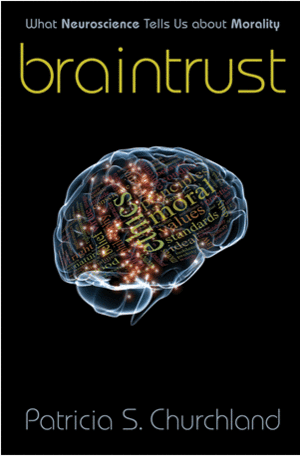
In Braintrust, Patricia Churchland, a philosopher at the University of California at San Diego, seems intent on advancing a project comparable to Darwin’s through the application of the most recent science, as the subtitle of her book suggests: What Neuroscience Tells Us about Morality. Readers may, however, decide instead to stick with that old-time evolution.
Churchland does not think that moral behavior can be reduced to any special kind of activity, as Darwin believed; rather, in her view, the term “moral” hovers over a variety of social behaviors, behaviors that might attract the same term but vary considerably across different cultures and individuals.
More here.
