
December 29, 2011
War No More
Timothy Snyder in Foreign Affairs (via Andrew Sullivan):
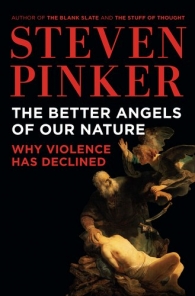
Treating Nazi Germany as a historical aberration also allows Pinker to sidestep the question of how Germans and central and western Europeans became such peaceful people after the demise of Nazism. This is a strange oversight, since European pacifism and low European homicide rates are where he begins the book. Today's Europe is Pinker's gold standard, but he does not ask why its levels of violence are the lowest in all of his charts. If, as he contends, the "pleasures of bourgeois life" prevent people from fighting, Pinker should also consider the place where these are most fully developed, and how they became so. Pinker persuasively relates how postwar economic cooperation among European states led to a pacifying interdependence, but he fails to stress that the postwar rebirth of European economies was a state-led enterprise funded by a massive U.S. subsidy known as the Marshall Plan. And he says very little about the concurrent development of redistributive social policy within those states. State power goes missing in the very places where states became preoccupied with welfare rather than warfare.
Pinker believes that people are more pacific when they have the time and the occasion to repeat interactions and reconsider their actions. Yet he has trouble acknowledging that, according to his own story, the one and only agent that can create that sort of cushioned society with educated minds and spare time has been the functional welfare state. This refusal seems rooted in Pinker's commitment to free-market libertarianism. His book's vision of a coming age of peace is a good example of how two trends favoring political passivity -- the narcissistic discursiveness of the American left and the antistate prejudices of the American right -- conspire in the same delusion: that while we talk, talk, talk, markets do the work of history. Unlike the Enlightenment thinkers he lauds, Pinker fails to see that the state is not simply, as he puts it, "an exogenous first domino" that fell long ago, beginning a chain of events but remaining motionless itself. L'état, c'est nous: the state is what we do, how we vote, the military service we do or do not perform, the taxes we do or do not pay, the federal grants that we do or do not apply for.
Pinker shows his libertarian hand when he casually claims that "economic illiteracy" causes redistributive policies and thus "class conflict." Many have made this claim, of course, but as he notes without seeming to realize he is disproving his own hypothesis, today's redistributive European welfare states are the most peaceful in world history. Pinker, who exhibits no economic expertise, confuses economic literacy with a blind faith that unconstrained markets are a self-sustaining good.
Posted by Robin Varghese at 11:29 AM | Permalink


Comments
This strikes me as a really weird argument. Is it preferable for 990 people to live without dying violently, or for 990,000,000 to do so?
Posted by: Sagredo | Dec 30, 2011 3:26:42 AM
A much needed antidote to the breezy ideological self-congratulations of TBAOON, and the fawning sycophancy of an unthinking readership. And I speak as someone more or less in the Pinker camp.
Posted by: Oholibamah | Dec 30, 2011 7:02:31 AM
It seems like every positive review normalizes to population while every negative review looks at absolute numbers! This for me also underscores the lameness that was Peter Singer's worthless essay. Shouldn't the utilitarian the most in the public eye have touched upon total vs average considerations?
Posted by: prasad | Dec 30, 2011 7:37:29 AM
It would probably be best if there were no one to suffer, but I don't see how the absolute number arguments make any sense when you are discussing whether people are becoming more or less violent. Pinker isn't making an argument on total suffering, he's just saying that people are becoming less violent on average and in general, that this is a good thing, and that we should understand why in order to sustain the trend. I don't see how anyone can object to this aspect. And it's funny how the 'progressive' knives come out on Pinker, even when he doesn't argue against, simply because his lucid exposition of facts has undermined so many of their central tenets. Rather than re-examining beliefs undermined first by the Blank Slate and now this book, they'd rather attack the messenger through diversionary arguments. I would strongly argue that the re-distributionism arises in a way along with pacifism, in that perhaps an increase in compassion drives both, but there is no clear argument that says that re-distribution drives pacifism, so he has no need to argue it. He stayed out of the re-distributionist argument, and really just focused on general ideas of economic liberalism - i.e., freedom of people to work and to trade the fruits of their labor. But don't forget that taxation is a form of violence...
Posted by: adhoc99 | Dec 30, 2011 5:06:47 PM
"This strikes me as a really weird argument. Is it preferable for 990 people to live without dying violently, or for 990,000,000 to do so?"
It's not a "weird" argument. You've in effect changed the subject.
Statistics do not work evaluating instances of human suffering. It's reductionism at its worst.
We swaddle increased deaths with increased population and think it's a good thing.
Posted by: mikeb | Dec 30, 2011 6:05:58 PM
But an increased population means proportionally increased lives well lived, other things being equal, so surely it's a good thing overall? A million times as much joy, a million times as mush misery, a million times as many people taking their chance in the great lottery of life. I can't see this as a cause for any kind of concern, quite the opposite, at least until considering the distinctly non-proportional effects of population pressure.
Of course, one can judge that life overall is generally not worth living (I think Sister Y takes this approach), but that's a separate argument.
Posted by: Sagredo | Dec 31, 2011 2:10:12 AM
"Pinker isn't making an argument on total suffering, he's just saying that people are becoming less violent on average and in general, that this is a good thing, and that we should understand why in order to sustain the trend. I don't see how anyone can object to this aspect."
Wait a minute. Less violent people can easily mean: more conciliatory to violence by the few, and those few can have more powerful weapons than ever before. So, 'less violent people on average and in general' is not necessarily a good thing.
Posted by: Levantine | Jan 2, 2012 1:49:41 PM
Post a comment