
| ABOUT US | ARCHIVES | LINKS | RSS FEED | MONDAYS | |

3quarksdaily

An Eclectic Digest of Science, Art and Literature

« How a mental disorder opened up an invisible world of colour and pattern | Main | A Symposium on American Grace: How Religion Divides and Unites Us »

December 28, 2011

Story Theory: Confessions of a Literary Darwinist

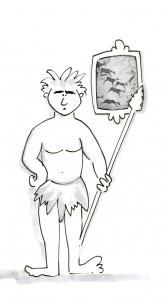
Primitive-dude-1-167x300R. Salvador Reyes over at the Tottenville Review:

First confession. I didn’t start out this way: believing that art is a Godless domain, a tactically-consumed, evolutionarily-wrought siren to the mind—just another victim hunted by our massive, pulverizing desire to devour and catalog every pattern in the universe that presents itself to our perpetually-ravished brains. I didn’t believe any of those things. Not in the beginning.

In the beginning, I just wanted to write. Why should I care how humans had come to love literature and art? I didn’t care. Until I asked the question. How had humans come to love literature and art? People have been asking this for centuries, and they’ve put forth a plethora of fascinating answers. But during the last couple of decades, theorists have started examining the question through the lens of evolution—and it’s beginning to look like a new future for literary studies is taking shape. Two of the most eloquent and compelling arguments for art’s evolutionary roots are the recently published On the Origin of Stories (Harvard University Press), by Brian Boyd and The Art Instinct (Bloomsbury Press), by Denis Dutton. Both seem destined to become part of the foundation of the emerging field of Literary Darwinism—where literature is being examined from new viewpoints, like neuroscience and evolutionary psychology. It’s a field that’s beginning to gain a following in the halls of academia, but my own journey to Literary Darwinism was trod outside those halls. I was simply a writer who wondered why readers sought out and consumed the literary objects I was trying to create. And while Boyd’s and Dutton’s books focus on the evolutionary answers to why humans began and continue to create art, as an artist I was more interested in how evolution has shaped audiences’ responses to art.

Because Literary Darwinism’s territory is still raw and untamed, taking the journey without a tour guide has given me the chance to carve my own path into its wilderness. Think of this as my travelogue—something to provide a view of this freshly-discovered fauna and flora from a writer’s perspective.

Posted by Robin Varghese at 01:12 PM | Permalink

Comments

Literary Darinism is not Darin and not literature...It cosists of academics looking for the next big thing to replace the last best thing, in order to be able to publish and to open a new journal or two.

Posted by: n.zuckerman | Dec 28, 2011 3:30:39 PM

You bet, n. It's just another way for academics to avoid reading and responding directly to actual works of literature. The thought of doing so gives them asthma attacks, which they medicate with emergency sprays of secondary texts.

Posted by: Philip Graham | Dec 28, 2011 9:12:34 PM

It's bollocks. What about an astrophysics-based literary criticism? Or Quantum Crit?

Posted by: Mike Cope | Dec 29, 2011 10:04:22 AM

So folks. What's your alternative theory of why people like art and literature?

Posted by: Brian Mulligan | Dec 31, 2011 9:42:52 AM

my theory of why people like art and literature is very simple: they both make the ugly, simple, mundane things in life beautiful! By nature a human being wants to identify himself with what he sees, hears, and reads. Understanding, perceiving what he sees gives him a sense of participation, belonging to the world as a whole.

Posted by: Dan Reyes | Jan 5, 2012 3:35:46 PM

My son who authored, "Story Theory: Confessions of a Literary Darwinist" one summer while he was in high school helped me paint yellow strips in my clinic parking lot. It marked the spaces for parked vehicles.Each space was exactly of the same length and width.Proof that at that time, art and literature has not yet evolved because now he would have painted the strips in different lengths & widths to accommodate different sizes of of vehicles maybe including trucks and applying a variety of colored pavement paints.But no speed bumps, I would have insisted.

Posted by: Dr. Leo A. Reyes | Jul 10, 2012 10:22:04 PM

Post a comment


Subscribe to this blog's feed  

PayAnywhere with iphone credit card swiper

Android Tablet

Bluetooth Headset

2013 New Style Dresses

Compare Car Rental Prices

DHgate.com Wholesale

3QD on Facebook

3QD on Kindle

3QD by Daily Email

Receive all blogposts at the same time every day.

Enter your Email:


Preview 3QD Email

3QD on Twitter

Miscellany

Lijit Search

AddThis Social Bookmark Button

Add to Google

Recent Comments

chris on Race Is Not Biology

Dave Ranning on REFLECTIONS ON WOOLWICH

Sumiran on Friday Poem

prasad on Race Is Not Biology

omar on REFLECTIONS ON WOOLWICH

G on REFLECTIONS ON WOOLWICH

Erich on REFLECTIONS ON WOOLWICH

omar on Race Is Not Biology

Raza Husain on Race Is Not Biology

Raza Husain on Race Is Not Biology

Josef Stern on REFLECTIONS ON WOOLWICH

Colette on POETRY IN TRANSLATION: CORDOBA

Dana on A young Houston couple is planning to give away $4 billion—but only to projects that prove they are worth it. Can they redefine the world of philanthropy?

omar on REFLECTIONS ON WOOLWICH

Dredd on REFLECTIONS ON WOOLWICH

omar on Race Is Not Biology

prasad on Race Is Not Biology

JF on REFLECTIONS ON WOOLWICH

Sundar on REFLECTIONS ON WOOLWICH

omar on REFLECTIONS ON WOOLWICH

musafir on Loneliness, isolation and desperate yearning

carlos on The Gut-Wrenching Science Behind the World’s Hottest Peppers

Dredd on A young Houston couple is planning to give away $4 billion—but only to projects that prove they are worth it. Can they redefine the world of philanthropy?

Dredd on Why Rational People Buy Into Conspiracy Theories

JonJ on Daniel Dennett's seven tools for thinking

Acclaim For 3QD


"I couldn't tear myself away from 3 Quarks Daily, to the point of neglecting my work. Congratulations on this superb site."—Steven Pinker, Johnstone Professor of Psychology, Harvard University.

"I have placed 3 Quarks Daily at the head of my list of web bookmarks."—Richard Dawkins, Charles Simonyi Professor of the Public Understanding of Science at Oxford University.

"Just wanted you to know I’m one of many who reads and enjoys 3 Quarks....almost daily."—David Byrne, musician, former lead-singer of the Talking Heads, artist, intellectual.

Read more here.

The 3QD Prizes

Subscribe to this blog's feed