
Sam Harris in his blog:
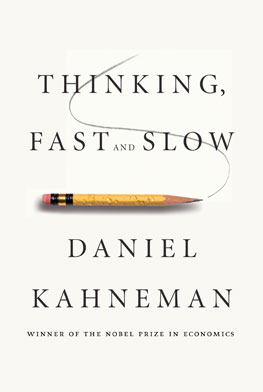
Daniel Kahneman is among the most influential psychologists in history and certainly the most important psychologist alive today. He has a gift for uncovering remarkable features of the human mind, many of which have become textbook classics and part of the conventional wisdom. His work has reshaped social psychology, cognitive science, the study of reason and of happiness, and behavioral economics, a field that he and his collaborator Amos Tversky helped to launch. The appearance of Thinking, Fast and Slow is a major event.
Kahneman was kind enough to take time out of a very busy book tour to answer a few of my questions.
Much of your work focuses on the limitations of human intuition. Do you have any advice about when people should be especially hesitant to trust their intuitions?
When the stakes are high. We have no reason to expect the quality of intuition to improve with the importance of the problem. Perhaps the contrary: High-stake problems are likely to involve powerful emotions and strong impulses to action. If there is no time to reflect, then intuitively guided action may be better than freezing or paralysis, especially for the experienced decision maker. If there is time to reflect, slowing down is likely to be a good idea. The effort invested in “getting it right” should be commensurate with the importance of the decision.
Are there times when reasoning is suspect and we are wise to rely on our snap judgments?
As Gary Klein has emphasized (Sources of Power is one of my favorite books), true experts—those who have had sufficient practice to detect the regularities of their environment—may do better when they follow their intuition than when they engage in complex analysis. Tim Wilson and his collaborators have demonstrated that people who choose between two decorative objects do better by following their impulse than by protracted analysis of pros and cons. The critical test in that experiment is how much they will like the chosen object after living with it for a while. Affective forecasting based on current feelings appears to be more accurate than systematic analysis that eliminates those feelings.
More here.