
| ABOUT US | ARCHIVES | LINKS | RSS FEED | MONDAYS | |

3quarksdaily

An Eclectic Digest of Science, Art and Literature

« libya and the left | Main | Thursday Poem »

December 21, 2011

Postcolonialism and Science Fiction: An Excerpt

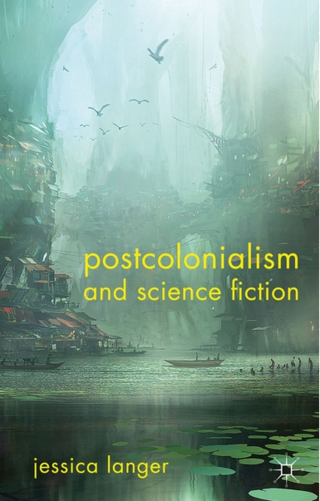
4210c3cabd31943ec3abeb7120c488f3Over at io9, an excerpt from Jessica Langer's new book:

Most readers will be familiar with the classic oppositional science fiction tropes of the grotesque bug-eyed alien bent on Earthly domination and the beautiful but empty planet, ripe for colonization – or, of course, the dangerous planet whose inhabitants dare to fight back against the lantern-jawed colonial hero. Several studies have addressed the parallelism between historical and science-fictional "alien" encounters, the most comprehensive and recent being John Rieder's exploration of this period in science fiction and history, Colonialism and the Emergence of Science Fiction (2008). The figure of the alien – extraterrestrial, technological, human-hybrid or otherwise – and the figure of the far-away planet ripe for the taking are deep and abiding twin signifiers in science fiction, are perhaps even the central myths of the genre. They are, to riff on the most famous work of Robert A. Heinlein, one of science fiction's most famous writers, the Stranger in a Strange Land. Aliens, including humans – who are, of course, alien to those aliens – and strange, foreign, other planets – which includes, of course, our own Earth, from the perspective of the alien. What the alien signifies, of course, varies greatly, as does the signification of the similarly central intergalactic terra nullius.

These two signifiers are, in fact, the very same twin myths of colonialism. The Stranger, or the Other, and the Strange Land – whether actually empty or filled with those Others, savages whose lives are considered forfeit and whose culture is seen as abbreviated and misshapen but who are nevertheless compelling in their very strangeness – are at the very heart of the colonial project, and their dispelling is at the heart of the postcolonial one.

How, then, can a genre so steeped in, so built upon, the Stranger and the Strange Land in its diegetic reality work to undo them in our consensus reality, what Darko Suvin calls our "zero world"?

Posted by Robin Varghese at 09:15 AM | Permalink

Comments

I like the Pogo theory of aliens better, which is, "we have met the enemy and it is us."

Especially since the composition of "us" is better understood now.

Pogo had the general high-level location down, but we really have to get down to it if we are to get out of our alien nature.

Posted by: Dredd | Dec 21, 2011 10:42:14 AM

@Dredd: dont you think a lot of colonial literature (heart of darkness leading the way, and ending with the sartre/fanon stuff) also contains a strong whiff of the quote you cite? i dont think your point is at all at odds with this colonial/sci-fi thesis.

Posted by: ed rackley | Dec 21, 2011 2:54:14 PM

As an antithesis to this notion, I would recommend for example Zoo Story by Lauren Buekens.

http://angryrobotbooks.com/our-authors/laurenbeukes/zoo-city/

Posted by: Christoph | Dec 21, 2011 4:27:46 PM

The writer has, apparently, never actually read Stranger in a Strange Land (a novel that has nothing to do with colonialism), but has glibly appropriated it as a convenient label for her thesis. Discovery and Exploitation are probably two of the most important tropes in the history of civilization, post-colonial or otherwise. Every people has played "aliens and invaders" at one time or another. Its presence in some science fiction is therefore neither surprising nor particularly interesting.

Posted by: Nathan | Dec 21, 2011 10:57:16 PM

Nathan, why take the time to voice your negative opinion of an excerpt? If you're uninterested, move on. It may be the sour weather or holiday stress, but I don't recall there being so many nonconstructive comments on this blog*, basically amounting to a highbrow version of anonymous online 'trolling'. To dismiss an essay, study or research topic as uninteresting on account of an excerpt is just silly and childish in a non-adorable way.

*I've now joined the ranks of commentators voicing their ridiculous, arbitrary assessment of 'the state of this blog and where its headed, bla bla bla.' Sorry

Posted by: troll2 | Dec 22, 2011 12:17:02 AM

@Nathan: I don't think you've actually understood what you've read. The point isn't that colonial adventurism appears in science fiction (what with rocket ships to other planets, it sort of defines a large part of the genre, no?). Your yawn indicates how little you're familiar with a burgeoning "post-colonial science fiction", and that perhaps your view of sci-fi is a tad boxed in. The point of Langer's work is that as science fiction writers from post-colonial settings take up the pen, and as post-colonial critiques filter into western science fiction, the colonial narrative as it is traditionally conceived, whether sympathetic to the "colonizer" or the "native", is upended. The excerpt is not pointing out the relationship between colonialism and science fiction (which might be yawn-worthy if that was ALL the book was), it is in fact introducing this obvious relationship in order to demonstrate through the remainder of the volume how it is being mutated and reworked by authors from a post-colonial perspective. Pick it up, you might learn something new :-).

Posted by: Bengo | Dec 22, 2011 2:22:54 AM

"How, then, can a genre so steeped in, so built upon, the Stranger and the Strange Land in its diegetic reality work to undo them in our consensus reality, what Darko Suvin calls our 'zero world'?"

I dunno. Don't mean to be super skeptical, but I'm not sure whether this question is a productive one. Any genre, given enough time, will play at and/or subvert its most cherished conventions. It doesn't magically destroy itself by doing this, either. In fact, if you want to critique or examine the tropes of a certain genre the best way to go about is through that genre. Right? Is the question indeed 'how can SF become postcolonial?' I'm sure there's some nuance I'm not getting. Anyways, very interesting regardless. Also bitchin cover

Posted by: Ethan | Dec 22, 2011 3:38:02 AM

Ethan: unfortunately the excerpt-of-the-excerpt published by 3QD cut off right before the next few sentences, which read:

"Rather than shying away from these colonial tropes, these twin giants of the science fiction world, postcolonial science fiction hybridizes them, parodies them and/or mimics them against the grain in a play of Bhabhaian masquerade. The figure of the alien comes to signify all kinds of otherness, and the image of the far-away land, whether the undiscovered country or the imperial seat, comes to signify all kinds of diaspora and movement, in all directions. Their very power, their situation at the centre of the colonial imagination as simultaneous desire and nightmare, is turned back in on itself."

The cover is by the concept artist Jesse van Dijk, whose work is incredible: http://jessevandijk.net/

Posted by: Jessica Langer | Dec 22, 2011 8:01:14 AM

"@Dredd: dont you think a lot of colonial literature (heart of darkness leading the way, and ending with the sartre/fanon stuff) also contains a strong whiff of the quote you cite? i dont think your point is at all at odds with this colonial/sci-fi thesis.

Posted by: ed rackley | Dec 21, 2011 2:54:14 PM
==========================
Good enough Ed.

The revolution now taking place in microbiology, in terms of what is meant by "human" should change many concepts.

We have known microbes are the oldest life form on Earth, the most abundant species, in the air, land, and water, but now we also know that they are the most abundant species within us.

Why a new notion of alien jumps in is that we don't know where all those microbe species originated.

Some on Earth, some elsewhere ("alien")?

It could be that in scientific fact, not scientific fiction, we are composed of both alien life and native Earth life at the same time.

And that could be a source of some of our "alien" problems.

Posted by: Dredd | Dec 22, 2011 8:07:36 AM

I like the piece.

"What the alien signifies, of course, varies greatly, as does the signification of the similarly central intergalactic terra nullius.

These two signifiers are, in fact, the very same twin myths of colonialism"

The greatest colonialism oriented science story is not fiction.

Microbes, having been on the Earth for a billion or so years before humans, at some point "decided" to colonize and even become symbiont to humans.

They colonize every human on the day of birth, and evolve within that person for life.

They take part in the formation of the human brain, and some of its performance thereafter.

We are colonized. We are outnumbered a good 10 to 1 in cell count.

The sci-fi / sci-fact controversy may come into the picture validly, if NASA scientist Richard Hoover is correct, that some of those microbes originated elsewhere beyond the Earth.

Posted by: Dredd | Dec 22, 2011 8:40:48 AM

Post a comment


Subscribe to this blog's feed  

PayAnywhere with iphone credit card swiper

Android Tablet

Bluetooth Headset

2013 New Style Dresses

Compare Car Rental Prices

DHgate.com Wholesale

3QD on Facebook

3QD on Kindle

3QD by Daily Email

Receive all blogposts at the same time every day.

Enter your Email:


Preview 3QD Email

3QD on Twitter

Miscellany

Lijit Search

AddThis Social Bookmark Button

Add to Google

Recent Comments

Matt on The Science Mystique

Eleutheria on Why is Europe so Messed Up? An Illuminating History

Elatia Harris on I am dust and ashes and full of sin

PeteChapman on I am dust and ashes and full of sin

Raza Husain on the culture animal

Chris on Positive Failure - a review of "The Power" by Rhonda Byrne

DAS on Why is Europe so Messed Up? An Illuminating History

DAS on Is the Brain No Different From a Light Switch? The Uncomfortable Ideas of the Philosopher Daniel Dennett

DAS on the culture animal

Raza Husain on Unknown Mathematician Proves Elusive Property of Prime Numbers

Dredd on NORTH KOREA’S NERVE WAR

Dredd on Unknown Mathematician Proves Elusive Property of Prime Numbers

Raza Husain on Is the Brain No Different From a Light Switch? The Uncomfortable Ideas of the Philosopher Daniel Dennett

Dana on germ houses

musafir on Tuesday Poem

soubriquet on Tuesday Poem

Eli on Unknown Mathematician Proves Elusive Property of Prime Numbers

Jim on Tuesday Poem

Josef Stern on Unknown Mathematician Proves Elusive Property of Prime Numbers

Shelley on Is the Brain No Different From a Light Switch? The Uncomfortable Ideas of the Philosopher Daniel Dennett

Bill on The Beautiful German Language

Eleutheria on The Bystander Effect in Medical Care. Why Do I Have So Many Doctors Not Taking Care of Me?

Eleutheria on Tuesday Poem

Raza Husain on the culture animal

musafir on The Bystander Effect in Medical Care. Why Do I Have So Many Doctors Not Taking Care of Me?

Acclaim For 3QD


"I couldn't tear myself away from 3 Quarks Daily, to the point of neglecting my work. Congratulations on this superb site."—Steven Pinker, Johnstone Professor of Psychology, Harvard University.

"I have placed 3 Quarks Daily at the head of my list of web bookmarks."—Richard Dawkins, Charles Simonyi Professor of the Public Understanding of Science at Oxford University.

"Just wanted you to know I’m one of many who reads and enjoys 3 Quarks....almost daily."—David Byrne, musician, former lead-singer of the Talking Heads, artist, intellectual.

Read more here.

The 3QD Prizes

Subscribe to this blog's feed