
by Randolyn Zinn
Despite being a fan of Wim Wender’s previous films, I was frankly dubious when I heard about his latest project. Really, I wondered, the work of legendary choreographer Pina Bausch shot in 3D? Admittedly, my limited experience with this technology was a passing glimpse of computer-generated fantasy fluff for kids…but still, what was Wim Wenders thinking, I wondered?
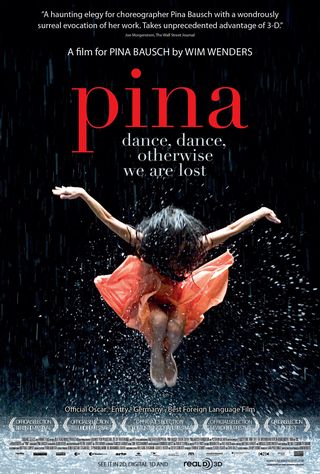
After seeing the film the other day, I’m pleased to report that Wenders has given a great gift to the world. Not only is PINA one of the first European 3D movies ever made, it is also the world’s first 3D art house film. Even better, the film brings the work of Pina Bausch to a wider audience. During a good part of its 103 minutes, I felt like I was alongside the dancers, hearing them breathe. When they leapt, I felt their exhilarating takeoffs and landings in my own body. When a line of dancers crosses behind a gauzy scrim at one point, it seems to reach into the audience, inviting us to join in the dance. PINA opens in New York on December 23 and will be coming to a theater near you. Here's the trailer.
PINA – Dance, dance, otherwise we are lost – International Trailer from neueroadmovies on Vimeo.
Wim Wenders and Pina Bausch met in 1985 after the filmmaker saw her piece “Cafe Müller” in Venice. “There were people performing who moved me as I had never been moved before,” he has said. “I had a lump in my throat and after a few minutes of unbelieving amazement, I simply let go of my feelings and cried unrestrainedly. This had never happened to me before.”
Over the course of their 20-year friendship, they dreamed of making a film together, but their amorphous plans soon became a sort of running gag. Pina would say, “What about doing it now, Wim?” And he would answer “I still do not know how, Pina!” Even after studying a variety of dance films, Wenders felt that he didn’t know how to capture the emotional and physical immediacy of Bausch’s tanztheatre, dance theater. Then he glimpsed the new digital 3D technology. He rushed into the cinema’s lobby to telephone Bausch. “Now I know how to do it, Pina.”

Wenders scheduled the film’s start date in 2009, but on June 30, two days before shooting was to begin, Bausch died unexpectedly. Everyone was devastated, of course. At 69 years of age and just four days after a diagnosis of cancer, she left behind a son, an acclaimed dance company, devoted fans around the world, and a trove of masterpieces that changed the course of dance and theater history. The film project stalled, impossible to make without Bausch and Wenders didn’t know how to continue. He had wanted to interview Pina, show her in rehearsal, and, in effect, co-direct the project with her. The dancers implored him to reconsider. “In the coming months,” they told him, “ we will perform all the pieces you wanted to record. You cannot leave us alone. You must film this. Now more than ever.”
The film is structured around stunning performances of “Le Sacre du Printemps”, “Café Müller”, “Kontakthof” and Vollmond”, interspersed with archival rehearsal footage of Bausch, interviews with the dancers and their solos and duets staged in public spaces around Wuppertahl, Germany where the company makes its home, the countryside of the Bergisches Land and the Wuppertal Suspension Line. Excerpts from “Kontakthof” are adroitly intercut in an empty dance hall between its three casts: the Tanztheater ensemble; ladies and gentlemen between the ages of 65 and 80, and teenagers ages 14+.
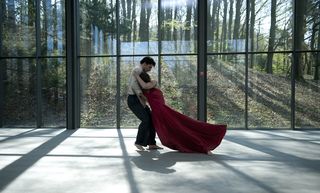
(Damiano Ottavio Bigi and Clémentine Deluy in Wim Wenders’ PINA. ©Neue Road Movies GmbH, Photo by Donata Wenders. A Sundance Selects release.)
The film doesn’t tear apart the mysterious artistic process that so defined Pina Bausch’s inquiry into life. Dancing was her medium, but her universal questions crossed cultural boundaries as they probed the human condition. Bausch created her unusual works by first posing questions to the dancers. Their improvised “answers” sprung from individual experiences expressed as dances and gesture phrases from which Bausch would slowly develop her evening-length pieces. As one dancer recounts, “Pina would ask for the moon and I’d answer her with my body.” What are you longing for, she wanted to know. “What does all this yearning come from?” As she famously said, “I’m not interested in how people move, but what moves them.”
(Pina Bausch in rehearsal. Photo by Gert Weigelt.)
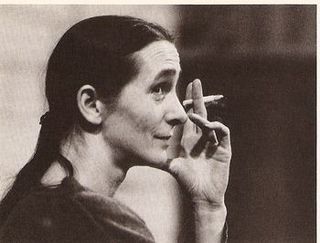
“You always felt more human working with Pina,” one dancer says. “She let us be sad and furious, to laugh and to cry.” The experience of making and performing this new hybrid form of tanztheater was so intense that one dancer remembers, “It was as if Pina were hidden inside of each of us. Or we were a part of her.”
For more on Bausch’s bio, process and choreography, see my article “Somebody Nailed My Dress To The Wall” by clicking HERE.
Wenders takes on Bausch’s strategy by interviewing company members with questions (that we don’t hear). As each dancer sits quietly before the camera, his or her spoken answers are overdubbed. Then in a quick cut, the same dancer is filmed dancing in a public location. One woman rises on her toes to bourrée on a factory loading platform, a couple engages in a love duet on a busy street corner, another in a forest, a mountain slope, and the Wuppertal Suspended Monorail.
(Fabian Prioville and Azusa Seyama in Wim Wenders’ PINA. ©Neue Road Movies GmbH, Photo by Donata Wenders. A Sundance Selects release.)
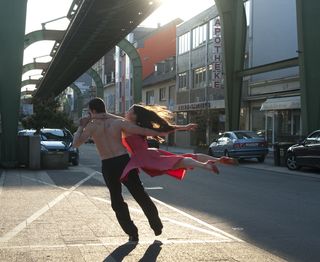
A strong sense of place has always characterized Wim Wenders’ films. He has been inspired by the landscapes of Cuba, Los Angles, Tokyo, Cologne and Paris, Texas, to name just a few. In PINA when he shoots the outdoor scenes, he puts Bausch’s work into the real-world context that has always been present in her dances. Her work was about how we live our lives, so to see the dances set in the world makes perfect sense. The solos and duets outside the theatre space are a perfect complement to the onstage performances.
DIGITAL 3D: A NEW OPPORTUNITY
In a discussion on June 29, 2010 at the International Film Conference, Wenders said that he wanted his film PINA to replicate the natural perception of space, as when spectators watch before the stage. “Or better,” he said, “right on it.”
Apparently the first screen tests for the project were disheartening. If he panned too quickly, he’d get a strobe-like effect. Any quick movement of a dancer’s arm, for instance, would produce a quick sequence of two, three or four arms. When he shot at a higher frame rate: 50 frames per second, instead of the standard 24, he got a better, sensational clarity and sense of depth. But theaters aren’t equipped to run films shot at 50 frames per second. He appealed to the Institute in America, responsible for the standard, only to discover that they had also denied James Cameron his request to shoot “Avatar” at 50 frames per seconds.
Wenders studied “Avatar” and noticed right away that Cameron had experienced the same problem with multiple images of moving arms and legs, but by cutting quickly and because much of his imagery was computer generated, he was able to cover up the problem. How to outwit the technology with real people dancing, Wenders wondered?
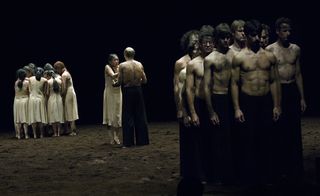
(Azusa Seyama, Andrey Berezin, dancers of the ensemble of “Sacre du Printemps” in Wim Wenders’ PINA. ©Neue Road Movies GmbH, Photo by Donata Wenders. A Sundance Selects release.)
His eventual strategy avoided lens changes so he basically shot the film on 2 focal lengths, both of them quite wide to simulate the angle of natural vision. “Overall,” he said, “we tried to follow as much as possible the physiology of human eyes.” In the theater shots, he used a long, telescopic crane stationed in the middle of the auditorium that could penetrate right into the stage between the dancers or rise high above the action.
In promotional material about the film, Erwin M. Schmidt, the 3D producer said that Wenders and Francois Garnier, the 3D Supervisor of the film, divided the floor plan of the theater space into a virtual checkerboard and used a protractor, which corresponded exactly with the viewing angle of the camera lens. They studied 2D videos of the dances beforehand and wrote a detailed schedule, noting precisely where on the quadrant the camera should be positioned at any given moment during the performance. During rehearsals and shootings, the director related these instructions via radio link to the team members. They recorded the four dance pieces live, during sold-out performances.
Understandably, the dancers had qualms at first about the crane: to move with this giant eye dancing along with them onstage? Normally, dance is shot far from the proscenium. However, dancers are notoriously flexible, and the ensemble soon became acclimated to their new technical partner; the camera literally dances with them and the results are stunning. The viewer feels as close to the action as if onstage with the dancers. You’ve never been so close. Francois Garnier, the 3D Supervisor says “Because dance is by nature a movement in space, there is no better method than 3D technology to show it. The sense of physical sensation is much more powerful than than any intellectual reflection. With 3D, cinema enters a new level.”
Two cameras, one atop the other, were connected by a semi-transparent mirror. The apparatus was so huge it was operated by many motors. “A remote controlled monster,” as Wenders put it, that required five people to operate all its functions. During his second shoot in April, he used a prototype of a Steadycam. In 3D, the camera must move otherwise the spatial effect is wasted. “Slow tracking shots pay off wonderfully,” he said” because they move the whole room and make the space more perceptible.
A Quick Lesson in 3D from Erwin Schmidt
To shoot in 3 D you need two cameras mounted either side-by-side or in a so-called mirror rig. In the latter, cameras are positioned at an angle of 90 degrees. A one-way mirror is installed in between them, at a 45 degree angle to the two lines of sight. One camera films through the mirror, the other films its reflection. The various rigs used on PINA’s set were all prototypes optimized by Alain Derobe especially for this project.
(Dancers of the Pina Bausch Company in Wim Wenders’ PINA. ©Neue Road Movies GmbH, Photo by Donata Wenders. A Sundance Selects release.)
We loved Pina Bausch. We miss her. She died too soon. Marion Cito, the great costume designer, responsible for all those gorgeous tanztheater gowns, said during filming, “Like many of my colleagues, I sometimes cannot believe that Pina Bausch is no longer here. The great sadness is still far from over. One senses, however, that she lives on in her works. I think it’s really great that Wenders is shooting the movie now, because Pina wanted this very much.”
I think so too. Danke, Wim Wenders.
The Dancers: Regina Advento, Malou Aiaudo, Ruth Amarante, Jorge Puerta Armenta, Pina Bausch, Rainer Behr, Andrey Berezin, Damiano Ottavio Bigi, Ales Cucek, Clementine Deluy, Josephine Ann Endicott, Lutz Forster, Pablo Aran Gimeno, Mechtild Grosmann, Silvia Farias Heredia, Barbara Kaufmann, Nayoung Kim, Daphnis Kokkinos, Ed Kortlandt, Eddie Martinez, Dominique Mercy, Ditta Miranda Jasjfi, Cristiana Morganti, Morena Nascimento, Nazareth Panadero, Helena Pikon, Fabien Prioville, Jean-Laurent Sasportes, Franko Schmidt, Azusa Seyama, Julie Shanahan, Julie Anne Stanzak, Michael Strecker, Fernando Suels Mendoza, Aida Vainieri, Anna Wehsarg, Tsai-Chin Yu and as guests in “Le Sacre du printemps”: Alexeider Abad Gonzales, Sephan Brinkmann, Meritxell Checa Esteban, Paul Hess, Rudolf Giglberger Chrystel Wu Guillebeaud, Mu-Yi Kuo, Szu-Wei Wu, Tomoko Yamashita, Sergey Zhukov, Andy Zondag.