
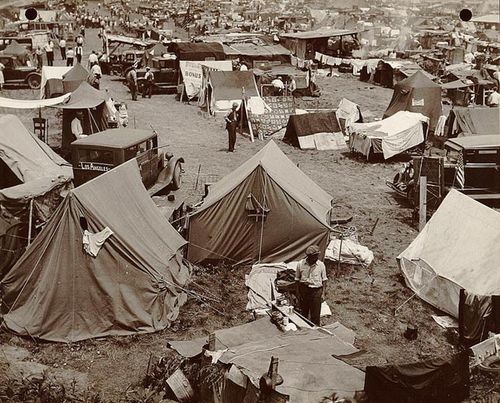
Elsewhere I have written about Occupy within the contest of two earlier American social protest movements against poverty: Coxey’s Army of unemployed men looking for work in 1894, and the Bonus Marchers of impoverished World War I veterans in 1932.
During the depression of 1893-98, the second worst in U.S. history, many Americans began to agitate for a federally-funded public works project to build and improve roads across the country. In addition to building up the infrastructure, such projects could also put men to work during an era when unemployment was in the teens and there was no goverment welfare safety net to speak of. Coxey's Army, led by an Ohio millionaire named Jacob Coxey, was the largest of many protest movements advocating this approach. Thousands of men marched to the nation's capital in support of the plan.
Later on, the Bonus Marchers were a collection of homeless and unemployed World War I veterans who sought government action during the darkest depths of the Great Depression. During the roaring `20s the government had promised to award them a one time bonus of $1,000 in gratitude for their wartime service, payable in 1945. However, unemployed vets, many of them homeless, sought early payment of the bonus in 1932. They too crossed the country in caravans, arriving in the nation's capital.
Despite their numbers, organization, and commitment, neither group was able to achieve its immediate goal. Congress did not create a public works job program as Coxey requested, nor did it award early payment of the cash bonus promised to war veterans as the Bonus Marchers requested. In both cases, the press and political opponents smeared peaceful and patriotic protestors as criminals and revolutionaries. And after arriving in Washington, D.C., both groups suffered state violence from police and even the military. Indeed, in 1932 one of America's lowest moments came when future WWII heroes Douglas MacArthur, Dwight Eisenhower, and George Patton all played a direct role in leading military forces against their former fellow servicemen, who had assembled peaceably
As we now witness what may very well be the decline of the Occupy movement, in the face of similar smears and violence, it is worth considering the following questions:
How do Historians look back upon Coxey’s Army and the Bonus Marchers; how do they measure their political significance; and what might that portend for the way history comes to view the Occupy movement should it soon fade from the scene as did its predecessors?
There are several lessons to be learned from Coxey’s Army and the Bonus Marchers. For starters, when times get tough, many Americans reasonably expect their elected officials to do something about it. These movements took place during the nation’s two worst economic crises, the Panic of 1893 and the Great Depression. Amid massive unemployment, many Americans understandably ask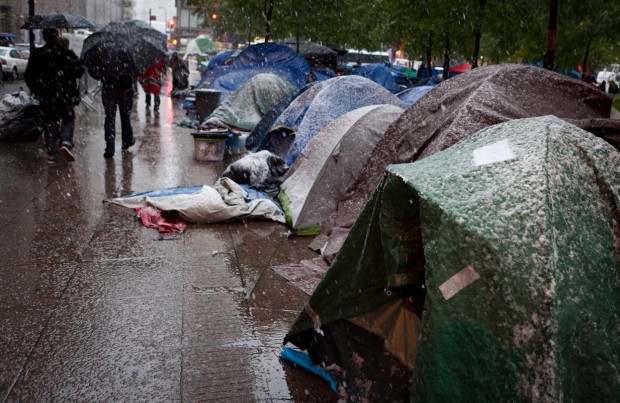
Even during the late 19th and early 20th centuries, the laissez-faire doctrines so popular among many economists and politicians rang hollow with people mired in poverty and lacking any means to change it. While prominent experts and powerful politicos believed the free market economy would just fix itself, many Americans rightly began to suspect otherwise. And in each case, the people turned out to be right. In the end, wars eventually forced the federal government into deficit spending that stimulated the economy out of depression: The Spanish-American War in 1898, and World War II, which the United States began mobilizing for in 1940.
Looking at the situation today, once again there are many who reject the notion of stimulating the economy. Whether such critiques are born of free-market dogma or petty politics aimed at winning elections on the backs of angry, struggling workers is almost besides the point. Either way, politics at the highest level have precluded serious economic stimulus; the Obama stimulus package of 2009 was too small by the standards of any serious Keynesian, and little else has been put forth since.
What will eventually force the federal government to pool its resources and drive this economy out of recession? Only time will tell. But for now, it’s important to remember that the “market” is only a metaphor. The economy is actually a series of countless, complex, interrelated social interactions that don't necessarily “fix” themselves.
Another historical lesson is that social protest movements against poverty have often met with repression and even violence. Why? Because beyond the ethereal details of economic philosophy are the hardscrabble realities of class divisions, both economic and social. And while the United States is the world’s wealthiest nation, it has always had a wide gap between rich and poor, and far more poor peple than its aggregate wealth would lead one to suspect.
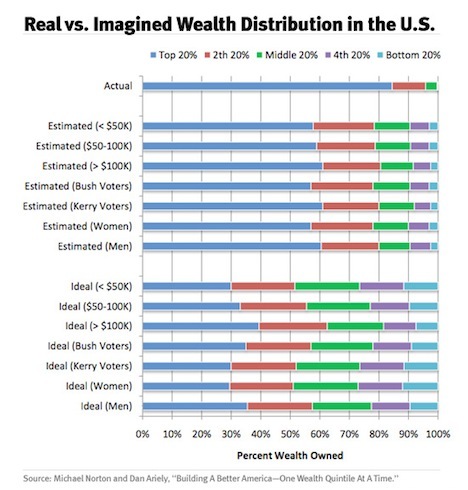
At the other end, it’s not as simple as rich people wanting to keep their money. Of course rich people want to keep their money. Everyone wants to keep their money. And rich people having “too much” money isn’t the reason the economy’s broken; it just exacerbates matters and makes a broken economy much more difficult to stomach. Unless of course you're rich.
In some ways then, the real class issue is not about economic class. It’s about social class. It's about prestige and aspiration.
Those middle class people who begin to slide are apt to advocate changes. But the middle class people who hold on are able to maintain find themselves in a tenuous position. Economic instability instills fear, and so it becomes easy to convince many of them that the real threat isn’t the broken economy, but rather the rabble who want to create even more instability by demanding fundamental changes to the system. Generally speaking, most people are naturally risk averse during tough times and are often in tune with the message: Be cautious, hold tight to what you have, and don't take any chances because change might make this even worse.
So at the end of the day, Coxey’s Army and the Bonus Marchers didn't fail simply because a small elite stood in their way, though of course that didn’t help matters. The real issue is that a significant portion of the middle class bought into smear campaigns that labeled them as criminals or communists or anarchists or just some ill-defined, dirty mob that betrayed American values and threatened everyone’s security and way of life.
The same thing happened to the Occupy movement. They’ve been smeared as hippies, as yuppies, as rich kids, as lazy, as delusional and clueless, as hypocrites, as unAmerican, and even as dangerous. And when a lot of people bought into that, it became much more difficult for Occupy to succeed. While all three of these movements were big, they weren’t truly massive. They weren’t Arab Spring or the fall of the Eastern Bloc. They didn’t have the widespread support of the masses, and to a large degree it’s because many people bought into the smear campaigns against them.
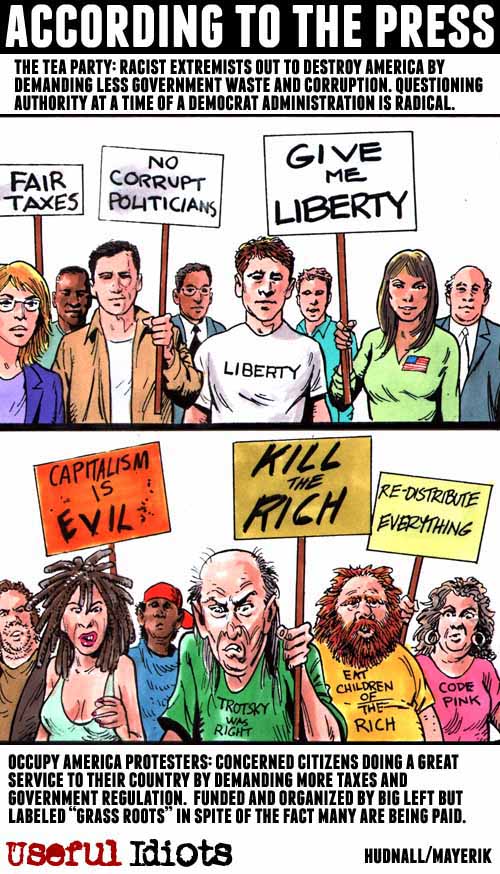
One idea that has received quite a bit of attention is the notion that the Occupy movements have “changed the discourse.” It’s a popular assertion, in part, because it’s so fuzzy and hard to pin down. And since it is difficult to measure the success of something like changing the discourse, it’s easy to feel good about the assertion if you are inclined to. But one has to seriously consider whether the discourse has actually changed, or whether it is simply the case that a lot of people were talking about Occupy issues while Occupy movements were grabbing headlines.
I think it’s probably a little of both. And now that Occupy is not grabbing nearly as many headlines as it did this autumn, we need a way to really ascertain whether or not the discourse has changed. How to do this? One popular approach is to measure the topics that are being talked and written about. However, people will probably continue to talk about Occupy-related topics so long as the economy drags, and most of them will probably stop once it picks up again.
I think a better way to measure the degree to which the discourse has or has not changed is to focus on ideas instead of topics. Identify the major ideas that the Occupy movement has stressed and try to see if they are truly becoming ensconced in popular and policy discourses.
When we look back at Coxey’s Army and the Bonus Marchers, one of the things we find is that the ideas they promoted did in fact find a home in American society. Jacob Coxey and his followers were proposing a radical new idea during the mid-1890s: essentially a Keynesian model of attacking a severely broken economy. During an era when laissez-faire dogma reigned supreme and policy makers’ commitment to minimal government spending and balanced budgets was resolute, Coxey’s Army had the moxie to say the government should spend lots of money to stimulate the economy by putting unemployed people to work on public works projects that would benefit society as a whole. And this was in the very early days of the Progressive era, when the idea of actively using government to improve society was just beginning to gain some traction.
So while Coxey’s Army failed in its ostensible purpose, it helped change the discourse by promoting an idea that would become increasingly popular in a general sense for twenty years to come. And more specifically, those ideas would see a fuller bloom during the next economic catastrophe, the Great Depression. Franklin Roosevelt’s New Deal eagerly incorporated ideas Coxey could be proud of. The Works Progress Administration and the Civilian Conservation Corps (FDR’s personal favorite of all the New Deal programs) were among several wherein the federal government directly hired unemployed Americans in the service of the nation.
Likewise, the Bonus Marchers also helped changed the discourse in the long run, despite the immediate failure to accomplish their stated 
How then might Occupy have changed the discourse? What fundamental ideas and approaches has it promoted? It would seem to me that the major ideas (and one could add or subtract a few no doubt) would include:
-Direct Democracy: A commitment to not only increased transparency in government, but also a stronger voice for citizens in it. Our republic was founded on the principle of indirect democracy, wherein the citizenry makes no political decisions other than to elect some of their rulers, and in fact most rulers are appointed by other rulers (judges, the president by the electoral college, originally U.S. Senators by state legislatures, etc.). Over the last two centuries, Americans have been able to choose more of their leaders directly (eg. U.S. Senators, some judges), and even make the occasional local or state-wide policy decision through popular referendum. Occupy, with its anarcho-collective roots and organization, is clearly dedicated to more direct democracy in American politics.
-Diminishing Corporate Influence: In particular Occupy has harnessed widespread anger at the financial corporations that drove this economy into the ground and then received public money by the trillions. But more generally, the movement has fundamentally rejected the strong political power of corporations, both through the legal fiction of corporate personhood and through the almost incomprehensibly strong influence corporations exercise on our governments. Diminishing corporate influence in American politics has been a basic tenet of this movement.
–Distribution of Wealth: A top heavy distribution of wealth during the Roaring `20s was one of many contributing factors to the Great Depression. As the economy heated up and American businesses eventually overproduced, consumers were incapable of absorbing those excess goods and services because there were simply too many poor and working class people without expendable income. What about the rich? Well, no matter how much money you have, you only need so many refrigerators. For Occupy, however, a top-heavy distribution of wealth, framed in its hallmark 99% slogan, isn’t simply a matter of sound economic policy. It’s a matter of economic and social justice.
We Historians typically wait about twenty years before diving into a topic, leaving the present to our fellow disciplines such as sociology, anthropology, economics, and political science. Therefor, it will be a while yet before my ilk seriously begins to argue about how History will judge Occupy, or if it will even be in the textbooks a hundred years from now . . . pardon me, the e-text holograms?
Either way, as a Historian I am simply out on a limb for now. But time will indeed tell, at least to some extent, what Occupy’s influence on society has been, and how deep it will run. Above are some of the parameters we will use to measure whether or not Occupy will stand side by side with Coxey’s Army and the Bonus Marchers as historically significant social protest movements that, in the long run, helped change America, hopefully for the better.