
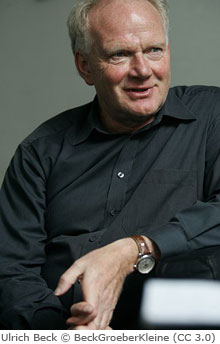
Mittelweg 36: What do the financial crisis and the nuclear energy crisis represented by Fukushima mean for Europe?
Ulrich Beck: I'd see the dynamics and the relevance of both events – the financial crisis and Fukushima – in terms of my concept of the risk society, or world risk society. The risk society is a could-be-society. The term risk refers to the “could-be”, the anticipation of catastrophes in the present. One has to differentiate here between the future, of which we know nothing, and our conception of the future, which is portrayed or socially constructed as a global risk in the widest sense. This catastrophic subjunctive is the typhoon of events that broke into the centre of social institutions and people's daily lives in the form of the financial crisis (though not only that): irregular, rooted neither in the constitution nor democracy, charged with unacknowledged incomprehension, blowing away hitherto fixed points of reference. As a result, the sense of a kind of common destiny arises. This is indicated by the abrupt downturns in the financial markets, whose turbulence makes tangible the interconnectedness of different worlds. If Greece declares bankruptcy, is that another sign that my pension in Germany is no longer safe? What does “state bankruptcy” actually mean? For me? Who would have thought that the banks, usually so arrogant, would ask the states for help, and that the chronically hard-up states would rush through measures enabling astronomical sums to be placed at the disposal of these cathedrals of capitalism? Today, it is universally taken for granted. That isn't to say that people actually understand what it means to be joined by a common financial destiny consisting of insecurity, incomprehension and the sense of cross-border dependency. This anticipation of global risk works its way into the very capillaries of daily life and, as I see it, is one of the major forms of mobilization in the twenty-first century. Everywhere these kinds of threat are perceived locally as cosmopolitan events creating an existential bond between one's own life and everyone else's. Such events collide with the conceptual and institutional framework that has so far delineated how we think about society and politics. They challenge this framework from within and at the same time encounter differing cultural conditions and contexts that lead to very contrary cultural and political estimations of the risks.