
| ABOUT US | ARCHIVES | LINKS | RSS FEED | MONDAYS | |

3quarksdaily

An Eclectic Digest of Science, Art and Literature

« What children’s drawings would look like if painted realistically | Main | Kepler 22-b: Earth-like planet confirmed »

December 06, 2011

Art and the Limits of Neuroscience

Alva Noë in the New York Times:
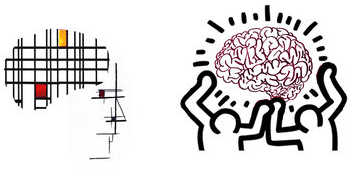
ScreenHunter_07 Dec. 06 13.08What is art? What does art reveal about human nature? The trend these days is to approach such questions in the key of neuroscience.

“Neuroaesthetics” is a term that has been coined to refer to the project of studying art using the methods of neuroscience. It would be fair to say that neuroaesthetics has become a hot field. It is not unusual for leading scientists and distinguished theorists of art to collaborate on papers that find their way into top scientific journals.

Semir Zeki, a neuroscientist at University College London, likes to say that art is governed by the laws of the brain. It is brains, he says, that see art and it is brains that make art. Champions of the new brain-based approach to art sometimes think of themselves as fighting a battle with scholars in the humanities who may lack the courage (in the words of the art historian John Onians) to acknowledge the ways in which biology constrains cultural activity. Strikingly, it hasn’t been much of a battle. Students of culture, like so many of us, seem all too glad to join in the general enthusiasm for neural approaches to just about everything.

What is striking about neuroaesthetics is not so much the fact that it has failed to produce interesting or surprising results about art, but rather the fact that no one — not the scientists, and not the artists and art historians — seem to have minded, or even noticed. What stands in the way of success in this new field is, first, the fact that neuroscience has yet to frame anything like an adequate biological or “naturalistic” account of human experience — of thought, perception, or consciousness.

More here.

Posted by S. Abbas Raza at 07:08 AM | Permalink

Comments

what a lead in!!!!!! thank you Abbas for the post. reading on now.

Posted by: unfinishedscript | Dec 6, 2011 8:30:41 AM

Couldn't agree more with the author.

In fact the premise of the article has been around for a while in different shapes or forms.

Bertrand Russell an analytic philosopher himself in one of his interviews laments the loss of focus on traditional metaphysics. With the ascendance of analytic philosophy in modern times and corresponding decline of the 'continental' tradition something has been lost.

The difficulties neuroscience is running into is a product of this. We may well be going around in circles unless we adopt a holistic approach in my view.

Posted by: Shahzad | Dec 6, 2011 9:49:29 AM

'the Cartesian dogmas of contemporary neuroscience'


this is sheer nonsense.

Posted by: contemporary neuroscientist | Dec 7, 2011 10:48:24 AM

re: contemporary neuroscientist

'the Cartesian dogmas of contemporary neuroscience'

counter-intuitive? controversially put? may well be ultimately unjustified? any or all of these things? sure we can all grant that. but *sheer nonsense*? Not so at all. It is important to keep in mind that Cartesian dogmas come in a packaged deal. The advances of neuroscience (and psychology) for example, has (to our satisfaction) refuted the (what Ryle calls) "ghost-in-the-machine" part of the package. If Cartesianism were *just that*, then the claim would be sheer nonsense. But it is not. What Noe has curtly indicated as "you are something inside of you" is another distinct claim in the package; and there are still others.

Posted by: more charitable reader | Dec 9, 2011 5:10:43 AM

re: Shahzad

"Bertrand Russell an analytic philosopher himself in one of his interviews laments the loss of focus on traditional metaphysics. With the ascendance of analytic philosophy in modern times and corresponding decline of the 'continental' tradition something has been lost."

i contest this picture of the history of at least analytic philosophy. prejudice against traditional metaphysics has greatly waned since the early decades of analytic philosophy. i dare say, in analytic philosophy, as practiced today, metaphysics (very much with resonance to the traditional vein of at least Aristotle) is burgeoning and very much alive, with much exciting work and debate. In any case, it is more than adequately alive enough to not count as being "lost."

Posted by: puzzled | Dec 9, 2011 5:22:19 AM

Post a comment


Subscribe to this blog's feed  

PayAnywhere with iphone credit card swiper

Android Tablet

Bluetooth Headset

2013 New Style Dresses

Compare Car Rental Prices

DHgate.com Wholesale

3QD on Facebook

3QD on Kindle

3QD by Daily Email

Receive all blogposts at the same time every day.

Enter your Email:


Preview 3QD Email

3QD on Twitter

Miscellany

Lijit Search

AddThis Social Bookmark Button

Add to Google

Recent Comments

araldo on Race Is Not Biology

jo smith on Daniel Dennett's seven tools for thinking

Louise Gordon on Why race as a biological construct matters

Louise Gordon on Race Is Not Biology

Dave on Race Is Not Biology

Bill on Daniel Dennett's seven tools for thinking

Boursin on Why Rational People Buy Into Conspiracy Theories

Usha Alexander on Race Is Not Biology

Abbas Raza on Daniel Dennett's seven tools for thinking

X on Race Is Not Biology

Usha Alexander on Race Is Not Biology

jo smith on Mohsin Hamid: 'Islam is not a monolith'

araldo on Mohsin Hamid: 'Islam is not a monolith'

Dr. X, Ph.D. on Race Is Not Biology

jo smith on Physicists Create Quantum Link Between Photons That Don't Exist at the Same Time

jo smith on Mohsin Hamid: 'Islam is not a monolith'

omar on Why race as a biological construct matters

Dr. Smith on Race Is Not Biology

Sundar on Daniel Dennett's seven tools for thinking

Sundar on Daniel Dennett's seven tools for thinking

Sundar on Why race as a biological construct matters

Sundar on Race Is Not Biology

Joel Grant on Why Rational People Buy Into Conspiracy Theories

khaled on Evolution shapes new rules for ant behavior

musafir on Mohsin Hamid: 'Islam is not a monolith'

Acclaim For 3QD


"I couldn't tear myself away from 3 Quarks Daily, to the point of neglecting my work. Congratulations on this superb site."—Steven Pinker, Johnstone Professor of Psychology, Harvard University.

"I have placed 3 Quarks Daily at the head of my list of web bookmarks."—Richard Dawkins, Charles Simonyi Professor of the Public Understanding of Science at Oxford University.

"Just wanted you to know I’m one of many who reads and enjoys 3 Quarks....almost daily."—David Byrne, musician, former lead-singer of the Talking Heads, artist, intellectual.

Read more here.

The 3QD Prizes

Subscribe to this blog's feed