
| ABOUT US | ARCHIVES | LINKS | RSS FEED | MONDAYS | |

3quarksdaily

An Eclectic Digest of Science, Art and Literature

« Story Theory: Confessions of a Literary Darwinist | Main | Hitchens, Athens, 1984 »

December 28, 2011

A Symposium on American Grace: How Religion Divides and Unites Us

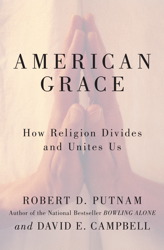
American-Grace2Over at The Immanent Frame, there is an interesting discussion on David Campbell and Robert Putnam's American Grace: How Religion Divides and Unites Us with a series of responses to the book by John Torpey, Molly Worthen, Jon Butler and David Hollinger. Hollinger:

Is bland beautiful? Almost never, most of us would say. But when it comes to religion in a diverse society, the answer may be yes.

This is the chief, if probably unintended implication of American Grace, which I take to be the most successfully argued, comprehensive sociological study of American religion in more than half a century. Robert Putnam and David Campbell harvest a generation of research and mature reflection about how religious affiliations of all kinds divide and unite Americans of different generations, regions, sexes, educational levels, and ethno-racial groups. Will Herberg’s endlessly discussed Protestant-Catholic-Jew, a book of 1955, was not remotely as methodologically self-conscious and as empirically grounded as is American Grace, but one must go back to Herberg to find so striking a single volume purporting to explain the religion of an author’s contemporary Americans. If this coming generation of scholars and journalists allow Putnam and Campbell to define the terms of conversation to the extent that our predecessors allowed Herberg to perform this role, we will be in fine shape.

Why does this book prompt the suspicion that bland may be beautiful? Because Putnam and Campbell argue that the decline of intense, sectarian devotion to any particular faith enables religious believers to be more tolerant and appreciative of ideas and practices different from their own. Putnam and Campbell’s central, data-driven theme is the fluidity of American religion. Americans move in and out of religious affiliations with dizzying frequency. While in other societies religious identity is more often perceived “as a fixed characteristic,” they explain, in the United States “it seems perfectly natural” to refer to one’s religion as a mere “preference.”

Posted by Robin Varghese at 01:43 PM | Permalink

Comments

"Putnam and Campbell insist that only about ten percent of Americans are true believers"

I think this is an important point that the New Atheists (with whom I'm quite sympathetic on many counts) overestimate the problems of Christian fundamentalism and Muslim terrorism. Although polls show 77% of Americans believe in angels, when push comes to shove most of them would abandon their belief in angels for an extra slice of pizza.

Posted by: FrankZ | Dec 31, 2011 2:15:25 PM

Post a comment


Subscribe to this blog's feed  

PayAnywhere with iphone credit card swiper

Android Tablet

Bluetooth Headset

2013 New Style Dresses

Compare Car Rental Prices

DHgate.com Wholesale

3QD on Facebook

3QD on Kindle

3QD by Daily Email

Receive all blogposts at the same time every day.

Enter your Email:


Preview 3QD Email

3QD on Twitter

Miscellany

Lijit Search

AddThis Social Bookmark Button

Add to Google

Recent Comments

Sundar on If Only We Had A Leader Like Chavez, Who Solved Real Problems -- Instead Of Debating Fake Ones Like The Deficit

flowers rainbows on Lift up your voices: The century-long battle for women's freedom

mr.ed on wagner in new york?

mirel on Here’s how to change the world

mirel on If Only We Had A Leader Like Chavez, Who Solved Real Problems -- Instead Of Debating Fake Ones Like The Deficit

X on Getting Smarter

Ross Williams on Getting Smarter

oroboe on Lennon's "Imagine" and McCartney/Wings' "Band on the Run" overlaid: One way of reuniting (some of) the Beatles

Richard H. Randall on Obama must Make Fighting Climate Change National Project, or Die the death of a thousand Scandals

seth edenbaum on The First New Atheist? Kierkegaard

waqnis on Mortify Our Wolves

nogodrod on KFC smugglers bring buckets of chicken through Gaza tunnels

waqnis on Here’s how to change the world

Fernando on Mortify Our Wolves

seth edenbaum on The case against empathy

Dredd on Mortify Our Wolves

Max on Here’s how to change the world

Rohana on Mortify Our Wolves

Raza Husain on If Only We Had A Leader Like Chavez, Who Solved Real Problems -- Instead Of Debating Fake Ones Like The Deficit

mirel on If Only We Had A Leader Like Chavez, Who Solved Real Problems -- Instead Of Debating Fake Ones Like The Deficit

araldo on Here’s how to change the world

Elatia Harris on Here’s how to change the world

Sundar on Here’s how to change the world

araldo on Here’s how to change the world

prasad on Here’s how to change the world

Acclaim For 3QD


"I couldn't tear myself away from 3 Quarks Daily, to the point of neglecting my work. Congratulations on this superb site."—Steven Pinker, Johnstone Professor of Psychology, Harvard University.

"I have placed 3 Quarks Daily at the head of my list of web bookmarks."—Richard Dawkins, Charles Simonyi Professor of the Public Understanding of Science at Oxford University.

"Just wanted you to know I’m one of many who reads and enjoys 3 Quarks....almost daily."—David Byrne, musician, former lead-singer of the Talking Heads, artist, intellectual.

Read more here.

The 3QD Prizes

Subscribe to this blog's feed